
Israeli forces kill nearly 60 Palestinians waiting for aid trucks in north Gaza

Israeli forces killed nearly 60 Palestinian aid seekers on Wednesday after shelling a crowd waiting for food trucks in the northern Gaza Strip.
The Gaza-based Government Media Office condemned the attack, which also left more than 570 people injured, as a "bloody massacre".
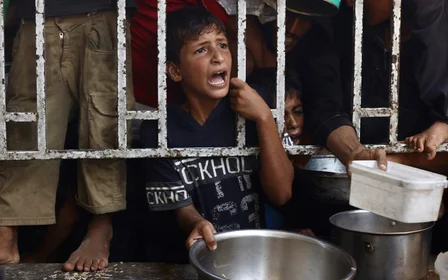
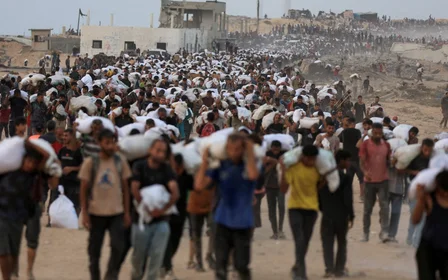
Hundreds of starving Palestinians had assembled in the Sudaniya area, near the Zikim crossing, where dozens of aid trucks were expected to enter the besieged enclave.
Israeli forces then opened fire indiscriminately on the crowd, according to local reports.
"This bloody massacre, and previous similar crimes, once again confirm that the occupation is using hunger as a weapon of war, cold-bloodedly targeting civilians seeking a livelihood, in flagrant violation of all international and humanitarian laws," the media office said in a statement.
New MEE newsletter: Jerusalem Dispatch
Sign up to get the latest insights and analysis on Israel-Palestine, alongside Turkey Unpacked and other MEE newsletters
The latest attack has brought the total number of aid seekers killed by Israeli forces at distribution points to 1,330, with over 8,818 wounded since late May.
Israeli troops have admitted to deliberately shooting and killing unarmed Palestinians waiting for aid in the Gaza Strip, following direct orders from their superiors.
Although much of the humanitarian aid is being delivered in the area near Zikim crossing, it is an extremely dangerous location, due to repeated Israeli attacks.
According to Al Jazeera correspondent Anas al-Sharif, the Israeli army "continues daily massacres against the hungry" in these locations.
In one of his reports, Sharif shared a graphic image showing the decomposing bodies of what appeared to be a young man and a child, several days after they were reportedly killed by Israeli forces.
“Amir walked 12 kilometres to get food, got nothing but scraps, thanked us for it, and died.”
— Middle East Eye (@MiddleEastEye) July 30, 2025
Anthony Aguilar, former US soldier who worked for the GHF, explains that a Palestinian boy kissed his hands, thanking him for aid, and then was killed by Israeli forces moments later pic.twitter.com/pqFgryvmGw
The United Nations Office for the Coordination of Humanitarian Affairs (Ocha) said last week that "there is simply nowhere safe to go" in the Gaza Strip.
"About 88 percent of Gaza is either subject to displacement orders or located within Israeli-militarised zones. The 12 percent that remains is already overcrowded and underserved," the report read.
The Palestinian health ministry reported that in just the past 24 hours, Israeli forces killed 111 Palestinians and wounded 820 others.
The death toll from Israel's war on Gaza rose to 60,249, with over 147,089 wounded since 7 October 2023.
Critical levels of starvation
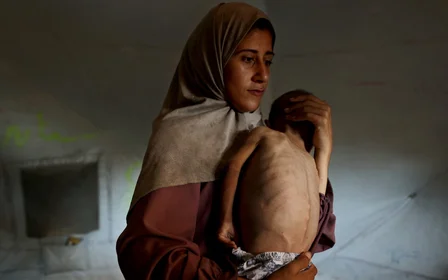
In addition to the killing of Palestinians seeking aid, Israel's blockade and starvation policy in Gaza has led to a rising number of deaths from malnutrition in recent days, according to health officials.
At least two children died from malnutrition in the past 24 hours, the Palestinian Health Ministry reported on Wednesday, bringing the total number of starvation-related deaths to 159, including 90 children.
The Government Media Office said that 112 trucks carrying humanitarian supplies entered the Gaza Strip on Wednesday. However, most were looted and stolen, which the office attributed to a "security chaos" orchestrated by Israel.
"We remind you that the Gaza Strip needs at least 600 trucks of relief and fuel daily to meet the minimum basic needs of its most vital sectors," the office said.
Israeli Prime Minister Benjamin Netanyahu previously admitted his country is arming gangs in Gaza, which have been accused by aid groups of stealing humanitarian aid.
Middle East Eye delivers independent and unrivalled coverage and analysis of the Middle East, North Africa and beyond. To learn more about republishing this content and the associated fees, please fill out this form. More about MEE can be found here.