Israel-Palestine live: Week three ends with over 7,000 Palestinians killed

Live Updates
According to the Committee to Protect Journalists (CPJ), 22 journalists have been killed since the start of the war on 7 October.
A statement on the organisation's website states: "Journalists in Gaza face particularly high risks as they try to cover the conflict in the face of a ground assault by Israeli troops, devastating Israeli airstrikes, disrupted communications, and extensive power outages."
Of the journalists killed, 18 are Palestinian and one is Lebanese, while at least eight others are wounded.
Journalists on the ground also face continued attacks, arrests, threats and censorship.
"CPJ emphasises that journalists are civilians doing important work during times of crisis and must not be targeted by warring parties," said Sherif Mansour, CPJ's Middle East and North Africa programme coordinator.
A spontaneous protest against Israeli Prime Minister Benjamin Netanyahu broke out today as he arrived at Beersheba during a tour around southern Israel.
Netanyahu was joined by Defense Minister Yoav Gallant and minister without portfolio Benny Gantz to see the military's ground preparations for the expected ground offensive into Gaza.
Israelis booed Netanyahu and the ministers, saying "these are the last days of your corrupt regime", and calling him a "criminal".
Some protesters also shouted: "You are a corrupt prime minister who abandoned us all, three fighters from my settlement were killed... "
This is not the first anti-Netanyahu protests since the start of the war on 7 October. Protesters have also denounced Netanyahu over his mishandling of the captives taken into Gaza.
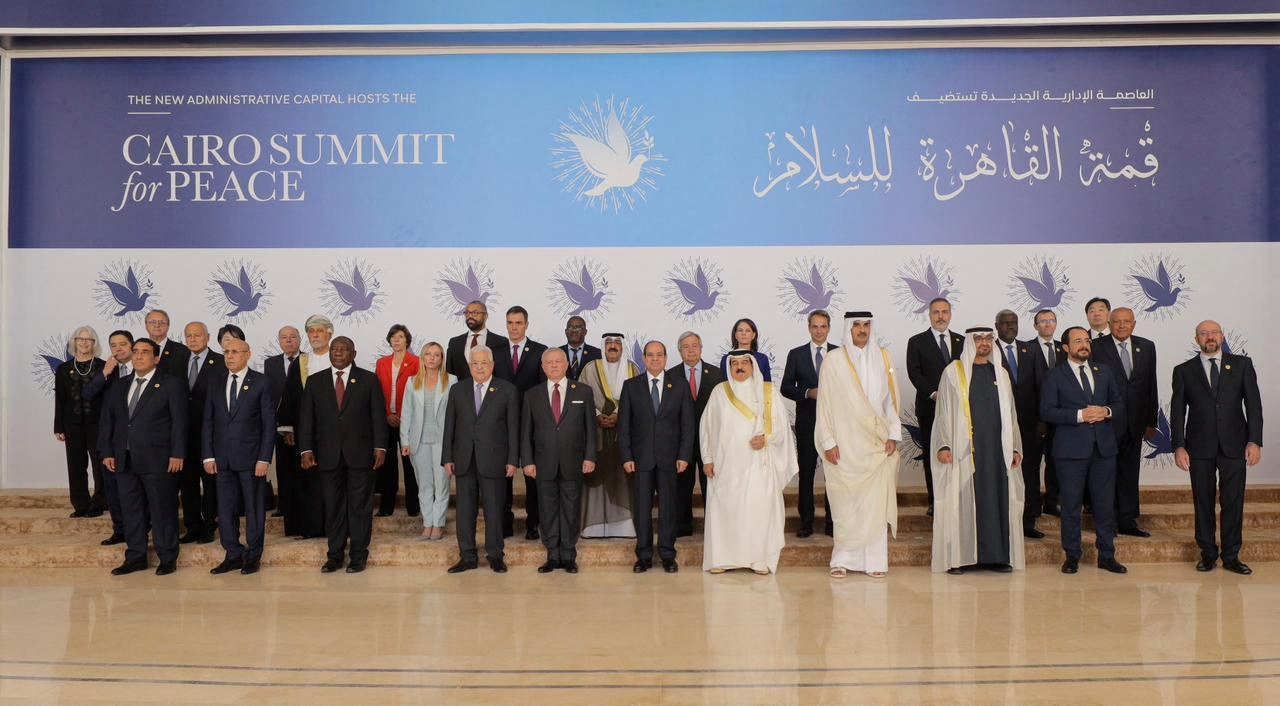
Antonio Guterres, the UN secretary-general, said at the Cairo peace summit that the Hamas attack on Israel "can never justify collective punishment of the Palestinian people".
At the summit, British Foreign Minister James Cleverly told attendees that he had asked the Israeli government to act in accordance with international law and protect civilian lives in Gaza. "Despite the difficult and unusual circumstances, I called on the Israeli army to act with discipline, professionalism and restraint," he said.
A Hamas official, Osama Hamdan, told a televised press conference that Hamas will not discuss the fate of Israeli captives until Israel ends its aggression on the besieged Gaza Strip and on Palestinians.
"Our stance with regards to Israeli army captives is clear: it's related to a (possible) exchange of prisoners, and we will not discuss it until Israel ends its aggression on Gaza and Palestinians," he said.
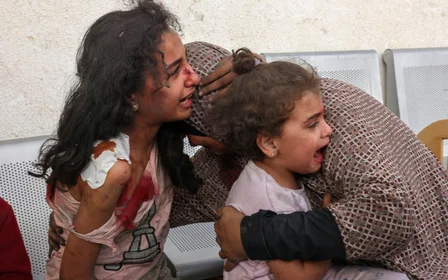
Children in Gaza are showing more signs of trauma, 15 days after the war started, due to Israel's ongoing and intense bombardment.
Psychiatrists have told Reuters that there is no safe place to hide in Gaza and that "children have started to develop serious trauma symptoms such as convulsions, bed-wetting, fear, aggressive behaviour, nervousness, and not leaving their parents' sides."
"Our children suffer a lot at night. They cry all night, they pee themselves without meaning to, and I don't have time to clean up after them, one after the other," Tahreer Tabash, a mother of six children sheltering in a school, told Reuters.
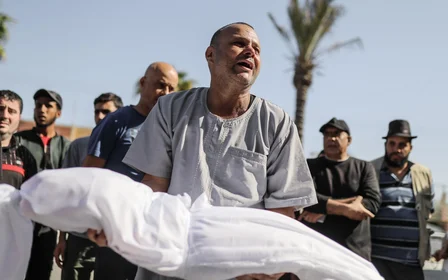
Over 1,756 children have been killed by Israeli bombings on Gaza so far, with the death toll expected to grow as Israel vows to launch a ground invasion.
Entire neighbourhoods have been wiped out by Israeli air strikes, with some families losing dozens of their family members in the bombings.
"When there's an explosion or any target getting hit nearby the children are always screaming, always frightened. We try to calm the younger ones, try telling them, 'Don't worry, it's just fireworks'. But the older ones understand what's going on," said Ibrahim al-Agha, a resident of the Khan Younis neighbourhood in Gaza.
According to Agha, children will need a great deal of support after the war ends.
However, mental health experts in Gaza have said there is no such thing there as post traumatic stress disorder because the trauma in the enclave is continuous, with repeated bouts of armed conflict stretching back nearly two decades.
Fans of the English Liverpool football club raised a banner on Saturday that read: "For God's sake save Gaza".
Watching local rivals Everton at the Anfield stadium, some fans were also spotted waving the Palestinian flag during the match.
The Israeli military dropped leaflets in Gaza informing citizens they would be "identified as a partner in a terrorist organisation" if they didn't adhere to Israel's orders to move south.
The Israeli forced displacement orders to 1.1 million Palestinians living in north Gaza, without any guarantees of safety or return, are a crime against humanity and a blatant violation of international humanitarian law, according to a UN expert.
The army has ordered hospitals, UN-supported schools and citizens to move to the southern part of Gaza. Hospitals and hundreds of thousands of people have refused to comply.
An Israeli air strike killed at least 70 people who were on a convoy last week from north to south Gaza, following the orders by Israel. The Israeli air force has also continued to pummel south Gaza.
"Urgent warning! To the residents of Gaza - your presence north of Wadi Gaza is putting your lives at risk," the Israeli military leaflets dropped in Gaza on Saturday read.
"Anyone who chooses not to evacuate from the north of the Gaza Strip to the south of the Gaza Strip may be identified as a partner in a terrorist organisation."
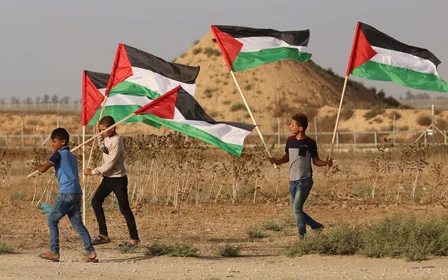
Thousands of people joined a London march in solidarity with Gaza, waving the Palestinian flag and chanting for a free Palestine.
The "from the river to the sea, Palestine will be free" chant was being echoed by thousands who amassed near Downing Street as more people were still joining the march, according to the Palestine Solidarity Campaign (PSC).
London's Metropolitan Police on Friday said they will not be arresting anyone chanting the popular slogan "from the river to the sea".
The chant is commonly heard at solidarity marches and refers to the area of historic Palestine between the River Tiberias and the Mediterranean Sea.
Pro-Israel groups claim it is antisemitic because it is an implicit call for the destruction of Israel, a charge rejected by Palestinian activists.
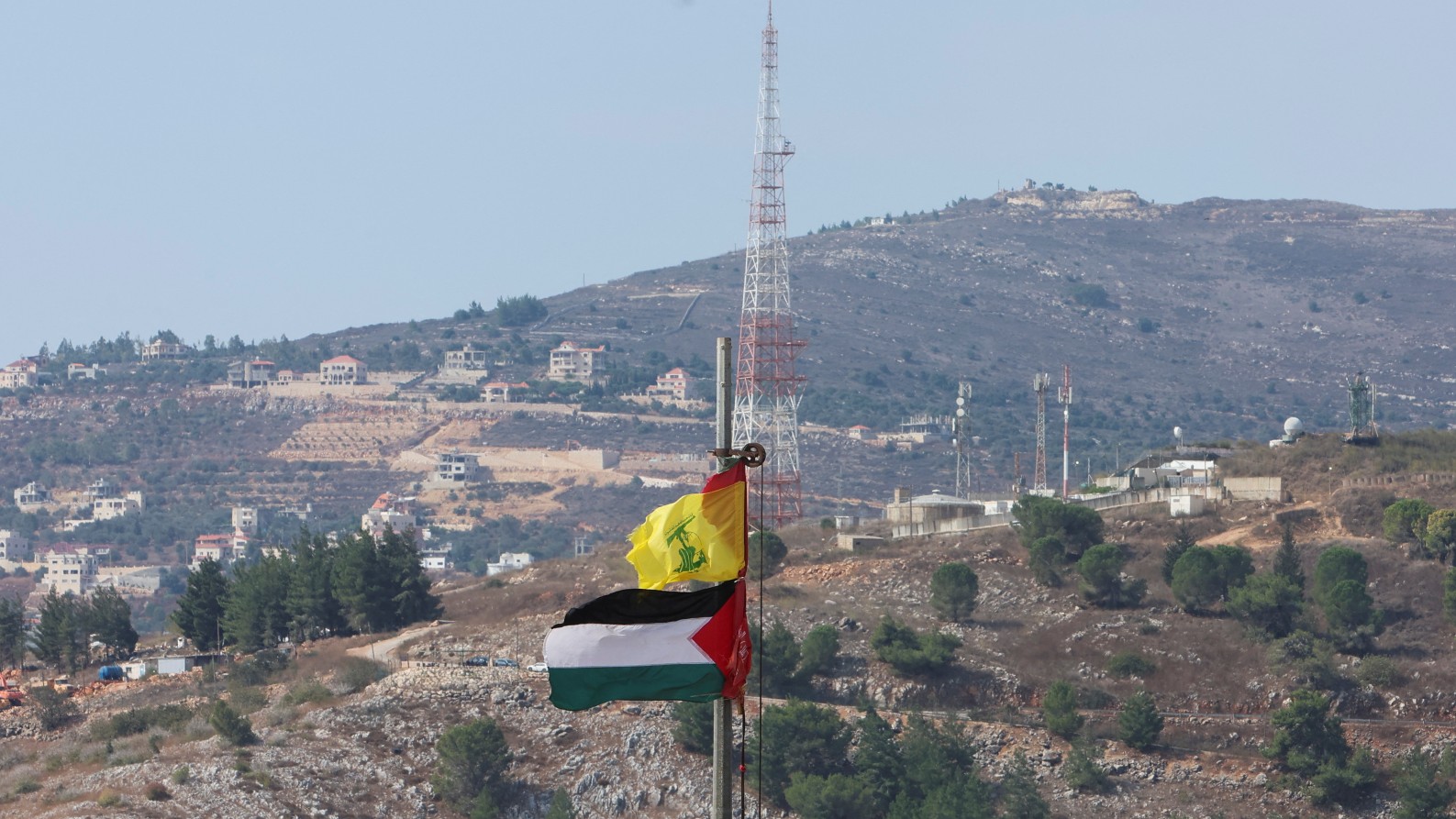
Israel and armed groups in Lebanon exchanged missile and artillery fire on Saturday as tit-for-tat skirmishes continue along the frontier separating the two countries.
The Israeli army said three anti-tank guided missiles were fired from Lebanon at the Margaliot and Hanita areas.
It added that was responding to the source of the attacks using drones and artillery fire.
Local media in Israel and Lebanon reported there were reports of injuries from the attacks.
An Israeli air strike hit a building near Al Jazeera Arabic reporter in Gaza, causing a massive explosion that was captured live on TV.
There were no immediate reports of injuries to Al Jazeera's staff.
Israel has been bombing Gaza non-stop for two weeks after the Palestinian attack of 7 October.
Several air strikes were reported on Saturday with reports of people killed and wounded, according to local media.
On Saturday morning, the Palestinian health ministry said the Israeli air force killed 248 people and wounded 400 more in the previous 24 hours.
Opinion by Amena ElAshkar - After the recent Israeli air strike on Gaza's al-Ahli Arab Hospital, which killed close to 500 people, and amid ongoing tensions at Lebanon's southern border with Israel, many are speculating about how Hezbollah's involvement in the conflict could change in the coming days.
Such questions come against the backdrop of sporadic skirmishes between Hezbollah and the Israeli military in southern Lebanon - a region often referred to as Israel's "northern front" - and centre on the potential for escalation.
Hezbollah has been engaging in tit-for-tat clashes with Israel since the outbreak of the Gaza conflict, as the party aims to maintain a deterrent stance while adhering to the established rules of engagement.
Clearly, Hezbollah is treading a delicate path in the south. It is not only fortifying the rules of engagement with the Israeli military, but also sending a clear message to both the Israeli and US establishments that it stands ready to engage at this critical juncture.
At the same time, there has been a notable mobilisation of Israeli forces towards the northern frontier, including reservists from elite units and battalions, while tanks and artillery are being positioned ahead of possible escalation.
The ambiguity surrounding Hezbollah's potential involvement in the war has inadvertently served Gaza's armed factions by keeping Israeli forces on alert, thereby dispersing the focus and resources of the defence establishment.
This constitutes a strategic advantage, hindering the Israeli military from concentrating its full might solely on the Gaza offensive, while adding a layer of complexity to the evolving geopolitical landscape.
Read more: When will Lebanon's Hezbollah enter the battle?

The Israeli military said on Saturday it's continuing to "prepare for the next phase of the war" a week after saying plans to launch a ground invasion of Gaza were underway.
In a communique posted on social media platform X, the army announced that plans were approved in recent days for the "expansion of combat".
"Regular and reserve IDF [Israeli military] units are deployed in the field, and conduct training in accordance with the approved operational plans," the military said.
Opinion by Taha Ozhan - Beginning on 7 October, "Israel at war" became the leading headline broadcast around the clock on global news channels. But for international audiences, the recent Israeli aggression transcends being merely breaking news; it has become a devastating glimpse into the daily lives of the Palestinians.
While Palestinian suffering, death, and destruction was a story most outlets had long ignored or taken for granted, the novel and unexpected development that day was in the surprise attack against Israel, during which more than 1,400 Israelis were killed.
The attack by Palestinian armed factions in 1948 territories marked a notable shift in the Israeli-Palestinian conflict, particularly since 1973. Not only did it result in the loss of Israeli soldiers and civilians' lives, it also shattered the illusion that a solution to the Palestinian question could be reached without Palestinians.
To employ the infamous "Rumsfeld matrix", for Israel, the US, and countries in the region, the attack served as a poignant reminder of the "known knowns": the existence of Palestinians.
Read more: Long kept in limbo, will Palestine be put back on the global agenda?
The Israeli military said it can confirm 210 people were taken to Gaza during the 7 October Palestinian attack.
Between 150-200 others remain missing with their fate unknown. The Israeli military has not been able to establish whether they are dead or alive and whether they are in Israel or Gaza.
Hamas estimates 200-250 people are held in Gaza but said they couldn't provide an exact number due to "operational difficulties" caused by the incessant Israeli bombardment.
The Israeli military also confirmed late on Friday that an Israeli soldier was killed by an anti-tank missile fired from Lebanon on Thursday. At least 309 soldiers have been killed since 7 October, including at least six killed in fighting near the boundary with Lebanon.
Overall, around 1,400 people in Israel have been killed since the conflict began, the majority of them killed on the first day. There is currently no available date on the number of children and women killed.
Arab leaders condemned Israel's two-week-old bombardment of Gaza on Saturday and demanded renewed efforts to reach a Middle East peace settlement between Israelis and Palestinians.
Speaking at a hastily convened gathering dubbed the "Cairo Peace Summit", Jordan's King Abdullah denounced what he termed global silence about Israel's attacks on the enclave and urged an even-handed approach to the Israeli-Palestinian dispute.
"The message the Arab world is hearing is that Palestinian lives matter less than Israeli ones," he said, adding he was outraged and grieved by acts of violence waged against innocent civilians in Gaza, the West Bank and Israel.
Palestinian President Mahmoud Abbas said Palestinians would not be displaced or driven off their land.
"We won't leave, we won't leave," he told the summit.
According to Reuters, three diplomats said it was unlikely there would be a joint statement from the Cairo gathering because of sensitivities around any calls for a ceasefire, and whether to include mention of Hamas's attack and Israel's right to defend itself.
The absence of a top official from Israel's main ally the United States and some other major western leaders has cooled expectations for what the hastily-convened event can achieve.
German Chancellor Olaf Scholz and British Prime Minister Rishi Sunak will not attend, while there has been no official word on whether French President Emmanuel Macron will go