

Israel seizes control of historic Nabi Samuel mosque from Islamic waqf

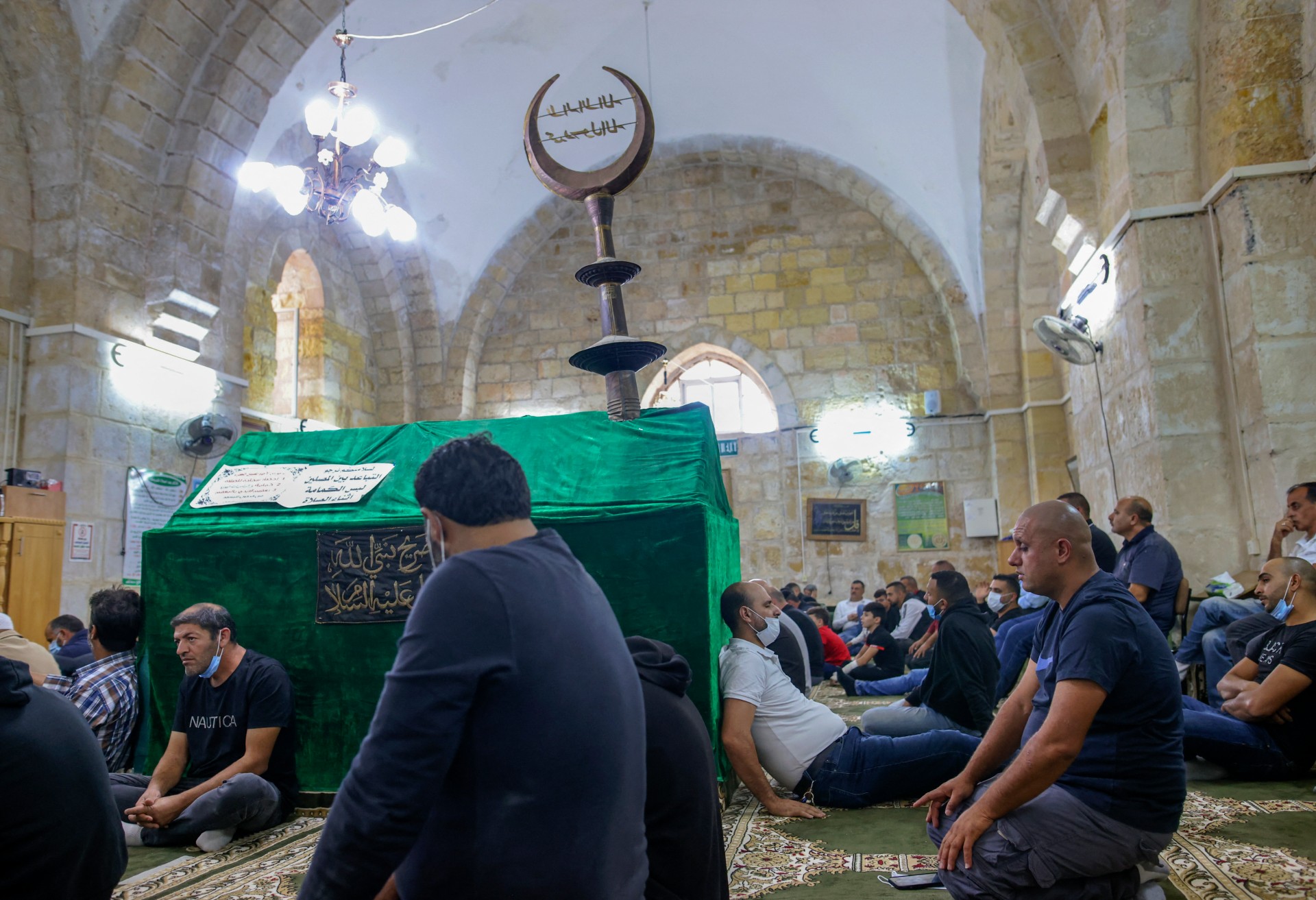
Israel has issued an order to seize the tomb of the Prophet Samuel (Nabi Samuel), an important religious landmark in the occupied West Bank run by the Islamic Waqf, in a move that has been condemned as the latest example of “Judaisation” of Palestinian sites.
On Tuesday, Israel’s civil administration, which carries out Israeli orders in the occupied West Bank, announced that it was expropriating 28 acres of land.
That land includes the Palestinian towns of Beit Iksa and Nabi Samuel, covering the area where the historic Nabi Samuel mosque stands.
The justification given by the civil administration, which is a subordinate to a unit in Israel’s defence ministry, was that the area was being seized “for the public benefit”.
It said it would undertake a development project “to preserve the archaeological site of the Prophet Samuel’s tomb”.
New MEE newsletter: Jerusalem Dispatch
Sign up to get the latest insights and analysis on Israel-Palestine, alongside Turkey Unpacked and other MEE newsletters
But Palestinian analysts have said that the move is yet another example of “Judaisation”, a term coined to describe Israeli authorities' use of archaeology and religion to target Palestinian land and identity.
Prophet Samuel is a venerated figure in the Jewish, Christian and Muslim traditions.
During the Byzantine period, Emperor Justinian ordered a church to be constructed on the spot where Samuel was believed to have been buried.
The site was located on a hilltop 6km northwest of Jerusalem, 885 metres above sea level.
The same site was also held in high regard by the Crusaders, who called it the “Mountain of Joy”, as it was the first point from which they saw Jerusalem.
Muslim rulers thereafter built structures on the site to commemorate Samuel.
The mosque that stands there today has features dating back to the Ayyubid and Mamluk periods. It includes a shrine which Muslims believe contains Samuel’s tomb, making it a highly significant Islamic landmark.
“All the lands in the area that were confiscated belong to the Alami family,” Khalil Toufakji, an expert on maps, borders, settlements and the city of Jerusalem, told Middle East Eye.
“They are an Islamic waqf [religious endowment], a hereditary waqf of the Alami family.”
Since Israel seized and occupied the West Bank in 1967, it has made gradual changes to the Nabi Samuel area.
That included building a synagogue in the underground chamber where Samuel’s tomb is believed to be, as well as restricting Palestinian access to parts of the site.
Over time, Israeli authorities have reduced the size of Muslim prayer space, and the site's facilities have increasingly come under Israeli control.
'Effective annexation'
Toufakji noted that in 1995, the Nabi Samuel area was turned into a nature reserve by Israeli authorities, after which excavation work began.
The latest move, he said, is “effectively an annexation”.
“This annexation process has begun,” he said. “The gradual annexation process, or the implementation of what the Israeli Knesset calls gradual annexation, through archaeological sites first, and then the establishment of infrastructure.”
Similar tactics have been used to forcibly displace Palestinians in the area of Silwan in Jerusalem, to make way for Israel’s search for an alleged “lost city”.
Excavations carried out by Israeli authorities since the 1990s in Nabi Samuel have not yielded any evidence of the Jewish narrative about the site promoted by the Israeli authorities, a spokesperson at the Palestinian Authority's Jerusalem governorate said.
“On the contrary, they have revealed clear Islamic landmarks and artifacts, most notably the historic mosque itself,” Omar Rajob, the head of the governorate's media office, told MEE.
“Nevertheless, the Israeli authorities continue to use 'archaeology' as a political tool to entrench a singular narrative about the site and erase the Palestinian and Islamic narrative.”
Rajob noted that a Jewish narrative is presented in information panels at the site, but the Islamic history is “completely ignored”.

“The issue is no longer simply about controlling the surrounding lands, but about imposing direct Israeli sovereignty over the entire religious and archaeological landscape of the village, including the historic mosque itself,” he said.
The move in Nabi Samuel is the latest in a string of projects developing Jewish sites on Palestinian land.
In November, Israel’s civil administration seized 444 acres around the Sebastia archaeological site in the occupied West Bank.
Two months later, the Israeli military seized municipal powers over Hebron’s Ibrahimi Mosque from Palestinians in a move widely seen as undermining Islamic administration of the site.
According to Toufakji, the Islamic Waqf authorities' role at Nabi Samuel is now limited to "opening and closing the doors".
Israel’s parliament, the Knesset, is in the process of discussing a bill that would create a new heritage authority in the West Bank, taking control of archaeological sites from the civil administration.
Elsewhere on Tuesday, Israeli Finance Minister Bezalel Smotrich and his Religious Zionism party carried out an election campaign tour at Solomon's Pools - a reservoir in the West Bank run by the Palestinian Authority (PA).
“It is inconceivable that this magnificent and unique place should be in the hands of Palestinian terrorists/the Palestinian Authority,” Smotrich said. “I will work to change this.”
Toufakji predicted that in the near future, Joseph’s Tomb, a religious site in Nablus under PA control, would also likely be seized by Israel.
“What is happening in Nabi Samuel cannot be separated from broader Israeli policies in occupied Jerusalem, which are based on reducing the Palestinian presence, expanding colonial control, and linking the settlements surrounding the city into a single geographical belt,” Rajob said.
“Palestinian archaeological and religious sites are being transformed into political tools used to reshape the landscape demographically and symbolically.”
Middle East Eye delivers independent and unrivalled coverage and analysis of the Middle East, North Africa and beyond. To learn more about republishing this content and the associated fees, please fill out this form. More about MEE can be found here.