Israel seizes strategic castle as it pounds southern city of Sour

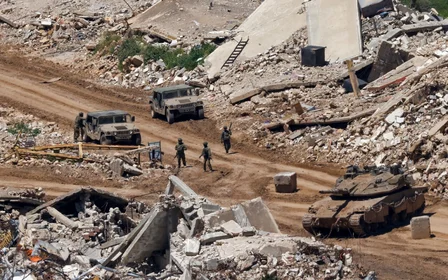
Israeli troops have captured the 900-year-old Beaufort Castle and the strategic ridge surrounding it in southern Lebanon, the military said on Sunday, as it expands its offensive despite a nominal ceasefire.
The capture of the medieval castle and ridge deepens Israeli footprint in the country beyond the demarcation zone known as the "Yellow Line", which it established in April following the ceasefire.
It comes after days of intense fighting and air strikes in nearby villages, where Israeli troops fought Hezbollah members in the rugged area.
On Sunday afternoon, the Israeli army carried out its most intense air strikes on the ancient coastal city of Sour, also known as Tyre, since the war began.
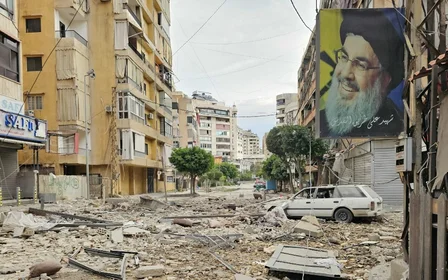
The bombing destroyed several buildings in the city centre, causing multiple casualties, according to local media. Footage showed widespread destruction as rescue and emergency teams rushed to the area.
New MEE newsletter: Jerusalem Dispatch
Sign up to get the latest insights and analysis on Israel-Palestine, alongside Turkey Unpacked and other MEE newsletters
An Israeli strike near Hiram Hospital in Sour wounded 13 staff members and caused severe damage to the building, according to the Lebanese health ministry.
The city's civil defence centre also received an Israeli phone call warning personnel to evacuate the headquarters.
Earlier, Israeli Defence Minister Israel Katz said he had ordered the army to expand its operations in Lebanon, cross the Litani River, which the Israeli military had previously used as a de facto boundary, and capture the Beaufort Ridge.
Beaufort Castle, known in Arabic as Qalaat al-Shaqif, is a strategic vantage point overlooking large parts of southern Lebanon and northern Israel. It is located about 5km from the major southern city of Nabatieh.
Israeli troops previously captured the castle in 1982 and held it until they withdrew from Lebanon in 2000.
Katz later announced that Israeli troops would remain at the castle as part of Israel's "security zone" in Lebanon.
Expanding invasion
Israeli Prime Minister Benjamin Netanyahu said on Sunday he had ordered troops to move further into Lebanon.
The latest advances came as the Israeli military issued a new mass expulsion order covering areas south of the Zahrani River and north of the Litani River, extending to roughly 40km from the border.
"A significant number of ground soldiers commenced offensive operations aimed at expanding the Forward Defense Line... The operation is currently expanding to additional areas," the Israeli military said.
At least 16 people were killed and 34 wounded in Israeli strikes on Saturday, bringing the death toll in Lebanon to 3,371 and the number of wounded to 10,129 since the war started on 2 March, according to the Lebanese health ministry.
Israeli Channel 14 reported that Netanyahu and Katz “are inclined to approve major strikes across Lebanon, including evacuation warnings affecting hundreds of thousands of Lebanese”.
Hezbollah launched multiple attacks targeting northern Israel over the weekend and clashed with Israeli soldiers occupying southern Lebanon.
The group said it was confronting Israeli forces around the outskirts of the towns of Zawtar al-Sharqiyah, Yohmor al-Shaqif and Dibbine, adding that the troops "had not yet succeeded in taking control of the towns".
The Israeli military said more than 25 projectiles were fired from Lebanon into Israel on Saturday. At the same time, air raid sirens sounded in the northern cities of Karmiel and Safad for the first time since the ceasefire, according to the Home Front Command.
It also said on Sunday that a soldier was killed the previous day by a Hezbollah explosive drone attack, bringing the number of Israeli troops killed in Lebanon since early March to 25.
Israeli Finance Minister Bezalel Smotrich this week called for Israel to "destroy one hundred buildings" in Lebanon for every drone that strikes a soldier.
According to a report by Israeli public broadcaster Kan, Hezbollah’s drone capabilities are limiting 80 percent of Israeli assaults in southern Lebanon.
Military delegations from both countries held security talks in Washington on Friday, with further US-brokered negotiations planned for next week.
Lebanese Prime Minister Nawaf Salam said the outcome of the negotiations was "not guaranteed", but called them "the least costly path for our country and our people".
Middle East Eye delivers independent and unrivalled coverage and analysis of the Middle East, North Africa and beyond. To learn more about republishing this content and the associated fees, please fill out this form. More about MEE can be found here.