Israeli attack on Palestinian refugee camp in southern Lebanon kills at least 13

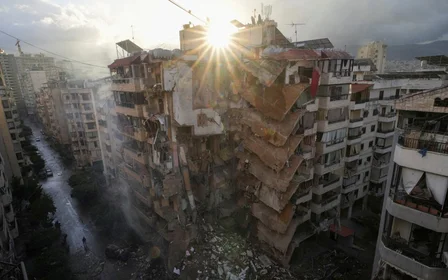
An Israeli airstrike on a Palestinian refugee camp in southern Lebanon killed 13 people and wounded several others on Tuesday, hours after Israeli attacks on cars elsewhere in the country's south killed at least two.
Local media reported that the attack targeted an area near a mosque and a football pitch in the Ain al-Hilweh refugee camp on the outskirts of the city of Sidon, which was packed with civilians.
Ain al-Hilweh is the largest Palestinian refugee camp in Lebanon. It houses a population of nearly 80,000 people who live in an area of just 1.5 sq km.
The Israeli military said, without providing any evidence, that the strike targeted a Hamas "military compound" allegedly used for training fighters.
Menawhile, Hamas condemned the attack and dismissed Israel's claim as "pure fabrication and lies", saying there are no military installations inside refugee camps in Lebanon, and that the area hit was a well-known open sports field regularly used by young men from the camp.
New MEE newsletter: Jerusalem Dispatch
Sign up to get the latest insights and analysis on Israel-Palestine, alongside Turkey Unpacked and other MEE newsletters
Palestinians described the attack as a "massacre," with footage shared online showing civilians and rescue teams carrying bodies and remains of those killed in the blast.
In one clip, the scattered remains of victims lay on a stretcher in a crowded street.
Continued Israeli violations
Several Israeli drone strikes were reported in Lebanon on Tuesday, marking the latest violation of a ceasefire that has been in place since November 2024.
Earlier, two Lebanese citizens were killed in separate strikes carried out by Israeli drones in the towns of Blida and Bint Jbeil, south Lebanon.
The ceasefire between Israel and the Lebanese movement Hezbollah took effect on 27 November last year, after both sides accepted an agreement brokered by the United States and France.
The agreement, which comprises 13 points, stipulated Israel's withdrawal from southern Lebanon, enabling civilians on both sides of the border to return to their homes.
Hezbollah was instructed to relocate its fighters and weapons from the area between the Blue Line - the unofficial border between Lebanon and Israel - to areas north of the Litani River.
In the south, the framework noted that its fighters must be replaced with the Lebanese army who will ensure that infrastructure and weaponry are removed and cannot be rebuilt.
However, Israel has repeatedly violated the agreement, carrying out some 500 air strikes since then and killing over 108 people, according to UN experts.
Israeli attacks in Lebanon have killed over 4,000 people over the past two years.
Middle East Eye delivers independent and unrivalled coverage and analysis of the Middle East, North Africa and beyond. To learn more about republishing this content and the associated fees, please fill out this form. More about MEE can be found here.