UK government confronted over Islamophobia, far-right and Gaza at Labour Muslim conference

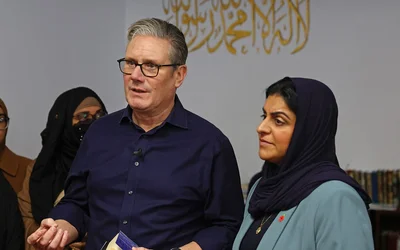
Walking into the UK's Labour Muslim Network (LMN) conference, it felt like a reunion first and conference second.
There were smiling faces behind stalls exhibiting LMN merch, there were fundraising efforts for Palestinians in Gaza, and advertising for the running order of the day.
On the surface, perhaps, it wasn't much different to any other political conference.
But it quickly became clear that this annual meeting wasn't just a polite convention.
Three themes, each weighty in its own right, were laid bare in the opening address: the rise of Islamophobia across the country; the once-emerging, now entrenched, far-right threat which scapegoats migrants and Muslims; and the unresolved tensions over the UK government’s response to international crises, particularly Israel's war on Gaza.
New MEE newsletter: Jerusalem Dispatch
Sign up to get the latest insights and analysis on Israel-Palestine, alongside Turkey Unpacked and other MEE newsletters
One of the first speakers, Lucy Powell, the deputy leader of the Labour Party, acknowledged what so many Labour leaders have tiptoed around: that fractures between the party and Muslim communities don’t just exist, they risk becoming a defining legacy of Labour’s ascent to power.
She described a community living in fear, unsettled by surging Islamophobia and its implications for democratic participation. Her message was simple: "We need to stand shoulder to shoulder."
Powell's speech, however, didn't stray from party-approved messaging. She pointed to the budget and the party's bold claim that it will transform life in the UK; yet while the far-right threat was regularly emphasised, absent were any references to Labour's own critics, those accusing the party of pandering to right-wing narratives, or of taking Muslim voters for granted.
Absent too was any acknowledgment of the growing number who have turned to independents and smaller parties after losing faith in Labour's stance on Gaza and other key issues.
Blaming the economy
Later, during a lengthy panel discussion, Rosena Allin-Khan, the Labour MP for Tooting, urged Muslims to embrace their faith and identity without feeling the need to constantly defend or apologise.
"The only way we fight hate is by not shying away… we have to believe the future is brighter," she said.
'If people are not struggling, they will not be ripe for exploitation and made to fight their neighbours'
- John McDonnell, Labour MP
John McDonnell, the left-wing Labour MP for Hayes and Harlington, who has been a vocal critic of Israel since it launched its genocidal war on Gaza, defended the government's economic policies and argued that lifting the two-child benefits cap, a move set to lift half a million children out of poverty, would have a profound effect on reducing societal tensions.
"If people are not struggling, they will not be ripe for exploitation and made to fight their neighbours," he claimed.
Later, he told Middle East Eye that Britain was witnessing the emergence of extreme-right demagogues and that they needed to be confronted head on.
"Demagogues have come along, and that includes the reform parties and Nigel Farage, who identify migrants as the cause of all the problems," he said.
"[But] it isn't just migrants, though. What's happened is that is then interpreted into anybody with a brown face. So we've seen on the far right marches in London, we saw speakers calling for a war on Islam.
"We need to call it out now," he added.
Adopt a definition of Islamophobia
Throughout the conference, speakers lamented the rise in hate crimes, and spoke of the emotional toll of perpetual scrutiny by politicians, including those in government, and the right-wing media.
Leeds councillor Abdul Hannan urged the party to put together a concrete plan of action, while others called on the government to adopt a definition of Islamophobia.
"I think I would like to see a definition of it, clear and concise, that's legally binding like we have for other groups," former London councillor Shamshia Ali said.
"We have the Equality Act 2010, but we need something a bit more, and we need to have that recognised, because women and girls are affected. And a lot of people are scared to report these incidents for fear of persecution or because they don't have faith in the system.”
Under the Equality Act 2010, Islam is protected as a religion but Muslims are not defined as a racial group, so are not covered by protection against racial discrimination.
In 2019, the Labour party adopted a working definition of Islamophobia from the all-party parliamentary group (APPG) on British Muslims, which included the statement: “Islamophobia is rooted in racism and is a type of racism that targets expressions of Muslimness or perceived Muslimness.”
The definition was adopted by many organisations but the then Conservative government did not follow suit, saying the definition had "not been broadly accepted".
A few years earlier, the Conservative government adopted the controversial International Holocaust Remembrance Alliance’s definition of antisemitism, which conflates legitimate criticism of the Israeli government with antisemitism.
The IHRA definition has faced repeated criticism as it also conflates antisemitism with criticism of historical policies that led to the creation of the state of Israel in 1948 - known to Palestinians as the Nakba or the Catastrophe.
'Muslims feel deeply betrayed'
Later, during a talk which covered the war on Gaza, the war in Sudan and the plight of Muslims in Indian-occupied Kashmir - there were widespread criticisms of the whip-approved messaging of the Labour Party.
Richard Burgon, the Labour MP for Leeds East, criticised the government for sanctioning 15 senior Venezuelan officials earlier this year, and asked why only a handful of Israeli officials had been sanctioned because of the devastating war.
"I think that really brings it home and brings home the fact that so much of international politics is not pursued through the prism of human rights, justice and international law, but is instead, pursued through the prism of geopolitical alliances," he said, referencing a recent Common's debate on US President Donald Trump's threats to bomb Venezuela.
"I think it's incumbent upon all MPs to push for accountability and action from the government. And so I published a new bill for sanctions on Israel. And I've also launched a new parliamentary working group for sanctions on Israel. Because for me, it seems to be key that we push for sanctions on Israel, that are widespread enough to help force them to stop their war crimes, to force them to stop the occupation, to force them to stop the genocide."
'The issue of Palestine has been a huge wedge in the Labour Party for Muslims'
- Nabeela Mowlana, councillor
Burgon's position, though unpopular in the front benches of parliament, was resoundingly welcomed by many in attendance.
"The issue of Palestine has been a huge wedge in the Labour Party for Muslims," Sheffield councillor Nabeela Mowlana said.
"I don't think you need to be Muslim to empathise with the plight of the Palestinians, but the active enabling of the far-right Israeli government, by the Labour government… it's almost natural that Muslim communities feel so deeply betrayed.
"It's welcome news that we suspended some arms licences, that we've now recognised the state of Palestine, but [this] actually ignores very deep-rooted issues with how a Labour government has been an active participant in these genocides," Mowlana said.
"And, of course, this community feels so deeply, so deeply betrayed," she added.
When asked whether the UK government had done enough, LMN chair Ali Milani said it needed to do far more and was "not even close" to where Muslim members wanted it to be.
"The atrocities, in Gaza, the genocide committed against Palestinian people in Gaza, the continued violations of international law in the West Bank are the moral questions of our time," he said.
"And we have been clear about that: whether it's a Labour government, a Conservative government, I don't care. The moral position is what matters. And as a Labour Muslim that is working as the chair, I will continue to fight on those cases."
Middle East Eye delivers independent and unrivalled coverage and analysis of the Middle East, North Africa and beyond. To learn more about republishing this content and the associated fees, please fill out this form. More about MEE can be found here.