Leicester Muslims blame Hindutva extremism and police failures for 2022 unrest

A new community-led report into the 2022 unrest in Leicester has concluded that rising Hindutva extremism, policy failures and systemic Islamophobia played a central role in the violence that rocked one of Britain’s most diverse cities.
The report, co-authored by the UK Indian Muslim Council and the Community Policy Forum, is the first independent inquiry into the unrest in Leicester in August and September 2022.
It draws on testimony from nearly 500 Muslim residents in the city, given between 2023 and 2024.
It challenges the prevailing narrative that framed the unrest as a clash between two equal sides and instead highlights the asymmetric nature of the provocation and violence.
The report finds that the violence - largely involving groups of Hindu and Muslim youths - was not spontaneous, but the culmination of rising tensions over several years.
New MEE newsletter: Jerusalem Dispatch
Sign up to get the latest insights and analysis on Israel-Palestine, alongside Turkey Unpacked and other MEE newsletters
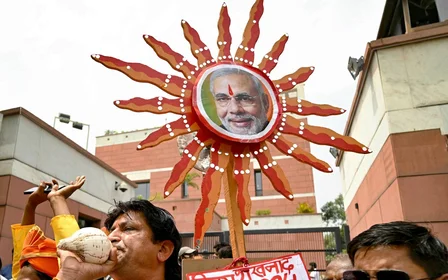
Respondents attributed this escalation to the spread of imported Hindutva ideology and deliberate acts of provocation by a fringe of extremists.
“We were blamed for our own trauma,” said one respondent. “Even local leaders wanted us to stay quiet to preserve the illusion of harmony.”
“Our kids were afraid to go outside,” said another participant. “Women were being harassed, but when we spoke out, we were told not to make it worse.”
Respondents stressed that the violence which took place in 2022 should not be blamed on Leicester's Hindu population, but on a "minority of extremists importing these ideologies into our streets".

Several said provocative behaviour preceded the violence, such as nationalist chanting, targeted marches, public harassment and fireworks set off outside mosques.
"It wasn't spontaneous," said one local Muslim resident.
"It was organised. People came into our areas shouting slogans, waving flags in our faces. They wanted us to react - and when we finally did, we were blamed for it."
The report links these provocations to a broader Hindutva digital ecosystem, citing influencers, bots and anonymous accounts from the UK and India which amplified Islamophobic content and incited hostility.
Following the unrest, Leicester Police confirmed that some of those who took part in the disturbances reportedly came from outside the city.
The report also raised concerns about the police and said respondents had lost faith in law enforcement, with some accusing the police of failing to protect them, or even siding with the agitators.
“The police just stood by and watched,” said one participant. “They were more concerned about avoiding bad press than stopping the violence. Some of us gave up even trying to report what was happening.”
Others said they encountered “hostile attitudes” from officers when reporting threats, with some feeling surveilled rather than supported.
The report states that regardless of whether bias was intentional, “the perception of police bias and inaction has created a serious barrier to rebuilding trust”.
Key recommendations made by the report include scrapping the Prevent strategy to replace it with a rights-based public health model, recognition of Hindutva and far-right extremism as domestic threats, reforming the police and recognising a definition of Islamophobia.
Identifying Hindutva as a threat
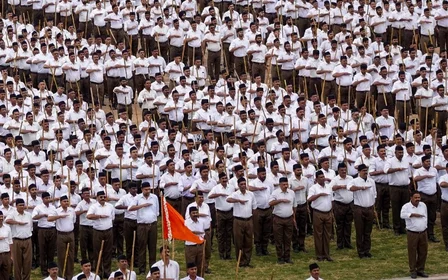
The 2022 riots began when nearly 200 Hindu men wearing masks and balaclavas marched through Leicester’s Highfield area chanting "Jai Shri Ram", which translates from Hindi to "hail Lord Ram" or "victory to Lord Ram", words that are increasingly appropriated by perpetrators of anti-Muslim violence in India.
Following the march, some Muslims came out onto the streets, leading to scuffles between the two groups.
Earlier this year, a leaked report produced by the UK Home Office stated that "Hindu nationalist extremism" played a part in the 2022 unrest, identifying it as a proposed target for British counter-extremism efforts for the first time.
Details of the leaked internal review into the British government's counter-extremism strategy were published by Policy Exchange, a right-wing think tank.
It advocated a focus on “behaviours and activity of concern” rather than ideologies.
The Home Office review called for the scope of counter-extremism work to be widened to cover a range of causes and activities, including Hindutva (Hindu nationalism), extreme misogyny, and a fascination with violence.
The publication of this report comes after the UK Indian Muslim Council, alongside 200 other Muslim organisations in Leicester, decided not to engage with the government-led inquiry into the unrest, due to deep concerns over the choice of chair and his previous Islamophobic remarks.
In early 2023, then-Communities Secretary Michael Gove commissioned former Labour MP Ian Austin to chair a government review into the unrest.
His appointment drew immediate condemnation from Muslim organisations, who cited his longstanding support for the discredited Prevent strategy, his ties to the neoconservative Henry Jackson Society, and his consistent record of dismissing Islamophobia while amplifying anti-Muslim tropes.
More than 200 local Muslim groups in Leicester publicly refused to engage with the inquiry, branding it a “cynical exercise in deflection.”
Middle East Eye delivers independent and unrivalled coverage and analysis of the Middle East, North Africa and beyond. To learn more about republishing this content and the associated fees, please fill out this form. More about MEE can be found here.