Lethal weapon: How Bollywood's 'Chauhaan' trivialises the suffering of Kashmiris maimed by Indian forces

Behind his thick glasses, 25-year-old Inam Ahmad’s eyes move with a strained flicker, a visible reminder of the permanent damage inflicted by pellet guns in Indian-administered Kashmir.
“My life is not only dark. I live with the pain every day as the pellets in my skull move or heat up,” says Ahmad, who lost 80 percent of his eyesight in 2017 at the age of just 16 when pellets fired by Indian armed forces pierced his skin and lodged inside his head, behind his eyes.
"They cause me immense physical pain and remind me that I will never be normal again," he says, describing the scores of pellets that continue to be stuck in his skull and neck.
Fahmeeda Jan, Ahmad’s mother, holds a photograph of Ahmad from when he was a toddler. She says he was full of life before he was hit by the pellets. The photograph shows a three-year-old boy in a green tracksuit, clinging to his younger sister's hand, his eyes looking upwards.
“After repeated surgeries, crushing financial costs and a lost education, this incident has uprooted our lives. He gets so fed up that he pulls his hair in frustration, becomes aggressive, and wants to end his life,” Jan says.
New MEE newsletter: Jerusalem Dispatch
Sign up to get the latest insights and analysis on Israel-Palestine, alongside Turkey Unpacked and other MEE newsletters
She says that while taking Ahmad for treatment outside Kashmir, she once asked a doctor to let her donate one of her own eyes to her son, but the doctor said such an operation was impossible.
“I wanted him to see again,” she says, adding that when he was hit, he had just passed matriculation but with this injury, his educational prospects have ended.
“Only those who this weapon has hit truly know what it is,” she adds.
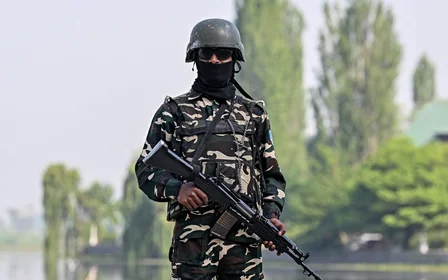
Originally developed for hunting birds, the pellet shotgun fires hundreds of metal shrapnels and has been used on protesters by Indian forces in Kashmir.
'Bollywood, especially post-2014, has been complicit in toeing the line of India’s ruling party where films, quite literally, are becoming the state’s PR machinery'
- Dr Niharika Pandit, author
Even as the "cruel" weapon remains banned for hunting animals in many countries, a 144-second promotional video of an Indian film Chauhaan declared that these metal pellets inflict "limited damage" on protesters.
For survivors like Ahmad, who was blinded by the metal spray when he was standing outside his home in Srinagar, the damage is anything but limited.
Released on 28 June, the teaser has sparked outrage, with critics saying that it trivialises the humanitarian crisis caused by pellet guns, which have caused "mass blindings" in the region.
The Bollywood film, starring Ajay Devgn, is directed by Neeraj Yadav and produced by Colour Yellow Productions and Jio Studios.
Jio Studios is owned by Reliance Industries, the conglomerate led by billionaire Mukesh Ambani. Opposition figures in India have described Reliance's media interests as being closely aligned with the government of Prime Minister Narendra Modi and his party's right-wing Hindutva narrative on Kashmir.
Shot against the backdrop of the conflict in Kashmir, a region split between India, Pakistan and China, the film is scheduled for theatrical release in October next year.
While no concrete details about the storyline have been released, scenes depicting stone-pelting, pellet injuries, and paramilitary operations point towards a narrative deeply rooted in political conflict.
In the teaser, Devgn’s voiceover, seemingly advocating for harsher measures, describes India’s conventional crowd-control measures of pellet guns as inadequate.
What are pellet guns?
The pellet-firing shotgun is a 12-gauge pump-action firearm that discharges a cartridge filled with 360 to 600 small lead and metal pellets that spread randomly over a wide area, making precision targeting impossible.
Introduced in Kashmir in 2010 following popular anti-India protests in which more than 100 people were killed at the hands of the Indian armed forces, the pellet-firing shotgun was officially declared as a "non-lethal crowd control device" by the authorities.
That definition has been contested by medical and rights groups.
The Office of the United Nations High Commissioner for Human Rights has labelled the pellet-firing shotgun as "one of the most dangerous weapons used in Kashmir".
According to a 2020 UN guideline on the use of "less lethal weapons" in law enforcement operations: "Metal pellets, including those discharged by shotguns, should never be used."
Amnesty International, in one of its reports said that the “injuries and deaths caused by this cruel weapon bear testimony to how dangerous, inaccurate and indiscriminate it is”.
Official figures revealed in the Kashmir assembly in 2018 showed that 6,221 people were wounded by metal pellets between July 2016 and March 2017.
No definitive figures are available on the total number of people who have been wounded or killed by the weapon.
Post-truth society
Chauhaan is not the only Bollywood film to attract criticism in Kashmir for advocating violence and advancing the Hindutva ideology.
Bollywood films, locals and activists say, regularly whitewash the suffering of civilians and systematically misrepresent the region's history.
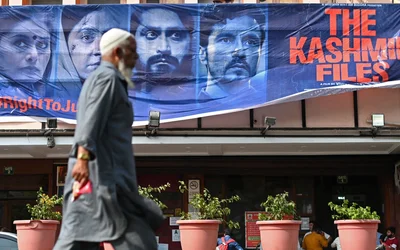
Films like Uri: The Surgical Strike, Shikara, The Kashmir Files and Article 370 have attracted significant criticism for "galvanising the image of Kashmiri Muslims as terrorists" and altering historical events with official support.
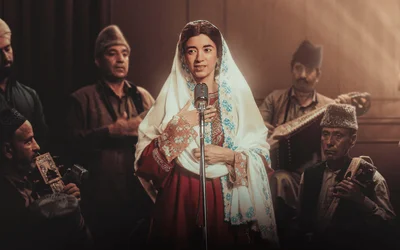
The film Article 370, which celebrates the unilateral abrogation of Kashmir's semi-autonomous status and stripping of political rights by the Indian government in 2019, was endorsed by Modi.
Observers say that the Indian state uses movies for political ends to advance a pro-Hindutva agenda.
Acccording to author Mirza Waheed, the visuals and the spoken lines in the trailer are indicative of an "erosion of basic social norms, of decency and civility in public life”.
Waheed states that the film’s insistence on expanding the scope of corporeal violence in Kashmir pointed to a shift in the mindset of Indian movie-goers.
“In normal cultures, one would expect filmmakers to portray the life of such victims on screen: for instance, what is it like for a young girl or boy permanently blinded by these vicious weapons, what does their world look like, what of their dreams?” says Waheed.
“The film, instead, explicitly calls for even more severe and lethal tactics," he adds.
Waheed says it a symptom of the "post-truth, anti-history" environment in many segments of society in contemporary India.
"Such mendacious narratives seek to subvert Kashmir's recent history, painting the victims in a completely dehumanised light and the perpetrators as virtuous, heroic,” he argues.
‘Deeply disturbing’
Far from being limited, the lasting physical and psychological damage sustained as a result of the use of pellet guns in Indian-administered Kashmir is apparent in the case of Insha Mushtaq.
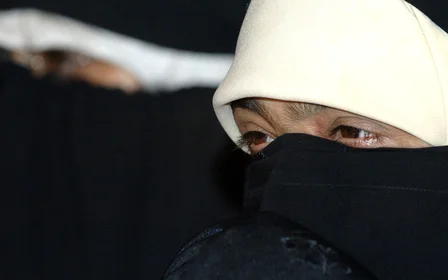
She was 14 when she was shot while standing near the window of her home in south Kashmir’s Shopian district in 2016. The injuries she sustained to her skull led to a facial deformity, and she has had to live with complete loss of sight since she was hit.
'For those who lost their eyesight, those who still live with pellets lodged in their bodies… this is not an action sequence or a cinematic backdrop. It is a lived trauma'
- Aga Ruhullah Mehdi, Kashmiri parliamentarian
In the same district, 18-month-old Hiba Nisar, the youngest victim of the pellet gun, was hit in 2018 when she was in her mother’s lap.
Aga Ruhullah Mehdi, a Kashmiri parliamentarian for the ruling National Conference, calls the teaser for Chauhaan deeply disturbing.
“The teaser of Chauhaan is deeply disturbing for every Kashmiri who carries the memories of the years when pellet guns became a symbol of pain and irreversible loss,” he wrote in a post on X.
"What they call 'ineffective' left behind thousands of shattered lives,” he adds.
“For those who lost their eyesight, those who still live with pellets lodged in their bodies, and the families who continue to bear those scars, this is not an action sequence or a cinematic backdrop. It is a lived trauma.
"Sadly, this is not an isolated instance. Time and again, mainstream cinema has chosen Kashmir as the setting for narratives that reduce an entire people to conflict, suspicion and violence," he concludes.
Mehdi, who has often criticised Indian rule in Kashmir, says that such portrayals "reinforce stereotypes that many Kashmiris have spent years trying to overcome", adding that "Kashmir deserves empathy, honesty and dignity - not the commercialisation of its pain.”
‘Fascist narrative’
Dr Niharika Pandit, whose book Occupying the Everyday: Militarisation and Gendered Politics of Living in Kashmir examines the consequences of what she calls the pervasive militarisation of Kashmir, told MEE that Bollywood films have been complicit in the typecasting of Kashmiri Muslims as terrorists while at the same time obfuscating their lived realities.
“Bollywood, especially post-2014, has been complicit in toeing the line of India’s ruling party where films, quite literally, are becoming the state’s PR machinery,” Pandit says.
Pandit said that Hindi cinema would once project Kashmiris as ethereal people, but without agency; the latest batch of movies suggests that their messaging has turned more propagandist in nature.
“They peddle the fascist narrative that somehow everything is normal in Kashmir and justify the state’s recent decisions such as the abrogation of Article 370 and 35A, further erasing Kashmiri histories and realities,” she says.
Niharika says that everyday forms of dehumanisation and erasure that Kashmiris face in Kashmir through Hindi films constitute "epistemic violence".
“First, you inflict widespread bodily violence that has debilitated many people, including young Kashmiris, and then you pretend it did not happen or was 'necessary' for national security,” she adds.
Kashmiri academic Dr Mohamad Junaid, who teaches at the Massachusetts College of Liberal Arts, states that Hindi cinema has often exoticised Kashmir’s landscape and demonised its people.
“The violence is a natural corollary of this dynamic. Hindi filmmakers should ask themselves why Kashmiris don’t watch their movies. But Hindi film is a mere reflection of what the Hindu right-wing has done to the public sphere.”
Middle East Eye delivers independent and unrivalled coverage and analysis of the Middle East, North Africa and beyond. To learn more about republishing this content and the associated fees, please fill out this form. More about MEE can be found here.