London student activist at risk of torture in Egypt after university revokes visa

An Egyptian student who campaigned for Gaza at his London university is at risk of imprisonment and torture if sent back to Egypt, after his university suspended him for his pro-Palestine activism.
Lawyers representing Usama Ghanem said the 21-year-old faces an “imminent risk of removal” from the UK to Egypt after King’s College London decided to indefinitely suspend him.
The suspension led the university to inform the Home Office, which automatically cancelled Ghanem's student visa and served him with notice of removal.
In a pre-action letter to King's to oppose his suspension, Ghanem’s lawyers accused the university of violating his human rights and discriminating against him for his anti-Zionist beliefs.
Ghanem studied international relations at King’s and helped co-found a society called the House of Wisdom, which aimed to promote debate and conversation on campus.
New MEE newsletter: Jerusalem Dispatch
Sign up to get the latest insights and analysis on Israel-Palestine, alongside Turkey Unpacked and other MEE newsletters
He also actively campaigned for the university to divest from companies profiting from Israel’s genocide in Gaza. This activism led King's to issue Ghanem with three separate disciplinary hearings in June 2024.
The first disciplinary hearing was for protesting at an alumni awards in June 2024. The second was for protesting at a talk about Iran and Israel in February 2025. The third was for protesting at the London Defence Conference in May 2025.
'I specifically wrote in my personal statement on the horrors I and my family endured'
– Usama Ghanem
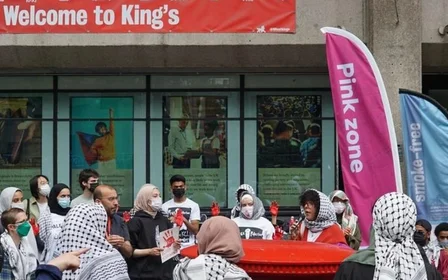
Ghanem also joined hundreds of other students across the UK in May 2024 at an encampment for Gaza at his university.
The encampment lasted several months, and led to the university changing its policies to ensure similar styles of protest will lead to students and staff facing disciplinary hearings that would lead to their expulsion and dismissal.
But it was his participation in a protest against an event hosting pro-Israeli speaker Faezah Alavi, a vocal supporter of Israeli Prime Minister Benjamin Netanyahu, that led the Campaign Against Antisemitism (CAA) to write a letter calling for the university to investigate students protesting against the event.
Correspondence passed to Middle East Eye showed that the CAA sent a letter to King’s President Shitij Kapur after the event, calling on him to investigate alleged “antisemitic and genocidal chanting” - referring to the chant “from the river to the sea, Palestine will be free”.
The CAA also referenced the university's adoption of the controversial International Holocaust Remembrance Alliance’s definition of antisemitism, which includes examples that pro-Palestine activists say conflate criticism of Israel with antisemitism.
“This intimidation must carry consequences that demonstrate your commitment to ensuring that such behaviour will not be tolerated,” said the letter written by the CAA to Kapur on 4 March 2025.
“This is not only a matter of institutional integrity but, in failing to take appropriate action, the University risks undermining its responsibility to create a safe and inclusive environment.”
Following this letter, Ghanem received a letter from the university informing him that he would be suspended, pending a review in August 2026. The letter also said he must go back to his home country pending his hearing.
Torture in Egypt
Before attending King's, Ghanem was imprisoned with his brother and father for opposing the Egyptian government in 2020.
This experience prompting him to flee to the UK for his safety.

Ghanem told Middle East Eye that King's was aware of his family's persecution by Egyptian security forces, as he had written about it in his application to study at the university.
Ghanem said King's was also aware of his experiences in Egypt and said he wrote about “escaping authoritarianism [in Egypt], only to experience it again at the university".
But despite this, the university told Ghanem that he must go back to his home country, and await the verdict on whether he should be excluded from the university.
“If I go back to Egypt, I could face possible arrest and torture, and the irony of it is that KCL knew I have experienced this,” said Ghanem.
“I specifically wrote in my personal statement on the horrors I and my family endured and how that informed my decision to consider studying at King’s College London.
“The last thing I expected was the same university sending me back to Egypt because I joined student calls for it to be more ethical.”
Ghanem added: “The university prides itself on standing up for free speech and other issues like Ukraine, but when it comes to Palestine, they shut down any attempt by students to speak on the matter.”
A KCL spokesperson did not respond to multiple requests for comment from MEE.
Clampdown on student activism
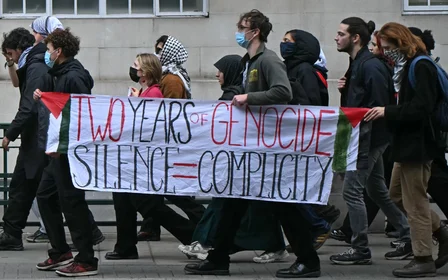
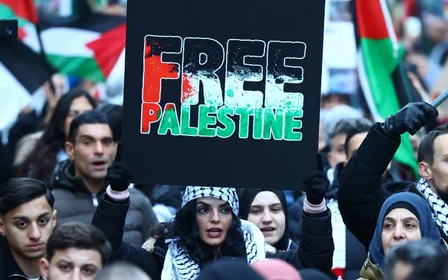
Since October 2023, student activism over Palestine has ramped up across UK universities, with dozens of encampments being established to demand their institutions end complicity with Israel.
Universities have responded with an increasingly firm clampdown through legal, disciplinary and increased security measures.
Several institutions, including KCL, London School of Economics, Manchester University and Edinburgh University issued eviction notices, after obtaining court injunctions.
Some students, like Ghanem, faced suspensions, often under the justification of health, safety or security concerns.
In 2019, KCL was forced to apologise to a group of students and a staff member for banning them from campus during a visit by Queen Elizabeth.
KCL admitted it was wrong to ban them, with the acting principal stating that the ban “did not meet our values”.
Middle East Eye delivers independent and unrivalled coverage and analysis of the Middle East, North Africa and beyond. To learn more about republishing this content and the associated fees, please fill out this form. More about MEE can be found here.