'Like a battlefield': The real story behind the Tel Aviv derby violence

The violence that led to the cancellation of the derby football match between Hapoel Tel Aviv and Maccabi Tel Aviv on Sunday was started and escalated by a brutal, politically motivated Israeli police force, eyewitnesses have told Middle East Eye.
The sources, including sports analysts, local residents and football fans, all said that police violence has severely escalated since the appointment of the ultranationalist settler leader Itamar Ben Gvir as national security minister in 2022.
As the government Ben Gvir sits in has waged genocide in Gaza and enforced a brutal military occupation of the West Bank, Israeli football has come under increasing scrutiny.
Maccabi Tel Aviv fans, in particular, have been the focus of a media storm since England's West Midlands Police banned the supporters from attending a Europa League match with Aston Villa on 6 November, citing severe security concerns.
On previous trips to Europe, Maccabi's fans have celebrated the Gaza genocide, incited violence against local residents and sung racist songs.
New MEE newsletter: Jerusalem Dispatch
Sign up to get the latest insights and analysis on Israel-Palestine, alongside Turkey Unpacked and other MEE newsletters
The West Midlands Police's decision created a furore in Britain, as Prime Minister Keir Starmer joined a raft of political leaders and commentators to condemn the move as "antisemitic".
Hours later, Maccabi and Hapoel fans were clashing with each other and the police, leading to Sunday's match being cancelled.
Events surrounding the Tel Aviv derby cast the row over whether Israeli fans should travel to England in a sharp new light, with Maccabi Tel Aviv initially blaming Hapoel fans for the violence.
Israeli police said they cancelled the game because of “public disorder and violent riots” that led to 12 civilians and three police officers sustaining injuries, with one admitted to hospital, as well as to the arrest of nine people after smoke grenades and pyrotechnics were thrown.
But sports journalists and football fans who witnessed the events told MEE that the police instigated the violence and wounded up to 70 civilians. They also said Maccabi Tel Aviv fans were not to blame.
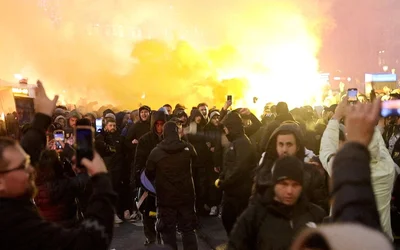
Video footage and photographs showed children being trampled by police horses, officers beating fans, a young father being attacked and police kicking Hapoel fans while they were on the ground.
'The police target Hapoel fans'
Ahmed, a Hapoel fan and Palestinian citizen of Israel who wished to remain anonymous for security reasons, watched the violence play out in front of him.
“The battle that erupted wasn’t between fans of Hapoel and Maccabi, but between the police and fans of Hapoel,” the 21-year-old told MEE.
Ouriel Daskal, an Israeli sports journalist, agreed.
“It’s not connected to Maccabi Tel Aviv fans in any way,” he said. “This is the police. It’s not something new, especially under Ben Gvir, who is a criminal. Since he’s become the minister responsible for the police, Hapoel fans have been subjected to violence many times.”
'Ben Gvir is an ignoramus idiot who exploits every opportunity to sow chaos, discord and violence'
- Alon Pinkas, Israeli diplomat
In their statement, Israeli police said that “disorderly conduct” and riots had injured police officers. “This is not a soccer game, this is a breach of order and serious violence,” they said.
But the analysts and witnesses MEE spoke to painted a very different picture, one in which the police, emboldened by Ben Gvir, who has previously been convicted on terrorism charges, unleashed a wave of violence that was at least in part motivated by Hapoel’s reputation as a left-wing club.
“The story here is of institutional bodies,” Amir Shini, a Hapoel Tel Aviv fan, told MEE. “The police is abusing citizens no matter who they are or what they are… They were looking for any reason to lash out. I didn’t even see arrests - I just saw police beating people.”
Ahmed said that he had arrived in the area two hours before the game.
“I was standing there, then about 20 police officers started to move as if someone higher up had given them an order,” he said.
“The violence they used was very over-the-top, and they had no reason for it. They beat everyone they came face-to-face with, even people who were just standing there doing nothing.”
Ben Gvir and the police
Fans told MEE that Jerusalem Boulevard, which runs close to Bloomfield Stadium, where the game was to be played, looked like a battlefield.
“Usually, people sit there before the game, in the many bars and coffee shops there,” Ahmed said.
“All of a sudden, police forces started to beat fans there. Anyone who was there was subjected to police violence,” he added.
“I expected some provocation by the police, but I didn’t expect it to be on this level. The increase in police violence is scary. Most victims I saw were Jewish Ashkenazi - they were blond. I saw about six Ashkenazi Jews being attacked by police.”
Shini, who runs a bar, said he was familiar with police conduct from going to demonstrations in Israel, where police officers don’t arrest protesters but “bang the ones they don’t like on the head like criminals”.
“What happened yesterday is extreme because it happened in the mainstream,” Amir said. “They used all their means, contrary to their own law.”
“I don’t know if at any point people will connect the dots and realise that for such a regime, it doesn’t matter who you are or what you are,” Shini told MEE, referring to an Israeli government and police force “that has been escalating in recent years”.
“Today the police don’t care if they are filmed,” he said. “They are backed by the establishment.”
Like the other witnesses and experts MEE spoke to, Amir saw the appointment of Ben Gvir as crucial. It was, he said, “the day they were waiting for because they could do all the things they wanted”.
Ben Gvir said the decision to cancel the derby was justified. “Our police officers operated under complex and dangerous conditions and deserve full support. Sporting events are not supposed to be battlefields and pogroms,” he said.
Alon Pinkas, a football fan and former diplomat who served as adviser to four foreign ministers, told MEE that Ben Gvir was “an ignoramus idiot who exploits every opportunity to sow chaos, discord and violence”.
Politics and Israeli football
Hapoel translates as “the worker”, and the team has been associated with Israeli unions and the left since it was founded in the 1920s during the British Mandate.
Today, Daskal said, “Hapoel is not far left, so it’s more like social democracy versus the far right”. Beitar Jerusalem, which has never fielded an Arab player and has strong, long-standing links to Prime Minister Benjamin Netanyahu’s Likud party, represents the far right.
'Beitar is more identified with the far-right, Hapoel with the centre-left and Maccabi with the centre-right'
- Yoav Borowitz, Israeli sports journalist
“Among Hapoel’s fans, you also have a real mix of Ashkenazi, ethnic Arab Jews and Arabs - it’s still the second-most supported Israeli team in the Arab villages, after Maccabi Haifa,” Daskal told MEE.
“Hapoel fans have been part of the demonstrations against the judicial reforms in Israel, many are left wing. There are journalists who are critical of Ben Gvir and the government among the fanbase.”
Maccabi Tel Aviv sits somewhere between Hapoel and Beitar. “Beitar is more identified with the far-right, Hapoel with the centre left and Maccabi with the centre right,” Yoav Borowitz, a senior sports producer and correspondent for Israel’s i24 News, told MEE.
“But Hapoel has a lot of right-wing fans and Maccabi has left-wing fans too.”
Daskal described Maccabi Tel Aviv as the team of bourgeois Israel. “Maccabi Tel Aviv fans are like the average Israeli,” he said.
And though Maccabi fans shocked with their behaviour in Amsterdam last November, when they rampaged through the city chanting “There are no schools in Gaza because there are no children left”, they also represent the ferocious anti-Palestinian - and anti-left wing - sentiment among Israelis.
Hapoel fans believe that hostility towards the left drove the police brutality on Sunday, too.
“Yes, there are many Arabs who are fans of Hapoel,” Ahmed said. “But this wasn’t the main issue, in my opinion. The police is on the side of the right wing, which is closer to Maccabi, who are known for being racist.”
In its club statement, Hapoel Tel Aviv was unequivocal: “It seems the police were preparing for a war and not a sporting event.”
Middle East Eye delivers independent and unrivalled coverage and analysis of the Middle East, North Africa and beyond. To learn more about republishing this content and the associated fees, please fill out this form. More about MEE can be found here.