
University of Michigan faculty vote in support of pro-Palestine students facing charges

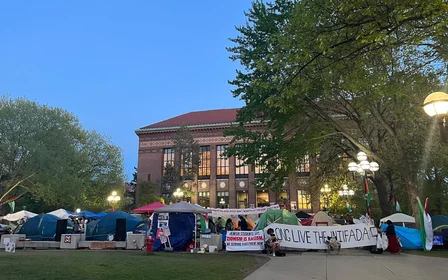
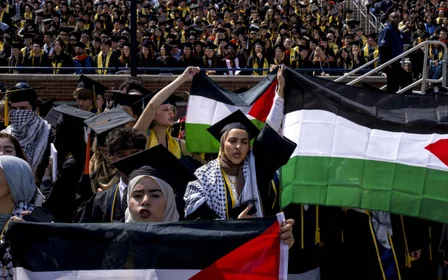
Nearly 60 percent of voting faculty members at the University of Michigan have backed a resolution in support of a dozen former students and staff who are now facing federal criminal charges for their participation in the 2024 anti-war encampments for Gaza.
The move is symbolic but also an indication of where much of the teaching staff stands.
On 12 November, after 2,425 members of the Faculty Senate voted on a motion stating that the Department of Justice's indictment "is part of a broader attack on both Palestine solidarity and labor unions in the United States", results showed 58.2 percent expressed support.
That's more than 1,000 professors, lecturers, clinicians and other University of Michigan employees.
The Faculty Senate has nearly 8,000 members, but not all of them participate in voting.
New MEE newsletter: Jerusalem Dispatch
Sign up to get the latest insights and analysis on Israel-Palestine, alongside Turkey Unpacked and other MEE newsletters
On Wednesday, Faculty Senate chair Kentaro Toyama expressed his dismay that the University of Michigan Police Department was specifically called out in the resolution as having been party to the repression of students' speech.
"Even if the allegations in the resolutions were true, UMPD reports to the UM President. Unless UMPD acts in defiance of UM leadership or the ethics of law enforcement, they are following civilian orders as police norms require," Toyama wrote in an email that was viewed by Middle East Eye.
The successful resolution, he added, "concerns matters that are complex and gray".

Adi Saleem, assistant professor of Romance Languages & Literatures and Judaic Studies, introduced the resolution at the Faculty Senate's meeting earlier this month. He told MEE on Thursday that there was anti-Muslim sentiment at play, and he and another colleague were called "Nazis" afterwards by those who opposed the resolution.
"Because this resolution was moved by a Muslim professor there is obviously something antisemitic about it," he said, sarcastically.
"In the days after the resolution passed, we, the supporters of the resolution, were the focus of a right-wing and Zionist social media campaign. All of us have had our faces kind of on multiple videos accusing us of, essentially, antisemitism."
That includes assistant professor of American Culture and Digital Studies, Yarden Azoulay Katz, who told MEE that he believes the Faculty Senate chair is under both political pressure and pressure from university donors.
"Toyama's statement delivers the complete package that the university's regents, right-wing donors, and Zionist lobbying groups want to hear: that Hamas equals terrorism, that Israel has the right to exist, that Palestine is only West Bank and Gaza, and that the police keep us safe," he said.
"It also effectively says that even if the courts did not charge the defendants with vandalism or find them guilty of anything, that we know they did it and that their actions were wrong."
"It's inexcusable," he added. "Toyama has also not been upfront about the pressures being exerted on him to make such a sweeping statement."
MEE has reached out to the University of Michigan.
Prolonged punishment
The University of Michigan has continued to discipline, fire and intimidate students and staff since the 2024 protests, many of those impacted have previously told MEE.
As recently as this June, the FBI carried out violent home raids targeting students and alumni.
But the saga began long before the Trump administration assumed power in early 2025 and vowed to crack down on pro-Palestine activists and critics of Israel.
In September 2024, Michigan Attorney General Dana Nessel charged 11 students and alumni for what she described as "violent and criminal behaviour" in setting up the encampments.
By May 2025, all the charges were dropped, after Nessel said the cases were just not worth her office's time anymore.
Last month, however, the US Department of Justice, overseen by President Donald Trump's former personal lawyer, Todd Blanche, indicted 12 other students who were engaged in the 2024 anti-war protests at the University of Michigan.

Among the charges are "conspiracy to transmit a threat to the institution", "conspiracy to tamper with a witness", and "the destruction of property to prevent seizure".
The US attorney for the Eastern District of Michigan, Jerome F Gorgon Jr, said the defendants "terrorize Jews".
"The main charge against them is sending messages on the internet. Really, I mean that's what it boils down to," Katz told MEE on Thursday. "They're using conspiracy charges... without needing to have any real substantive evidence."
"The property damage that's described in the indictment, none of it concerns federal buildings, right? So, the federal government has no business even getting into a hypothetical vandalism case here," he added.
The DOJ further alleged there was "an increased support for Hamas on college campuses" at the time of the encampments that emerged at universities across the country.
At the time, between March and May 2024, Israel was killing up to 200 Palestinian civilians a day in its assault on Gaza, and then-President Joe Biden had refused to use any leverage to stop the attacks.
"If you don't stand up to this right now, there's no telling how far it could escalate," a former student-turned-employee of the university, Zainab Hakim, who is named in the indictment, told MEE last year.
"They are trying to paint a peaceful expression of First Amendment rights as violent in order to repress the movement," she said.
"I don't regret trying to do the right thing."
There is a legal fund that has been set up for the so-called "Michigan 12".
Middle East Eye delivers independent and unrivalled coverage and analysis of the Middle East, North Africa and beyond. To learn more about republishing this content and the associated fees, please fill out this form. More about MEE can be found here.