MEE correspondent Mohammed Amin, refused UK visa, wins One World Media Award

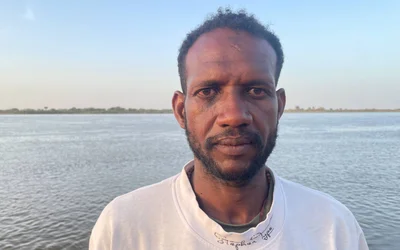
Mohammed Amin has won One World Media’s prestigious Journalist of the Year award for his reporting as a freelance correspondent for Middle East Eye from Sudan.
Amin was unable to attend the London awards ceremony in person on Wednesday night after the Home Office refused to grant him a visa to travel to the UK.
Accepting the award by video, the Sudanese journalist said: “One of the discriminatory things the Home Office told me was that I might not leave the country, meaning that I might seek asylum here.
“I would like to say here that the Sudanese are not a heavy burden in this world. We are equal partners in humanity.”
Amin pointed to the determination of the Sudanese, including how the village of al-Tekeina, from where he reported, defended itself against the Rapid Support Forces (RSF) paramilitary, which has been widely accused of genocide.
New MEE newsletter: Jerusalem Dispatch
Sign up to get the latest insights and analysis on Israel-Palestine, alongside Turkey Unpacked and other MEE newsletters
“It tells us what people can do when they have the will, and what independent media can do,” he said.
Amin described Sudan as “a very wounded and traumatised country”, and said that the war was not between the opposing RSF and Sudanese Armed Forces, “but between fascism and the Sudanese people”.
He ended by calling for media in the Global South to unite and create news platforms and new ways of telling stories, including funding, “to make it truly independent”.
UK bans award winning journalist from entering country
The Home Office told Amin that he did not have a genuine reason for coming to the UK and that he would not leave the country afterwards, despite him being sponsored throughout his visit by Middle East Eye and also having an invitation from the award organisers. There is no right of appeal against refusals.
Amin lived in the English port city of Plymouth for two years when he was a child. In November 2022, he attended the Rory Peck Awards on London’s South Bank, where he won the Martin Adler Prize for his reporting on Wagner Group massacres in Sudan and the Sudanese coup.
On that occasion, Britain's then-Conservative government issued him a visa without hesitation. Applicants from Sudan wishing to enter the UK have faced increased barriers and scrutiny since the outbreak of war in April 2023.
In March 2026, the UK’s Labour government introduced a visa brake, preventing any Sudanese student applications from outside the country, as well as for nationals of Afghanistan, Cameroon and Myanmar.
Chinwe Kalu-Uma, One World Media's interim director told MEE: “It is deeply disappointing that Mohammed, our Journalist of the Year Award winner, who has at great risk continued to report from inside Sudan so that the world might pay attention, has been denied a visa to travel to London to receive that recognition.
“His absence from our stage is itself a story about the barriers Sudanese people face, not only in their own country, but in being seen and heard beyond it.”
Other nominees for Journalist of the Year included Ghada Abdulfattah for her reports for the New York Times from Gaza; and Tony Cheng for his coverage of the aftermath of the March 2025 earthquake in Myanmar for Al-Jazeera.
Reporting the war in Sudan
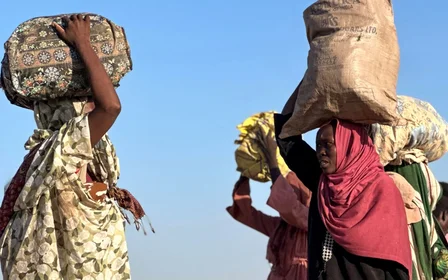
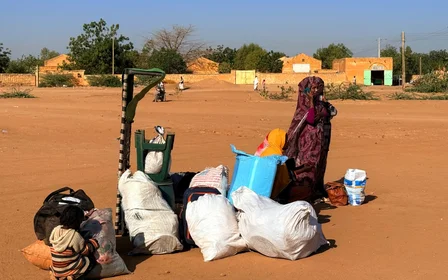
During the past year, Amin has reported across Sudan on the aftermath of the bloody siege of el-Fasher, how the war has been fuelled by the drug captagon and the targeting of the Kanabi community by all sides in the conflict.
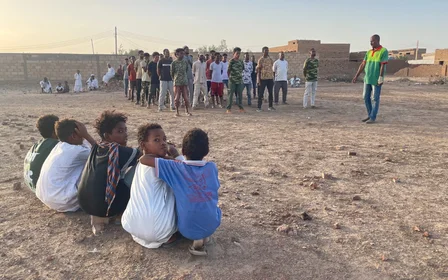
His report of how the village of al-Tekeina resisted sustained attacks by the RSF went viral on Sudanese media and was translated by several Arabic sites. The next day, a delegation led by the prime minister of Sudan visited al-Tekeina, the village’s first official visit in more than six decades, and promised to help the reconstruction.

In their comments, One World Media's judges said: "Mohammed Amin’s work provides rare, essential insight into a conflict the international community has largely ignored. He centres voices from within his own community to reveal the human reality of the conflict, exposing not only what is happening on the ground but why it matters far beyond Sudan’s borders.
"His reporting combines clarity, sensitivity, and political relevance, demonstrating the wider implications of the conflict while remaining rooted in lived experience."
David Hearst, co-founder and editor-in-chief of MEE, said: “Mohammed Amin has reported from Sudan with courage, precision and an unwavering commitment to the people whose lives have been shattered by this conflict.
“His reporting has documented not only the brutality of the war, but also the resilience of Sudanese civilians. At great personal risk, Mohammed has ensured that Sudan's story reached a global audience.
"His work embodies the very best traditions of journalism: bearing witness, holding power to account, and giving voice to those who would otherwise go unheard.”
A Home Office spokesperson, asked why Amin had been refused a visa, told MEE: “We carefully consider each case on its individual merits and in line with published policies.
“It is longstanding government policy that we do not comment on individual cases.”
Middle East Eye delivers independent and unrivalled coverage and analysis of the Middle East, North Africa and beyond. To learn more about republishing this content and the associated fees, please fill out this form. More about MEE can be found here.