Netherlands bans Israeli ministers, urges EU sanctions over Gaza

The Dutch government has barred two of Israel’s far-right ministers from entering the country, citing their incitement of violence and support for ethnic cleansing.
“[National Security Minister] Itamar Ben Gvir and [Finance Minister] Bezalel Smotrich are no longer welcome here,” Dutch Foreign Minister Caspar Veldkamp announced late on Monday.
The Netherlands formally declared both men as persona non grata and pledged to enter their names into the Schengen Area’s registry of undesirable individuals.
Defending the move in parliament, Veldkamp said the pair had “repeatedly incited violence against the Palestinian population, persistently advocated for the expansion of illegal settlements, and called for ethnic cleansing in the Gaza Strip”.
“These actions and statements are beyond justification,” he added.
New MEE newsletter: Jerusalem Dispatch
Sign up to get the latest insights and analysis on Israel-Palestine, alongside Turkey Unpacked and other MEE newsletters
“The cabinet has taken this step because their conduct undermines any prospect for peace and breaches fundamental principles of international law.”
Ben Gvir, Israel's national security minister, responded on X, saying: "Even if I’m banned from all of Europe, I’ll keep working for our country and demanding that we topple Hamas and back our fighters."
He also suggested that the Netherlands welcomes and tolerates “terrorism” while a “Jewish minister from Israel is unwelcome”.
'The people of Gaza must be given immediate, unfettered, safe access to humanitarian aid'
- Dutch Prime Minister Dick Schoof
In his statement, Veldkamp also revealed that since 7 October 2023, the Dutch government had rejected 11 export licences for military equipment or dual-use items destined for Israel.
However, it did approve two licences related to components for the Iron Dome missile defence system.
Veldkamp said Israel’s ambassador to the Netherlands would be summoned for urgent discussions.
“We will ask him to urge [Israeli] Prime Minister [Benjamin] Netanyahu’s government to change course,” he stated. “The current situation is intolerable and morally bankrupt.”
On Monday, Middle East Eye reported that the Netherlands has named Israel as a foreign threat to the country's national security for the first time, citing disinformation campaigns endangering the lives of Dutch citizens.
A report published by the National Coordinator for Security and Counter-terrorism (NCTV) said that Israel attempted to influence public opinion and politics in the country by circulating documents directly to Dutch journalists and politicians instead of using the official diplomatic channels.
Deepening tensions
The diplomatic row between Israel and the Netherlands escalated on Monday after Dutch Prime Minister Dick Schoof warned of potential European Union sanctions against Israel over its conduct in Gaza.
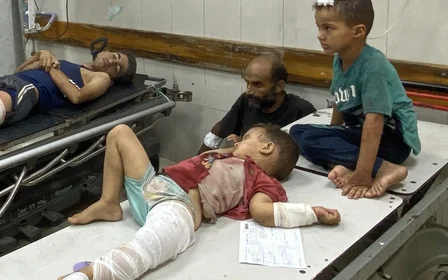
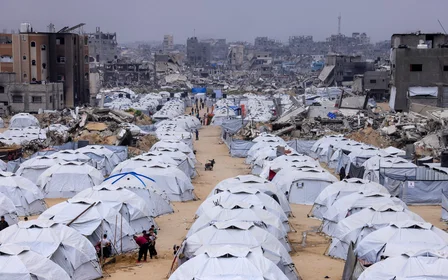
In a social media post, Schoof said he had convened an emergency meeting with senior ministers to address what he described as the “catastrophic” conditions in the besieged enclave.

“The people of Gaza must be given immediate, unfettered, safe access to humanitarian aid. If the EU decides tomorrow that Israel is not in compliance with the relevant agreements on this, the Netherlands supports the plan to suspend Israeli participation in the EU research programme Horizon,” said Schoof.
He added that additional measures, which could potentially affect trade, might also be considered.
Israeli President Isaac Herzog responded by accusing Schoof of misrepresenting the tone and content of their recent phone call.
“Sorry, Prime Minister, with all due respect this tweet does not reflect the spirit or the details of our phone call,” Herzog posted.
“Nor does it reflect my crystal-clear position: it will be a huge mistake if the EU takes such steps, especially in light of Israel’s ongoing and upgraded humanitarian efforts.”
The Netherlands is the seventh country to sanction Ben Gvir and Smotrich, joining the United Kingdom, Canada, Australia, New Zealand, Norway and Slovenia.
Middle East Eye delivers independent and unrivalled coverage and analysis of the Middle East, North Africa and beyond. To learn more about republishing this content and the associated fees, please fill out this form. More about MEE can be found here.