
Over 500 ready to risk arrest to protest Palestine Action ban on Saturday

Over 500 people are set to participate in a protest against the UK government’s ban on the direct action group Palestine Action, putting to the test a pledge by the Metropolitan Police to arrest anyone showing support for the proscribed organisation.
Campaign group Defend Our Juries (DOJ) is organising the protest on Saturday in Parliament Square to demand the reversal of the group’s proscription, saying that the protest would only go ahead if at least 500 people committed to joining.
As of Monday evening, the group said that as many as 1,000 people had signed up, confirming on Tuesday that it would go ahead.
The protest will involve participants holding cardboard signs reading: “I oppose genocide. I support Palestine Action.”
DOJ has called similar protests over the last month since the government moved to proscribe Palestine Action as a terrorist organisation on 4 July, making it a criminal offence to be a member of or show support for the group.
New MEE newsletter: Jerusalem Dispatch
Sign up to get the latest insights and analysis on Israel-Palestine, alongside Turkey Unpacked and other MEE newsletters
Falling foul of the law proscribing the group is punishable by a sentence of up to 14 years in prison.
The proscription followed an incident in which members broke into RAF Brize Norton and spray-painted two planes they said were “used for military operations in Gaza and across the Middle East".
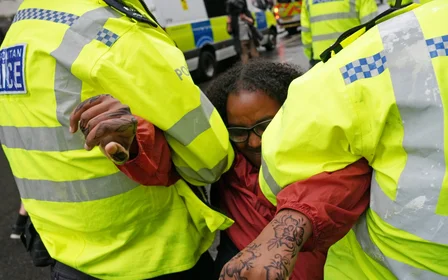
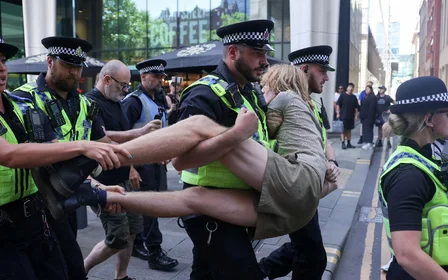
Since then, over 200 people have been arrested - including priests, vicars and former magistrates - after they were deemed by police officers to have expressed support for the group.
On Thursday, three people who participated in a protest calling for Palestine Action’s ban to be lifted in Westminster on 5 July were charged with showing support for a terrorist organisation.

DOJ said the protests have “changed the meaning” of an arrest under the Terrorism Act and that it is considered a “badge of honour” within the movement.
But the numbers expected at Saturday’s protest are unprecedented, with DOJ warning that Met police chief Mark Rowley faces a “dilemma” after pledging to arrest all participants.
DOJ highlighted that the mass arrests could place strain on a prison system already “on the brink of collapse” and remains at 97.5 percent capacity, according to an independent review this week.
“Is Mark Rowley really going to spend his political capital and credibility as well as significant public resources on arresting more grandparents and NHS workers under the Terrorism Act in front of the world’s press?” a DOJ spokesperson said.
Police resources will be further strained by simultaneous protests by far-right groups targeting hotels housing asylum seekers in London.
However, a source with knowledge of the police’s planning for Saturday’s protest told The Guardian: “If they think that by turning up with significant numbers that we can’t arrest them for breaking terrorism laws, they need to think again.
“They will be arrested. However, we have to do it, they will be arrested for breaking terrorism laws.”
At previous protests that led to mass arrests, the Met has arrested people on the spot and immediately released them on bail after confirming their identities and home addresses.
A 'slippery authoritarian slope'
On Thursday, an open Zoom call organised by DOJ for members of the public wanting to participate in Saturday’s protest was shut down minutes before it was due to start, following a police order.
DOJ reported that an email from the Zoom Trust and Safety Team explained: "Zoom has received a request from the Metropolitan Police Service, Counter Terrorism Internet Referral Unit, London UK seeking to restrict access to users to a meeting scheduled by your account."
The group said they managed to reschedule a meeting within half an hour, which hundreds attended.
"These attacks on the right to protest just show how [Home Secretary] Yvette Cooper's conflation of direct action with terrorism would put us on a dangerously slippery authoritarian slope, if it is allowed to stand," a DOJ spokesperson said.
"Trying to shut down our campaign has had precisely the opposite effect, confirming the power of collective action and our cardboard signs. There’s never been a more important time for people wanting to protect our freedoms to take a stand".
Saturday's protest comes amid mounting pressure on the UK government to lift the controversial ban amid concerns that it could be used to stifle criticism of Israel and the right to protest.
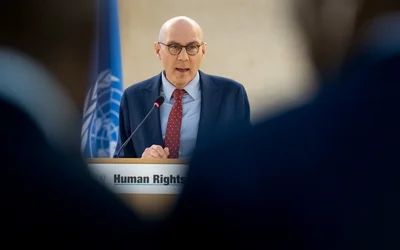
Last month, UN human rights chief Volker Turk said that the ban was “disproportionate and unnecessary” and called for the designation to be rescinded.
He said: "UK domestic counter-terrorism legislation defines terrorist acts broadly to include ‘serious damage to property’.
"But, according to international standards, terrorist acts should be confined to criminal acts intended to cause death or serious injury or to the taking of hostages, for purpose of intimidating a population or to compel a government to take a certain action or not.
“It misuses the gravity and impact of terrorism to expand it beyond those clear boundaries, to encompass further conduct that is already criminal under the law.”
Meanwhile, on Thursday, Amnesty International warned that the mass arrests could break international law, with Amnesty UK Chief Executive Sacha Deshmukh saying: “Arresting people on terrorism offences for peacefully holding a placard flies in the face of international human rights law.
"At a time when people are quite rightly outraged by the genocide they see being perpetrated in Gaza, it is more crucial than ever that there is space to peacefully express that outrage.”
Also on Thursday, scores of leading global academics, including Judith Butler, Tariq Ali, Angela Davis, Naomi Klein, Rashid Khalidi, Avi Shlaim and Ilan Pappe, signed an open letter denouncing Palestine Action’s proscription as an "attack on fundamental freedoms".
On 30 July, a High Court judge ruled in favour of Palestine Action and granted the direct action group a judicial review to oppose the ban on the group.
Ahead of the planned protest on Saturday, DOJ wrote to Home Secretary Yvette Cooper, urging her to surrender herself “to your nearest police station for violating the Genocide Act 1969”.
In a letter to Rowley, the group wrote: “Your disproportionate and embarrassing actions do not serve the British public. They are gross violations of our democratic rights and freedoms. We will refer them to the High Court.”
Middle East Eye delivers independent and unrivalled coverage and analysis of the Middle East, North Africa and beyond. To learn more about republishing this content and the associated fees, please fill out this form. More about MEE can be found here.