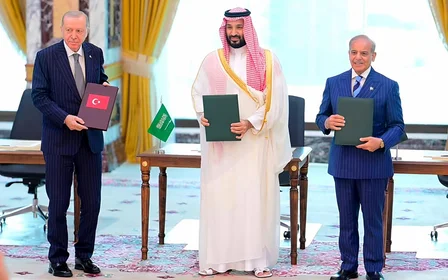
Pakistan says time has come to implement Mecca defence pact

Pakistan’s defence minister has said the time has come to implement the Mecca defence agreement with Saudi Arabia and Turkey as Houthi attacks on the kingdom intensify.
Speaking to Geo News on Wednesday, Khawaja Asif said Pakistan remained committed to defending Saudi Arabia and the holy cities of Mecca and Medina, adding that Islamabad had a duty to protect them even without the agreement.
“Makkah Agreement applies to us, and we will fulfil our duty,” said Asif without elaborating on what Pakistan may do.
Houthi officials have denied targeting the holy city.
"Our operations target its [Saudi] oil facilities and military bases, which are far removed from the sacred sites," Houthi spokesman Yahya Saree said.
New MEE newsletter: Jerusalem Dispatch
Sign up to get the latest insights and analysis on Israel-Palestine, alongside Turkey Unpacked and other MEE newsletters
Asif also said Pakistan had passed a Saudi message to Iran amid concern in Riyadh over the attacks.
“I don’t think Iran as a state will open another front,” Asif said, adding that they were already involved in a war in the region.
He said Pakistan would continue trying to prevent the conflict from spreading.
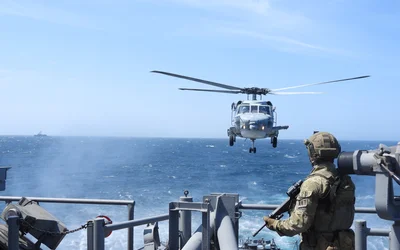
The comments came as Saudi state television reported that one person was killed and two others injured after the kingdom intercepted a drone in the southwestern governorate of Taif on Thursday. The person killed was a Yemeni resident.
Saudi Arabia’s civil defence said the Houthis launched the drone at Taif.
It was the first death announced in Saudi Arabia this month since the Houthis intensified attacks on the kingdom.
Pakistan has sought to position itself as a regional mediator after facilitating talks between Washington and Tehran, while also deepening its military ties with Saudi Arabia and Turkey.
On 7 August, the three countries signed the Joint Defence Agreement in Mecca, under which an attack on one member would be treated as an attack on all.
The pact immediately drew comparisons with Nato’s Article 5, although analysts cautioned against interpreting the provision too literally.
China has meanwhile privately pressed Iran to use its influence with the Houthis after Saudi Arabia appealed to Beijing over the attacks, Reuters reported, citing three Iranian sources.
Beijing has publicly called for restraint, dialogue and the restoration of safe navigation, but privately asked Tehran to help prevent further disruption to energy routes crucial to China.
The sources did not say how Beijing delivered the message or whether Chinese officials raised it during Iranian Foreign Minister Abbas Araghchi’s visit to China on Wednesday.
Tehran responded that peace and stability in the region depended on ending the US-Israeli war on Iran, according to the sources.
Middle East Eye delivers independent and unrivalled coverage and analysis of the Middle East, North Africa and beyond. To learn more about republishing this content and the associated fees, please fill out this form. More about MEE can be found here.