Palestine Action ban has made UK 'international outlier' warns UN rapporteur, court told

A UN official warned that Britain has become an "international outlier" by choosing to ban direct-action group Palestine Action, a court heard on Thursday.
Speaking on the second day of the judicial review into the UK's ban on Palestine Action, Adam Straw KC set out the intervention on behalf of UN Special Rapporteur Ben Saul.
Saul, who serves as the UN Special Rapporteur on Human Rights and Counter-Terrorism, criticised the UK's decision to ban Palestine Action and deemed it a "fundamental breach of human rights."
During proceedings, Adam Straw KC stated that responsible states have limited what they define as terrorism, and protest groups are not generally classified as terrorists, stating that Britain has become an "international outlier" as a consequence.
"There is a consensus, or emerging consensus, that this proscription was an unlawful interference in international law," said in court.
New MEE newsletter: Jerusalem Dispatch
Sign up to get the latest insights and analysis on Israel-Palestine, alongside Turkey Unpacked and other MEE newsletters
"There is also a consensus, or emerging consensus, that the definition of terrorism does not extend to serious damage to property."
Straw added that Saul's statement was endorsed by other UN Special Rapporteurs focusing on human rights, including Francesca Albanese and Gina Romero, and that proscription of groups as terrorist "that are not genuinely so" often occurs in authoritarian states.
"It is deeply concerning that such practices appear to have spread to a number of liberal democracies," Saul wrote in his witness statement.
"Organisations must never be listed as terrorist for engaging in protected speech or legitimate activities in defence of human rights."
Sally Rooney fears ban will impact UK sales
The court also heard a witness statement from Irish novelist Sally Rooney who said the ban on Palestine Action could stop her receiving royalties and lead to her books being withdrawn from sale due to her support for the group.
Rooney highlighted how the production company Element Pictures had expressed concern that paying her royalties from adaptations of her novels could be a crime.
She also said in her statement submitted to London's High Court that the law was unclear on whether her publishers, Faber & Faber, could pay her royalties on book sales, meaning "my existing works may have to be withdrawn from sale" in Britain.
"The disappearance of my work from bookshops would mark a truly extreme incursion by the state into the realm of artistic expression," she said in the statement.
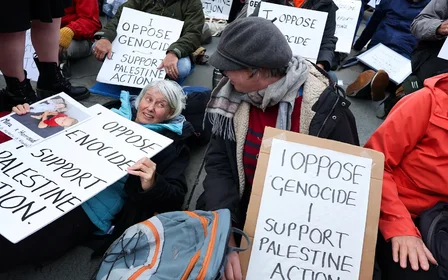
Since the ban on Palestine Action, more than 2,000 people have reportedly been arrested for holding signs that said: "I oppose genocide, I support Palestine Action." Within that figure, police said that at least 100 people were also arrested for holding up signs in support of Palestine Action.
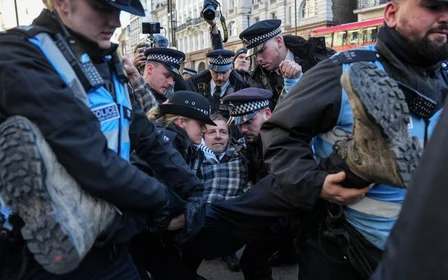
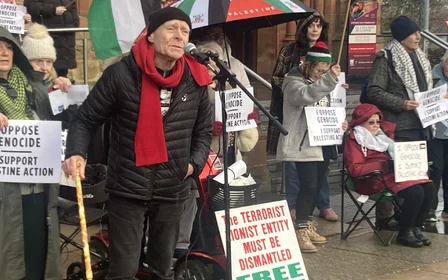
According to Defend Our Juries, police arrested approximately 140 protestors opposing the ban on Palestine Action outside the Royal Courts of Justice.
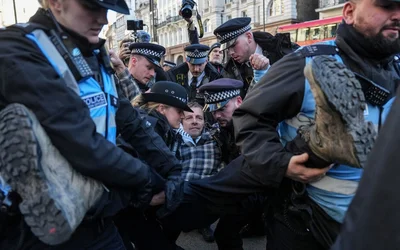
Officers could be seen carrying protestors from the court as police blocked off access to the road leading up to the High Court.
The government meanwhile contested claims made by lawyers representing Palestine Action co-founder Huda Ammori and said the group met the threshold needed to proscribe the direct-action group.
James Eadie KC, acting for the Home Office, told the court that the UK parliament is the ultimate authority to define terrorism.
“Parliament has decided what terrorism is, which includes serious damage to property, whether or not alongside it there is violence against people,” said Eadie.
Middle East Eye delivers independent and unrivalled coverage and analysis of the Middle East, North Africa and beyond. To learn more about republishing this content and the associated fees, please fill out this form. More about MEE can be found here.