
'We were scared to die': The West Bank workers hiding in bins to reach Israel

In April, around 70 Palestinian men climbed into the back of a rubbish truck, hoping to cross into Israel undetected and search for work.
Quickly discovered at a West Bank checkpoint, the men were left to languish under trash bags for over two hours in sweltering heat, before being pulled out and detained by Israeli soldiers.
Majd, a 37-year-old from Beit Furik, just south of Nablus, was one of the labourers crammed inside. He asked that his real name not be used.
“At the beginning when they stopped us, we were afraid to go to jail,” he told Middle East Eye. “Then when it took longer to get out, we were scared to die.”
The lengths Majd has gone to in order to find work – and provide for his family – are far from unique. In the immediate aftermath of 7 October 2023, Israel cancelled around 150,000 work permits. As savings have dried up, many Palestinians have had no choice but to sneak into Israel.
New MEE newsletter: Jerusalem Dispatch
Sign up to get the latest insights and analysis on Israel-Palestine, alongside Turkey Unpacked and other MEE newsletters
Permit revocations are only one of the drivers behind the West Bank's economic crisis, which has seen GDP contract by more than 20 percent.
While the current Israeli government has manufactured this collapse, controls imposed since the start of the occupation have left the territory uniquely exposed to such damage.
Wages initially rose at the start of the occupation, after Palestinians gained access to Israeli labour markets. But the following decades saw a phenomenon known as "de-development" take hold, as a stunted agricultural and industrial base emerged with little room to grow.
'We are talking about a system in which Israel is dominating, and imposing severe restrictions in order to control and manage the Palestinians'
- Walid Habbas, analyst
According to a UN report published in 1984, restrictions on agricultural and industrial production, import and export controls, and a lack of investment in the absence of a financial system left the West Bank economically dependent on Israel.
Such changes brought a "relative lack of opportunities for employment in the occupied territories, with consequent daily commuting to Israel by the Palestinian labour force," the report noted that s.
That commuting pool grew steadily, and by the 1980s a third of the Palestinian workforce was employed in Israel.
To control this flow of labour, a general exit permit was introduced in 1972. It allowed relatively easy movement between the occupied territories and Israel, as workers did not need case-by-case approval to enter.
The first major reform came in 1991, when the general system was scrapped and permits were individualised. Free movement, previously the default, now required specific authorisation.
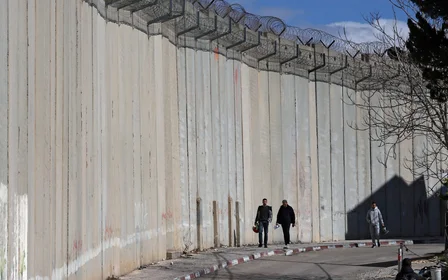
Speaking to Middle East Eye, Walid Habbas of the Palestinian Forum for Israeli Studies said this shift, coupled with the building of the separation wall from 2002, meant "the system became more effective in controlling the mobility, the labour force and the trade".
'I looked for jobs here [in the West Bank], and I couldn't find anything'
- Majd, Palestinian labourer
From the 1990s onwards, the authorities showed a willingness to weaponise the system, freezing permits after Palestinian-led attacks and during the Second Intifada (2000-2005).
During the Oslo era, Israel formalised its control over the economy through the Paris Protocol.
Under the agreement, it began collecting tariffs, purchase taxes and VAT on imports on behalf of the newly established Palestinian Authority.
These funds, known as clearance revenues, were meant to be transferred to the Palestinian treasury each month. But, as with the permit system, Israel has often used them as a lever against the West Bank, delaying or withholding payments.
For Habbas, treating the Palestinian economy as separate from Israel's is misleading. "We are talking about a system in which Israel is dominating, and imposing severe restrictions in order to control and manage the Palestinians," he said.
Accelerated collapse
In the months before 7 October, a fifth of the West Bank's labour force crossed into Israel for work.
Clearance revenue, another major component of the Palestinian economy, accounted for about 70 percent of the PA's total income. Immediately after the attack, the Israeli government pulled both levers, revoking all permits and withholding funds.
Misyef Misyef of the Palestine Economic Policy Research Institute said the sudden loss of both private wages and public revenue hit the entire West Bank, including those working inside the territory.

"The private sector is suffering and cannot sell their product because the purchasing power of the family is now very low," he told MEE.
Majd and his family are among the hundreds of thousands bearing the brunt of the closures.
Before the war, he had spent six years working in construction around Tel Aviv, earning between 7,000 and 8,000 shekels a month.
The work was gruelling – on the road by 3am and home only in the evening – but it came with insurance, and he was able to save about half of what he earned.
Through the first year of closures, those savings kept his family afloat. As the money ran out, the father of two twice jumped a wall near Jerusalem, staying in Israel for several weeks at a time to work illegally.
"I looked for jobs here, and I couldn't find anything," he said, adding that "when there is a pressure on you to provide, you have to think of a way."
Crossing without a permit was common before the war – an estimated 50,000 Palestinians worked without one – but it has become far more dangerous.
Alongside the arrests, around 50 men have been killed. Israel's national security minister, Itamar Ben Gvir, said the shooting of labourers was "starting to bring the numbers down".
For his third crossing, Majd chose the truck after being told it would be safer. "No one sees you, so at least you don't get shot," he said.
'There's no country that has 15 percent unemployment … in Palestine, we're now talking about 30 percent'
- Misyef Misyef of the Palestine Economic Policy Research Institute
Even so, Majd and the other labourers were arrested and held at a police station in a nearby settlement. Those without prior convictions, including him, were released the next day and made to walk home past settlements in the early morning.
Nearly three years on from the initial closures, the ban shows no sign of being lifted. Israel has restored about 7,000 permits in industries it deems critical, but the vast majority of Palestinians remain unable to work.
Misyef underlined how far the situation had deteriorated: "This has not happened in any economy anywhere in the world," emphasising that "there's no country that has 15 percent unemployment … in Palestine, we're now talking about 30 percent."
Such widespread joblessness has helped push the poverty rate to more than double its pre-war level, from 12 percent to 28 percent.
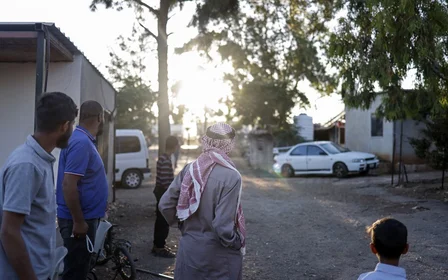
Today, Majd gets by on what little his father can spare, unsure whether he will risk the journey again. His children weigh most heavily on him.
"What's going to happen to them in the future? I am worried I am not able to provide what they need," he said.
His father walked by with a small herd of sheep – now the only source of income for a once financially comfortable family.
"I am depressed from everything that happened," he said. "I have become like a dead body."
Middle East Eye delivers independent and unrivalled coverage and analysis of the Middle East, North Africa and beyond. To learn more about republishing this content and the associated fees, please fill out this form. More about MEE can be found here.