Palestinian killed during settler attack on olive farmers in West Bank

A Palestinian man was killed and nine others wounded on Wednesday in an attack by Israeli settlers on farmers near the occupied West Bank town of Burqa.
According to the Palestinian Ministry of Health, 44-year-old Ali Hassan al-Bazari was killed as farmers attempted to harvest olives on their land between Burqa and the Ramin Plain, east of Tulkarm.
Witnesses said Israeli soldiers were present and protected the settlers during the attack. It was not immediately clear whether al-Bazari was killed by settler or army fire.
The ministry said nine Palestinians sustained injuries of varying severity, including one person who was critically wounded.
Some of the injured were taken to Thabet Thabet Government Hospital in Tulkarm, while others were transported to Rafidia Hospital in Nablus. A woman was among those wounded.
New MEE newsletter: Jerusalem Dispatch
Sign up to get the latest insights and analysis on Israel-Palestine, alongside Turkey Unpacked and other MEE newsletters
The Ministry of Health said the Israeli army also assaulted ambulance crews near the Burqa Plain as they attempted to reach and evacuate the wounded from the Ramin Plain.
Soldiers detained three paramedics and a volunteer, confiscated their ambulance keys and later released them, ordering them to leave the area.
Shadi Abu Omar, a member of the Burqa Village Council, said the area where the attack took place is classified as Area B of the West Bank and is far from any Israeli settlements or settler outposts.
Under the Oslo Accords, civil affairs in Area B are administered by the Palestinian Authority.
Abu Omar said residents had gone to the area to harvest olives and were not expecting to encounter settlers.
'Settlers approached the harvesters, began beating them and then bound them'
- Shadi Abu Omar, member of Burqa Village Council
However, he said, a group of settlers arrived in a vehicle and opened fire on them.
"After the shooting, the settlers approached the harvesters, began beating them and then bound them," he told Middle East Eye.
"Among them was al-Bazari, who had been shot in the back. Despite bleeding from the wound, he, along with the other injured people, including a woman, was tied up."
According to Abu Omar, the wounded lay bleeding for three hours because soldiers prevented ambulances from reaching them, assaulted medics and detained several of them.
He said the attack took place in the presence of the Israeli army, which did not intervene to drive the settlers away.
The settlers also blocked ambulance crews from reaching several of the wounded, threatening to shoot anyone who approached the scene and preventing their evacuation to hospital.
Settler violence
The attack comes amid a surge in settler violence against Palestinians, particularly farmers, during the olive harvest season.
According to the UN Office for the Coordination of Humanitarian Affairs (Ocha), more than 1,100 Palestinians were injured in settler-related attacks between the beginning of the year and early September. More than 1,000 of those injuries were directly attributed to settlers.
Ocha data shows a sharp rise in injuries directly caused by settler attacks in recent years: from an average of one Palestinian injured every three days in 2020, to two a day in 2025 and more than three a day in 2026.
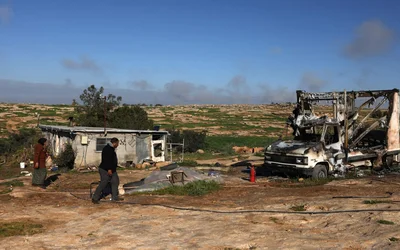
The UN has also documented more than 1,300 incidents linked to settler attacks since the start of the year, affecting around 250 Palestinian communities across the West Bank. That amounts to more than six incidents a day.
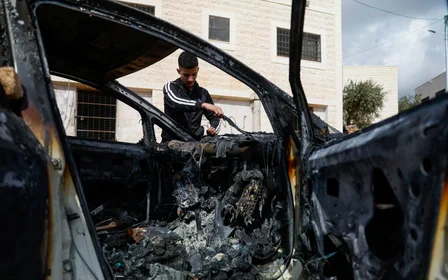
The incidents have included physical assaults, the burning and damaging of homes and vehicles, vandalism of property and farmland, and attacks on Palestinians attempting to reach their land.
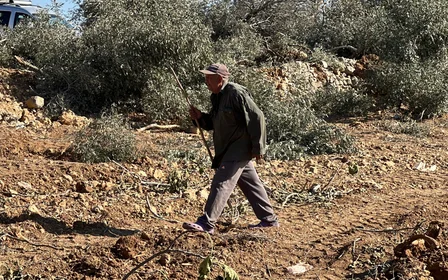
Attacks during the olive harvest are particularly significant. Ocha has identified access to agricultural land and livelihoods as a major context for settler violence, documenting injuries to farmers and the destruction of hundreds of olive trees and agricultural property across several towns.
Salah al-Khawaja, director at the central office of the Wall and Settlement Resistance Commission, said settlers in the West Bank increasingly act with impunity.
He said settlers were carrying out killings in front of the media, shooting at farmers and burning farmland.
"We are facing a government that supports terrorism and criminality, providing full backing to settlers because it is a terrorist government," he said.
Middle East Eye delivers independent and unrivalled coverage and analysis of the Middle East, North Africa and beyond. To learn more about republishing this content and the associated fees, please fill out this form. More about MEE can be found here.