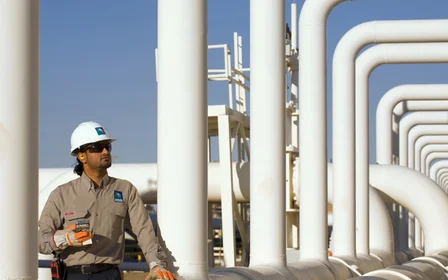
Saudi Arabia cancels oil shipments to European refineries

Saudi Arabia has informed at least two oil refining customers in Europe that they will not receive crude oil allocations in October, as the war in the Middle East hits global energy markets.
European refineries buy Saudi Arabian crude under term contracts meant to ensure a standard monthly supply, but energy companies can cancel those shipments under extraordinary circumstances, known as force majeure.
Earlier this month, Qatar extended its force majeure for liquefied natural gas shipments to early November because of the maritime blockade of the Strait of Hormuz.
Saudi Arabia appeared more insulated from the conflict because of its East-West Pipeline, which runs from the Gulf to the Red Sea port of Yanbu, allowing the kingdom to bypass Iran and the US’s tussle for control of the Strait of Hormuz. The pipeline allowed Saudi Arabia to export approximately two-thirds of its pre-war oil volumes, or around four million barrels per day (bpd) of oil.
Last week, a drone attack disabled the pipeline, which Saudi Arabia said came from Iraq, where militias are aligned with Iran. The Houthis have also claimed attacks on the port of Yanbu and other Aramco oil facilities.
New MEE newsletter: Jerusalem Dispatch
Sign up to get the latest insights and analysis on Israel-Palestine, alongside Turkey Unpacked and other MEE newsletters
The price of Brent, the international benchmark, has risen since the Houthis launched an offensive in Yemen, putting them in control of the country’s Red Sea coastline. At the same time, they have targeted Saudi Arabia with drones and missiles, as the kingdom launches strikes on their territory.
Brent was trading at $103 per barrel on Friday, but energy analysts say that price doesn’t reflect the physical cost to purchase barrels of oil, and the price for refined products, like diesel and jet fuel, is even higher.
In the US, which is more insulated from the war as a result of its domestic energy industry, the price of diesel was up 7.7 percent in the last week.
Saudi Arabia began rerouting its oil shipments through the Suez Mediterranean Pipeline after the Houthis declared an embargo against the kingdom’s shipping.
Saudi Arabia led a coalition of Arab states trying to oust the Houthis from power after they conquered a vast swath of northwestern Yemen a decade ago. In 2022, the kingdom’s Yemeni allies, the internationally recognised government, signed a ceasefire with the Houthis and Saudi Arabia tried to extricate itself from the war.
But the kingdom has maintained an air and sea blockade against Houthi ports and airports. The group says they want the blockade lifted in order to end their embargo on Saudi Arabia.
Middle East Eye delivers independent and unrivalled coverage and analysis of the Middle East, North Africa and beyond. To learn more about republishing this content and the associated fees, please fill out this form. More about MEE can be found here.