She was told her missing fiance was killed in Gaza. A year later, he returned alive

For around a year, Hamada al-Banna was missing after he set out to obtain a sack of wheat flour from humanitarian aid trucks near Zikim in northern Gaza.
His family did not know his whereabouts or whether he was still alive or had been killed alongside his brother, who was with him that day.
As his family began to lose hope, his fiancee, Reem Jadallah, held on to the last remaining possibility. She sold her gold to hire a lawyer to find out whether he was being held in Israeli prisons.
But the news she finally received was the one she had spent months fearing: that Banna had been killed under torture.
Months later, Banna called his family and told them he was alive.
New MEE newsletter: Jerusalem Dispatch
Sign up to get the latest insights and analysis on Israel-Palestine, alongside Turkey Unpacked and other MEE newsletters
The 23-year-old was released from Israeli detention on Sunday after being forcibly disappeared for around a year in Israeli custody.
Disappeared and tortured
Speaking to Middle East Eye, Banna said: “On that day, I had gone to the Zikim area with my brother Adham, it was 9 August 2025. We used to go there during starvation to try to get flour. But after I managed to get back, my friends told me that my brother was killed.
“I dropped the sack of flour and went looking for him. I moved towards an area that appeared to be close to where the Israeli army was stationed, but I didn’t realise that at the time.”
The Israeli military fired a shell towards Banna, leaving him unconscious.
“A huge explosion hurled me about ten metres through the air before I hit the ground. I was wounded in my leg and chest, and after that I remember nothing,” Banna said.
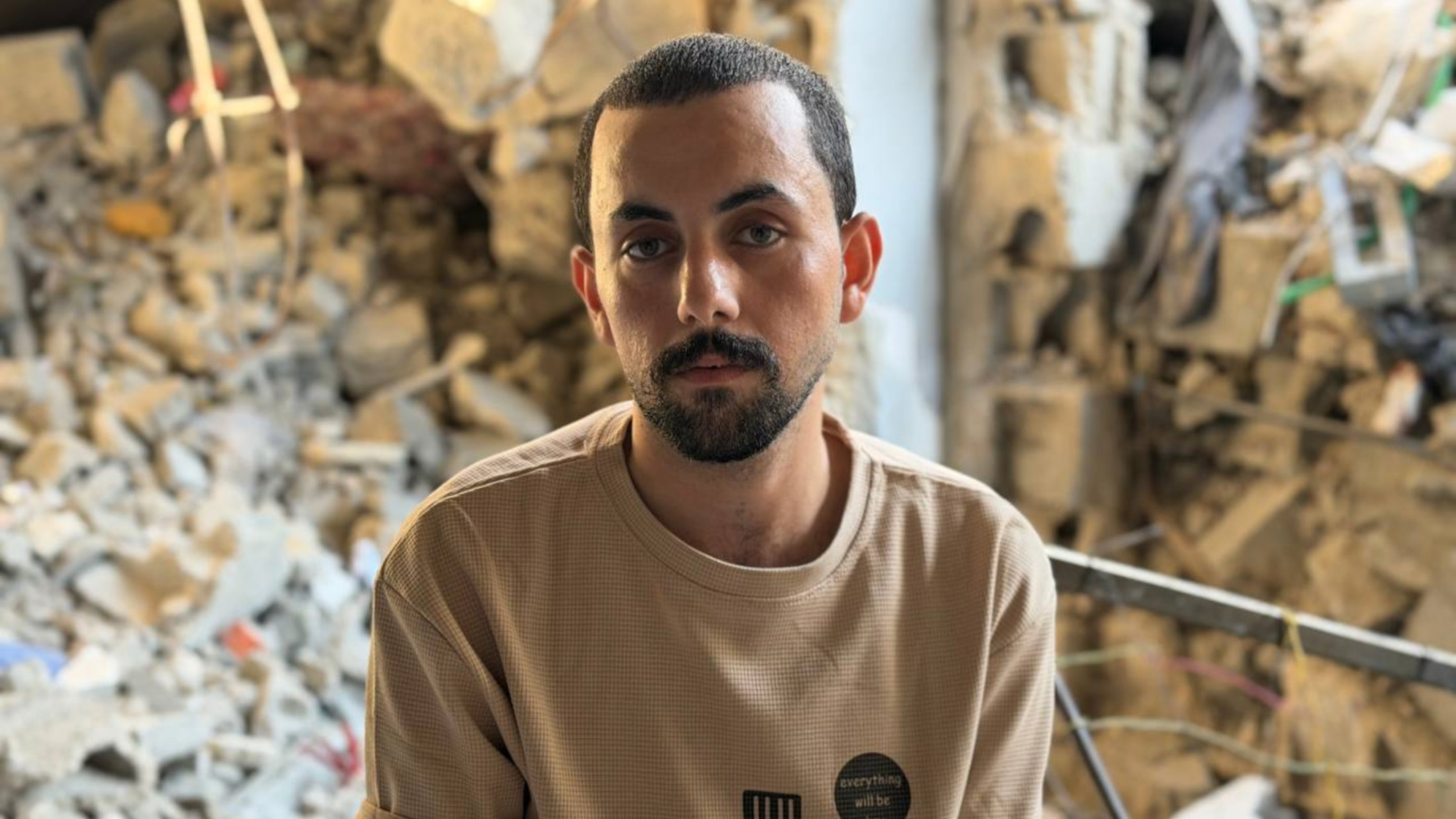

“Later, I learned that I had been in a coma for six months. I woke up in Israel's Soroka Hospital suffering from memory loss. I didn’t know who I was or why I was there.”
Doctors and officers told Banna what had happened, and gradually his memory returned.
“Once I became fully aware of my surroundings, a soldier came to speak to me. He began provoking me and hurling obscene insults at my mother. I couldn’t tolerate it, so I threw my IV fluid bag at him,” Banna recalled.
The soldier violently assaulted him before the Israeli military transferred him to the notorious Sde Teiman prison.
There, Banna spent another four months in solitary confinement, during which he was subjected to various forms of torture.
“They would suddenly enter my cell and beat me brutally for no reason. They sprayed me with pepper spray, beat my genitals, and threw stun grenades into my cell,” he said. “On one occasion, for six full days, they kept me in the disco room.”
“Disco rooms” are known among Palestinians detainees as spaces in Israeli prisons designed to break down their mental and physical resilience through prolonged exposure to deafening noise and music, causing severe sleep deprivation, confusion, and psychological distress, particularly before or during interrogation sessions.
'They sprayed me with pepper spray, beat my genitals, and threw stun grenades into my cell. On one occasion, for six full days, they kept me in the disco room'
- Hamad al-Banna
Banna was later removed from solitary confinement and transferred to another section of Sde Teiman prison.
By then, his family had already been informed that he had been killed under torture.
Yet his fiancee refused to stop searching for answers.
“I couldn’t believe he was killed. I kept waiting for him since the day he disappeared,” Jadallah, 18, told MEE.
“He used to go to Zikim to try to bring back food, then come and visit me afterwards. That day, I waited for him as usual, but he never came. Later, his family told me that he was missing.”
Originally from northern Gaza, the couple first met after both their families were displaced to the same area in Gaza City.
As Israeli attacks intensified around them, Banna asked Jadallah to stay by his side and proposed to her.
“After he went missing, we began a long search. I looked through hospitals, asked his friends about him, and searched everywhere, but there was no trace of him,” Jadallah said.
Banna was listed as a missing person, a term that has become increasingly common since the beginning of Israel's genocide in Gaza on 7 October 2023.
According to the Palestinian Centre for the Missing and the Forcibly Disappeared (PCMFD), around 8,000 Palestinians, including approximately 2,900 children, have been reported missing across the Gaza Strip since 2023.
Most are believed to have been killed and remain buried beneath the rubble.
However, hundreds are believed to have been detained by the Israeli military during ground incursions, at checkpoints, or while Palestinians were attempting to reach humanitarian aid near areas where Israeli forces were present, particularly in eastern Gaza.
‘Not the same person’
“There was a possibility that the Israeli army had detained him, so we contacted HaMoked, an Israeli legal aid organisation. They told us that he was being held in an Israeli prison but that they had no further information about his condition or even his exact whereabouts,” Jadallah recounted.
“They said we would need to appoint a lawyer to obtain more details.”
'Everyone kept telling me to give up hope, but I never did. Deep inside, I always felt that he was still alive'
- Reem Jadallah
Since the beginning of the genocide in Gaza, Israeli authorities have withheld information about the fate and whereabouts of detained Palestinians and refused requests from international organisations, including International Committee of the Red Cross (ICRC), for information on their locations.
However, some families were able to obtain limited information about the fate of their loved ones held in Israeli prisons through lawyers in Israel and the occupied territories.
But while Banna’s family and in-laws were unable to afford legal representation, his fiancee refused to give up.
“I sold all my gold so we could hire a lawyer,” she said. “Some time later, the lawyer told us there was still no information about him. Then he returned with a list of names of people who had been declared dead and told us that Hamada had been killed under torture in prison. That was around February 2025.
“At this point, his family stopped searching for him, and all efforts to find him came to an end, except mine. I never stopped.”
Jadallah continued searching for him on her own. She went from one hospital to another, searching among the bodies whenever new victims were brought in.
Whenever she heard that detainees had been released, she would take Banna's photograph and go to meet them, showing them his picture and asking whether they had seen him or knew anything about his fate.
“No one ever told me they had, because he had spent most of his detention in hospital and then in solitary confinement. Everyone kept telling me to give up hope, but I never did. Deep inside, I always felt that he was still alive,” Jadallah said.
On 7 July, the ICRC called the Banna family. Hamada was on the line, using a Red Cross phone to tell them that he was alive and had been released.
"When his family called to tell me, I was in complete shock. I started laughing. I said, 'I don't understand. What do you mean?” Jadallah said.
“I couldn't believe it. I was afraid to believe it because I thought it might be another false piece of news. I didn't truly believe it until I saw his photograph with the released prisoners.”
Jadallah got dressed and rushed to meet her fiance.
“When I arrived, he was asking everyone around him, ‘Bring me my fiancée,’” she recalled with a smile.
But while Jadallah believed her long and exhausting search had finally come to an end, she soon realised it was only the beginning of a different ordeal.
“The Hamada who came out of prison was not the same person I had been waiting for all this time,” she said.
“I noticed how much he had changed. Sometimes, in the middle of a conversation, he suddenly stares into space and begins reliving memories of his detention. He has become irritable, and even the slightest sound bothers him.”
She added that the effects of his imprisonment continue to shape his daily life.
“Since his release, he has not slept lying down like the rest of us. He sleeps sitting upright because that is how he was forced to sleep in prison. He barely eats, taking only very small portions of food because that is what he became accustomed to in detention.”
The couple had been due to marry shortly before Banna disappeared. Now, Jadallah says their wedding has been postponed indefinitely.
“We simply cannot afford it anymore. We lost everything we had prepared for our marriage. We had furnished the home where we were going to live in together, and I had bought everything I needed for our new life. It’s all gone,” she said.
“But none of that matters to me now. I lost everything, but I got him back. That is what matters most.”
Middle East Eye delivers independent and unrivalled coverage and analysis of the Middle East, North Africa and beyond. To learn more about republishing this content and the associated fees, please fill out this form. More about MEE can be found here.