
Sudan's Heglig: Why the oil field taken by the RSF matters

Sudan’s Rapid Support Forces (RSF) captured the country’s largest oil field on Monday, as the paramilitary group continues to gain ground from the Sudanese Armed Forces (SAF) in the strategic, resource-rich south.
Heglig, a small town that sits in the Muglad Basin on the border between Sudan’s South Kordofan state and South Sudan’s Unity State, hosts some of Sudan’s most important oil fields and key infrastructure, including about 75 wells, as well as tanks and processing stations.
It is a crucial stop on the approximately 1,600km-long Greater Nile Oil Pipeline, which runs from the Unity oil field in South Sudan to Port Sudan, where the oil is exported to the international market.
The stretch of pipeline that runs through West Kordofan to the vicinity of el-Obeid, the SAF-held state capital of North Kordofan, is now under the control of the RSF, which has brought engineers with it to Heglig.
“The liberation of the Heglig oil region is a pivotal point in the liberation of the entire homeland, given the region's economic importance,” the RSF said.
New MEE newsletter: Jerusalem Dispatch
Sign up to get the latest insights and analysis on Israel-Palestine, alongside Turkey Unpacked and other MEE newsletters
Emadeddin Badi, the author of a recent report on Sudan’s war economy, told Middle East Eye: “Militarily, the fall of West Kordofan opens a corridor towards el-Obeid, and ultimately a pathway back to Omdurman and Khartoum."
"This is the RSF’s strategic aim, and one the UAE is facilitating by ensuring supplies and financial backing,” he added.
The UAE denies that it supports the RSF, despite mounting evidence reported by MEE, the United Nations and others throughout the Sudan war.
“Economically, Heglig is a critical transfer node, while el-Obeid hosts a major refinery. Securing both would give the RSF an additional revenue stream and further entrench its wartime economy,” Badi said.
RSF advances across southern Sudan
At the end of October, the RSF captured el-Fasher, the army’s last holdout in the vast western region of Darfur, after a siege of over 500 days.
Victims and eyewitnesses told MEE that the paramilitary fighters raped and executed civilians in large numbers.
Since then, it has - with the support of the Sudan People's Liberation Movement-North (SPLM-N) faction led by Abdelaziz al-Hilu - turned its attention to Kordofan, which neighbours Darfur and is rich in gold and oil, both resources exported to the UAE.
'With Heglig now in RSF hands, the UAE will seek to maximise the political, military and economic leverage this creates'
- Emadeddin Badi, conflict analyst
With the SAF divisions in the region isolated and support from Turkey and Egypt failing to transform the fighting fortunes of its soldiers on the ground, the RSF has enjoyed a string of victories.
Earlier this month, it took Babanusa, the headquarters of the SAF’s 22nd infantry division.
The capture of Heglig means the RSF now controls the whole of West Kordofan and a vital part of the Sudanese and South Sudanese economy.
“With Heglig now in RSF hands, the UAE will seek to maximise the political, military and economic leverage this creates,” Badi said.
On Tuesday, the paramilitaries began targeting Um Rawaba in North Kordofan with drones. The key city had been recaptured by the army in January.
The RSF also has its sights set on the strategically vital city of el-Obeid, where there is an oil refinery and where the SAF’s fifth infantry division has been heavily reinforced.
El-Obeid sits on the road from Darfur to Khartoum, which the RSF’s chief, Mohamed Hamdan Dagalo, has not given up retaking.
A western military analyst, who asked to remain anonymous for security reasons, told MEE that they also expected to see the RSF take more of the border region with South Sudan from SAF, particularly around South Sudan’s Upper Nile state.
“The trajectory is obvious,” Badi said, “a deeper push through Kordofan and a systematic seizure of nodes tied to Sudan’s oil economy.”
SAF withdrawal from Heglig
Military sources told Middle East Eye that the SAF’s 90th infantry brigade withdrew from Heglig and its oil fields after striking an agreement with leaders from the local Messiria group and South Sudan’s army, the South Sudan People’s Defence Forces (SSPDF).
'I suspect that South Sudanese officials are divided on whether to support the RSF'
- Jihad Mashamoun, Sudanese analyst
The 90th infantry brigade and the SSPDF previously worked together to secure the oil fields that straddle the border between Sudan and South Sudan.
These are vital to landlocked South Sudan’s economy, which is almost entirely reliant on oil and the pipeline that leads to Port Sudan.
South Sudanese television broadcast footage of South Sudanese soldiers with RSF fighters in Heglig, but MEE understands that faced with advancing Rapid Support Forces, the SSPDF had little choice but to facilitate the departure of the Sudanese army and welcome in the RSF.
“I suspect that South Sudanese officials are divided on whether to support the RSF,” Jihad Mashamoun, a Sudanese analyst on Sudan and Horn of Africa affairs, told MEE.
“One reason is that the government might be beholden to the UAE’s control of the RSF in terms of ensuring the RSF does not attack the oil pipelines,” he said, pointing also to a $12bn “loan deal” struck between South Sudan and a junior member of Abu Dhabi’s ruling Al Nayhan family.
Oil in Sudan and South Sudan
In April 2023, just as the war between the RSF and the SAF broke out, data from S&P Global Commodities at Sea showed that 130,400 bpd of crude was shipped from Port Sudan’s Bashayer terminal to the UAE and Malaysia.
At the same time, Heglig itself produced about 40,000 bpd and processed some 130,000 bpd of South Sudanese crude, according to government data. It was the main processing facility for South Sudan’s oil exports.

 Earlier this year, a UN panel of experts reported that South Sudan’s oil exports had fallen by 70 percent, and before its capture, operations at Heglig were regularly disrupted by RSF drone strikes, which in November forced the South Sudanese government to shut the field and reduce its capacity.
On Monday, an engineer at Heglig confirmed to AFP that the RSF had taken over the facility and said the team had “shut it down and halted production, and the workers were evacuated to South Sudan”.
“The processing plant near the field through which South Sudanese oil passes was also shut down,” the engineer said.
One source briefed by RSF commanders told MEE that the paramilitary group wants a greater cut of the revenue from Heglig’s oil. In the past, the SAF and RSF have struck resource revenue-sharing agreements.
At the same time, sources briefed on the plans told MEE that businessmen connected to the RSF in Darfur want to take oil from Heglig and elsewhere in Kordofan and East Darfur, put it into container trucks and drive it overland to be refined outside Sudan.
The RSF controls major oil fields in Darfur operated since the 1990s by China before being forced to shut early in the war. Last month, the China National Petroleum Corporation informed Sudan it would end its investments there.
Split Sudan
The RSF’s control of Darfur and its gains in Kordofan mean that Sudan is now effectively split in two, with the army holding the north, east and centre, and the RSF in control of the west and, with the help of its allies, swathes of the south.
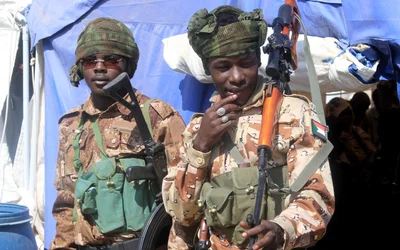
The situation raises, once again, the prospect that Sudan will, like Libya, split in two.
Mashamoun said he did not think this was likely to happen yet. “That is because Libya is split down the middle with each side having seashores,” he said. In Sudan, the Red Sea coast is effectively controlled by Sudan's army-backed government and its allies.
“The RSF has a lack of bureaucracy compared to Haftar in Libya, while General Abdel Fattah al-Burhan and his de facto Sudanese government has the bureaucracy of a state.”
Badi sees clear parallels between the way the UAE-backed RSF operates and the way eastern Libyan commander Khalifa Haftar, another Emirati ally, works.
“The parallel with Haftar in Libya is clear. Politically, his UAE-enabled control of Libya’s oil crescent became a decisive bargaining chip, with shutdowns used to force concessions,” he said.
“The RSF can now replicate a similar model. Economically, both cases involve leveraging oil infrastructure to underwrite military operations and negotiate from a position of strength.”
Middle East Eye delivers independent and unrivalled coverage and analysis of the Middle East, North Africa and beyond. To learn more about republishing this content and the associated fees, please fill out this form. More about MEE can be found here.