Major report urges overhaul of Prevent and narrower terror definition

A major review has found that British counterterror laws are being used too widely, highlighting the recent ban on Palestine Action, and has recommended an overhaul of the Prevent counter-extremism programme.
The Independent Commission on UK Counter-Terrorism Law, Policy and Practice has completed a three-year review led by Sir Declan Morgan, former lord chief justice of Northern Ireland, and 14 commissioners.
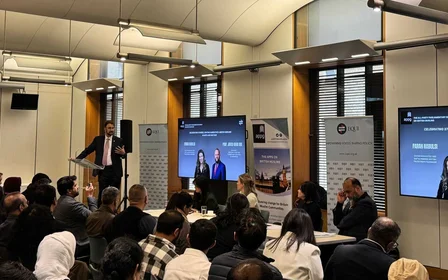
Its report, launched on Tuesday at an event hosted by the Royal United Services Institute (RUSI) in Westminster, calls for the UK's definition of terrorism to be tightened.
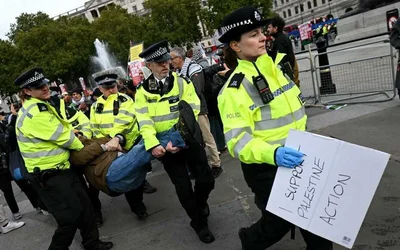
It is a significant intervention following the recent ban on direct action group Palestine Action (PA) as a terror group, which has led to the arrest of almost 2,000 protesters under the Terrorism Act at demonstrations against the ban.
Jonathan Hall, the government's independent reviewer of terrorism legislation, told MEE at the report's launch: "This is a far reaching and impressive document that is not full of wafty generalities but shows a real commitment to making practical recommendations."
New MEE newsletter: Jerusalem Dispatch
Sign up to get the latest insights and analysis on Israel-Palestine, alongside Turkey Unpacked and other MEE newsletters
The report says that proscriptions should only be used to protect the public from terrorism - and should end after five years unless the government renews them.
It notes that existing counterterror laws "can create confusion, deter lawful civic engagement, and strain relations with communities connected to affected organisations - particularly where banned groups also pursue political objectives".
"Palestine Action is the first organisation to be proscribed mainly for serious damage to property and the first proscribed direction action group."
The report further highlights what it calls "limits to parliamentary oversight of proscription", noting that the "order proscribing Palestine Action included two other groups, the Maniacs Murder Cult and the Russian Imperial Movement.
"Parliamentarians could not oppose the proscription of Palestine Action while supporting the proscription of the other groups."
At the launch, former attorney general and Conservative politician Dominic Grieve would not be drawn on whether its recommendations would lead to the de-proscription of PA if implemented.
"I can't say because I haven't seen all the most relevant material," he said.
But Grieve added that "any decision to proscribe is both a legal and political one".
The commission has further advocated an overhaul of Prevent, concluding that the counter-extremism programme is not fit for purpose.
A staggering 90 percent of the 58,000 people reported to Prevent since 2015 were ultimately judged not to be counterterrorism concerns.
And new Prevent data from the past year released last week revealed that a significant nine percent of people referred to the programme were considered suicide risks.
RUSI's acting director of terrorism and conflict studies, Dr Jessica White, told MEE: "It is not easy to define the boundaries of violent extremism from other forms of violence and hate that can incite acts of terrorism, especially in the blurred reality of today's on/offline existence.
"This makes it more important than ever, as the findings note, that we ensure Prevent efforts are understanding and responding to the communities they serve, especially the identity factors such as gender, race and religion that are being weaponised to radicalise and incite violence."
The commission's chair, Morgan, said at the report's launch that the "premise underlying" Prevent is wrong, saying the policy "should focus on those who pose a significant risk to public security".
The report itself says Prevent "rests on the assumption that individuals at risk of committing terrorist acts can be identified through observable indicators - an assumption not consistently supported by empirical evidence."
It adds: "Prevent referrals increasingly involve individuals experiencing complex vulnerabilities, including mental ill health, social isolation, or neurodivergence, rather than clear terrorism-related risks.
"This shift has blurred Prevent’s purpose and stretched its remit beyond its original aim."
The report recommends that Prevent should become "one part of a broader, locally led safeguarding framework capable of addressing diverse forms of vulnerability and violence.
"Multi-agency safeguarding hubs, modelled on existing local authority approaches in violence reduction and public health, could deliver proportionate early intervention while allowing Prevent to focus specifically on terrorism-related concerns".
'An important step'
John Holmwood, emeritus professor of sociology at the University of Nottingham and co-author of the People's Review of Prevent, told Middle East Eye that the proposals are an "important step in 'de-securitising' schools and services for young people".
He added: "We should be very concerned that a Prevent referral may itself cause harm. The recent release of Prevent data shows that nine percent of referrals are at risk of suicide and a further five percent at risk of self-harm.
"Taken together this is similar to the number deemed at risk of radicalisation."
Prevent has come under scrutiny over the recent case of Axel Rudakubana, who pleaded guilty to murdering three young girls in the English town of Southport last year.
Rudakubana, who was 17 at the time of the attack, was first referred to Prevent in 2019 when he was 13 years old, and on two further occasions in 2021.
The commission's report notes that a Home Office internal review found that after Rudakubana was reported to Prevent, there was "no clear evidence of ideology" found and he was considered not at risk of radicalisation.
This meant he was not referred to Channel, the government's anti-radicalisation programme.
Government guidance after the Southport killings has led to a "surge in referrals" to Channel, with many cases involving "increasingly young people with multiple complex needs with no ideology present",
A "lack of funding for other violence prevention interventions" means these cases are sent to Channel, which has the most funding and resources.
The report says this means Channel could be overwhelmed by cases and may "miss instances of individuals being drawn to terrorist violence".
Criticising the logic behind the current operation of Prevent, the report says the policy is "picking up many people who may be a risk to themselves or others and need support, but few are terrorism-related".
It adds that "providing support through a counterterrorism programme is problematic given the serious concerns about Prevent, its effectiveness and its impact on those targeted".
Middle East Eye delivers independent and unrivalled coverage and analysis of the Middle East, North Africa and beyond. To learn more about republishing this content and the associated fees, please fill out this form. More about MEE can be found here.