
New agreement sees dissolution of Kurdish-led Syrian Democratic Forces

The Kurdish-led Syrian Democratic Forces (SDF) have announced their dissolution in Syria as part of an agreement with the interim government.
The SDF, formed out of a number of Kurdish and Arab organisations in 2015 to fight the Islamic State group, announced the move on Tuesday in a televised statement.
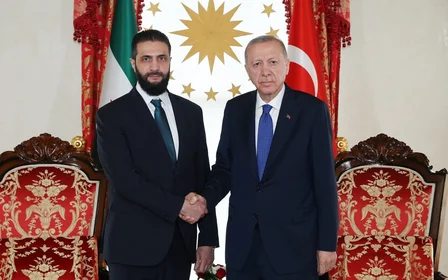
Following a meeting with interim President Ahmed al-Sharra, SDF commander-in-chief Mazloum Abdi said the organisation had completed its mission and would integrate with the national military forces.
"We want this day to mark a real transition: from the battlefield to the field of development, from the era of arms to the era of peace, and from defending Syria to building Syria," he said.
The two sides originally agreed on integrating their forces on 29 January. However, disputes over the terms led to violent clashes and a stalling of the process.
New MEE newsletter: Jerusalem Dispatch
Sign up to get the latest insights and analysis on Israel-Palestine, alongside Turkey Unpacked and other MEE newsletters
Syrian outlet Al-Majalla on Wednesday posted what it said were the terms of the agreement between Abdi and Sharaa over the SDF's dissolution.
Among the stipulations were national recognition of the Kurdish language and "theoretical" subjects taught in Kurdish in schools.
They also said the Women’s Protection Units (YPJ), an all-female armed brigade within the SDF, would join the Ministry of Interior as part of an internal security and counterterrorism force.
Middle East Eye contacted the Syrian Ministry of Information for confirmation of the details of the agreement, but received no response by the time of publication.
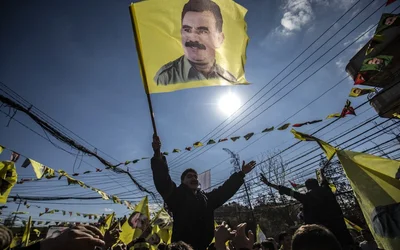
A number of Syria's regional neighbours hailed the move, including both Saudi Arabia and Turkey, which long regarded the SDF as a terrorist organisation due to their links to the Kurdistan Workers Party (PKK).
"At this stage, the dissolution of the SDF represents an important step forward in strengthening state authority across the country and uniting the various segments of society," said Burhanettin Duran, the Turkish presidency's communications director, on X.
"It is essential for establishing lasting stability that the Syrian administration continues to adopt an inclusive approach."
Since the overthrow of President Bashar al-Assad in December 2024, Sharaa's interim government has struggled to pull together a fractured and war-torn nation.
Thousands have been killed in violent clashes between members of Syria's minority groups - including Alawis, Druze and Kurds - and armed groups and security forces.
The SDF controlled vast swathes of the north of Syria at its peak, particularly driving out IS forces with the aid of US air strikes.
Following Assad's overthrow, however, the US dropped its backing for the SDF in favour of the new authorities in Damascus, who also captured much of the organisation's territory.
Middle East Eye delivers independent and unrivalled coverage and analysis of the Middle East, North Africa and beyond. To learn more about republishing this content and the associated fees, please fill out this form. More about MEE can be found here.