Syrian foreign minister's visit to Lebanon opens cautious channel to Hezbollah

Syrian Foreign Minister Asaad al-Shaibani's second official visit to Lebanon carried a significance that went well beyond the formal meetings on his schedule.
Unlike his first trip to Beirut following the fall of Bashar al-Assad, this visit included a meeting with Parliament Speaker Nabih Berri, the leader of the Amal Movement and Hezbollah's closest political ally.
The meeting came after a series of controversial statements by US President Donald Trump suggesting that Syria could be asked to "take care of" Hezbollah, and amid growing pressure on Damascus to assume a role in confronting the Lebanese group.
For Beirut, the visit offered additional reassurance that Syria's new administration did not intend to respond to that pressure by intervening militarily in Lebanon.
For Damascus, it provided an opportunity to explain the extent of the pressure it faces, while signalling that Hezbollah could help prevent further escalation by addressing tensions along the Lebanese-Syrian border.
New MEE newsletter: Jerusalem Dispatch
Sign up to get the latest insights and analysis on Israel-Palestine, alongside Turkey Unpacked and other MEE newsletters
A senior Lebanese official who met Shaibani during the visit told Middle East Eye that the trip had been coordinated with the Lebanese side to send a clearer message about Syria's intentions.
"The visit was very much needed to reassure Lebanon and ease concerns about the possibility of a military intervention pushed by the United States," the official said.
"[Syrian] President Ahmed al-Sharaa's reassuring message during his television interview was a positive sign, but the foreign minister's visit sent a stronger message that the new Syrian administration poses no threat to the Lebanese state or its sovereignty."
Berri brought into the dialogue
Shaibani's meeting with Berri marked a notable departure from his previous visit, when the speaker was not included in the official programme.
Berri has long maintained close ties with Damascus, including during the rule of Assad. Although he opposed Hezbollah's military intervention in the Syrian war, his position as the leader of Lebanon's principal Shia political movement and Hezbollah's most important domestic ally makes him a natural intermediary between the group and Syria's new leadership.
'If the national interest requires meeting with Hezbollah, we are open to doing so'
- Syrian Foreign Minister Asaad al-Shaibani
It was therefore significant that Shaibani chose Berri's headquarters to make one of his clearest public statements concerning Hezbollah.
Asked about Syria's position towards the group, the Syrian foreign minister said: "If the national interest requires meeting with Hezbollah, we are open to doing so."
The statement followed similar remarks by Sharaa, who said Syria was prepared to communicate with all Lebanese parties, including Hezbollah, if dialogue served the interests of both countries.
The public signals from Damascus have been accompanied by a gradual softening in Hezbollah's own language towards Syria's new authorities.
Hezbollah Secretary-General Naim Qassem has repeatedly called for opening a new page in relations with Damascus.
Senior Hezbollah official Nawaf Moussawi has also publicly referred to the Syrian president as "Brother Ahmed al-Sharaa", a striking shift from the group's earlier treatment of the man previously known as Abu Mohammed al-Jolani, the nom de guerre he used while leading his al-Qaeda offshoot, Hay'at Tahrir al-Sham.
A senior Hezbollah official told MEE that the situation had now matured to the point where there was no longer a reason to delay direct contact.
"What is needed now is the initiative," the official said. "There is an opportunity for the relationship to be strengthened and organised."
The official suggested that Turkey, which maintains a close relationship with the Syrian administration, could play a role in arranging an initial meeting.
Pressure from Washington
The visit took place against the backdrop of increasingly explicit comments by Trump about a possible Syrian role against Hezbollah.
The US president first raised the idea in an NBC Meet the Press interview recorded on 5 June and broadcast two days later. Calling for a more "surgical" approach against Hezbollah, Trump said Washington could assist or "recommend Syria".
"We can help them with that, or we can recommend Syria," Trump said, praising Sharaa and claiming that the Syrian president "would love to help".
His wording remained vague and did not specify whether he envisaged a Syrian military intervention, diplomatic involvement or pressure on Hezbollah through the border.
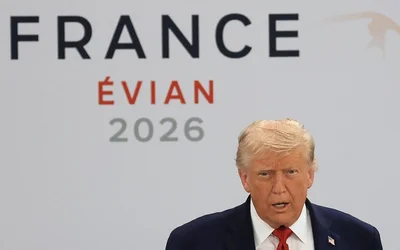
But Trump became more direct during the G7 summit in France on 16 June. "I suggested to Israel to let Syria take care of Hezbollah, because, to be honest with you, I think they do a better job of doing it," he told reporters.
Trump criticised Israel's conduct of the war on Lebanon, saying it had taken too long to defeat Hezbollah while causing extensive civilian casualties and destroying residential buildings.
The following day, Trump confirmed that he had personally discussed Hezbollah with Sharaa, although he declined to say whether the Syrian president had agreed to take action.
The repeated remarks heightened concerns in Lebanon that Washington was trying to draw Syria into the conflict and open a new front against Hezbollah from the east or northeast.
What Shaibani told Berri
Middle East Eye understands that these concerns were discussed in detail during a private, 45-minute meeting between Shaibani and Berri.
According to a source briefed on the meeting, the Syrian foreign minister told the speaker that Damascus was facing intense American pressure to intervene militarily against Hezbollah along the northeastern frontier.
Shaibani expressed frustration that Hezbollah was not doing enough to help Damascus resist that pressure, the source said.
'The Syrian administration does not want Sunni-Shia tensions to escalate, because the region cannot bear more bloodshed'
- Source quoting Shaibani
In particular, he raised the presence of Hezbollah positions in disputed border areas that remain outside the effective control of the Syrian state.
According to the source, Shaibani told Berri that transferring control of these positions to the Lebanese army would help reduce tensions and deprive advocates of military action of one of their main arguments.
He suggested that Berri could initially act as an indirect mediator between the two sides.
"The Syrian administration does not want Sunni-Shia tensions to escalate, because the region cannot bear more bloodshed," the source quoted Shaibani as saying. "If you lose, we lose with you. We do not want that, and this is not poetry."
The remarks indicated that Damascus views the potential consequences of a confrontation with Hezbollah as extending far beyond the Lebanese border.
Despite the history of hostility between Syria's new rulers and the Lebanese group, Syrian officials appear concerned that a military campaign could deepen sectarian divisions inside Syria, destabilise border regions and draw Damascus into a conflict it cannot control.
Reassurance, but also a request
Sharaa had previously attempted to calm the controversy during an interview with Al Mashhad television on 21 June. He said Trump's remarks had been misinterpreted as suggesting that the Syrian army would enter Lebanon "tomorrow morning".
According to Sharaa, discussions with Washington had focused on how Syria could contribute to a safe and peaceful solution rather than an invasion of Lebanon.
"Our vision is based on supporting the Lebanese state once again, strengthening its institutions and seeking a solution that everyone believes in," he said. "We are looking for economic channels between Lebanon and Syria, not military ones."
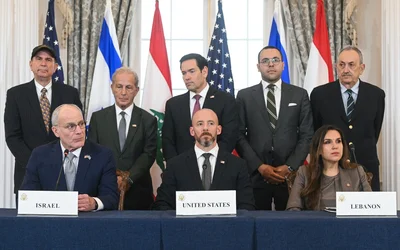
Sharaa also said Damascus was prepared to meet with Hezbollah, despite what he described as the "deep Syrian wound" left by the group's role in supporting Assad during the civil war.
Shaibani's visit reinforced that reassurance, but it also carried a request. Damascus wants Hezbollah and the Lebanese state to take steps along the border that would help Syria withstand American pressure and demonstrate that contentious areas can be brought under recognised state control without Syrian military action.
Berri's inclusion in the visit was therefore not ceremonial.
As Hezbollah's closest ally and the Lebanese official most capable of maintaining communication with both the group and regional governments, he could become the principal channel through which Syria and Hezbollah cautiously redefine their relationship.
The visit did not produce a formal meeting between Syrian officials and the group. But it suggested that both sides are moving away from complete estrangement and towards a controlled dialogue shaped by immediate security concerns.
For Damascus, that dialogue may offer the best way to avoid being forced into a military role it does not want.
For Hezbollah, it could provide a channel to prevent Syria's eastern border from becoming a new front in the growing regional campaign against the group.
Middle East Eye delivers independent and unrivalled coverage and analysis of the Middle East, North Africa and beyond. To learn more about republishing this content and the associated fees, please fill out this form. More about MEE can be found here.