
Trump administration charges Cuba's Raul Castro with murder

The US has unsealed an indictment against Cuba's former president, Raul Castro, charging him with conspiracy to kill US nationals, destruction of aircraft, and four counts of murder related to the 1996 shootdown of two American aid planes close to the island.
Five other defendants are named: Lorenzo Alberto Perez‑Perez, Emilio Jose Palacio Blanco, Jose Fidel Gual Barzaga, Raul Simanca Cardenas, and Luis Raul Gonzalez‑Pardo Rodriguez.
The move sets the stage for 94-year-old Castro to be brought to the US to face trial, potentially via the same "law enforcement operation" that the Trump administration employed to capture former Venezuelan President Nicolas Maduro.
President Donald Trump repeatedly boasts of the January 2026 mission as a critical victory for his government, despite its legally dubious nature. He has also openly suggested that Maduro's swift extraction emboldened him to launch the 28 February war on Iran, alongside Israel.
"We indict men outside of this country all the time, and there's all kinds of different ways that we get them here," acting attorney general Todd Blanche, who previously served as Trump's personal lawyer, told reporters at a press conference in Miami, Florida.
New MEE newsletter: Jerusalem Dispatch
Sign up to get the latest insights and analysis on Israel-Palestine, alongside Turkey Unpacked and other MEE newsletters
"The reason why we indict somebody is because we want them here to face justice with a jury of their peers. How we go about doing that obviously depends on the circumstances in the case, and I'm not going to go beyond that, but...this isn't a show indictment. This is an indictment because we expect that there is a warrant issued for his arrest, so that he will show him[self] here by his own will, or by another way."
Ramped up pressure
Cuba's president, Miguel Diaz-Canel, said on X on Wednesday that the indictment "reveals the arrogance and frustration that the representatives of the empire feel towards the unyielding resolve of the Cuban Revolution and the unity and moral strength of its leadership".
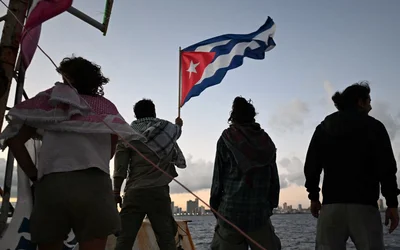
He called the move a "political maneuver, devoid of any legal foundation, aimed solely at padding the fabricated dossier they use to justify the folly of a military aggression".
The charges mark the latest step by the Trump administration to ramp up pressure on Cuba's government to effectively submit and surrender, given the island has been a keen focus for Secretary of State Marco Rubio, whose parents are Cuban.
On Monday, Rubio launched yet another round of sanctions on Havana. The island has been sanctioned and blockaded by the US since the 1960s, squeezing its financial system and energy grid.
In January, Trump signed an executive order declaring Cuba "an unusual and extraordinary threat" to the US and imposed tariffs on any country selling goods or oil to the island nation. The president has previously said he would "have the honour of taking Cuba".
"Whether I free it, take it, I think I can do anything I want with it…They’re a very weakened nation right now."
Brothers to the Rescue
On 24 February 1996, the Cuban air force shot down two Cessna aircraft belonging to the Miami-based Brothers to the Rescue aid organisation, which had previously carried out missions to save Cubans trying to escape their country by sea.
The group was formed by Cuban exiles who fiercely opposed the Cuban government and its former leader, Raul's brother, Fidel Castro.
Four men aboard the planes were killed: Carlos Costa, Armando Alejandre, Jr, Mario de la Pena, and Pablo Morales.
In a statement released on Wednesday, the US Department of Justice said Cuban intelligence agents infiltrated Brothers to the Rescue and relayed detailed information about its flight operations back to the Cuban government.
The White House has always denied that the group had any ties to US intelligence, but Cuba believed its main agenda was to destabilise its government.
"My message today is clear: The United States and President Trump does not and will not forget its citizens," Blanche said on Wednesday.
If convicted, the defendants face a maximum penalty of death or life imprisonment on the murder and conspiracy counts. Castro, in particular, faces up to five years in prison for each count of destruction of aircraft.
The sentencing of any defendant, however, is ultimately determined by a judge.
Middle East Eye delivers independent and unrivalled coverage and analysis of the Middle East, North Africa and beyond. To learn more about republishing this content and the associated fees, please fill out this form. More about MEE can be found here.