
Trump moves to name some Muslim Brotherhood chapters 'terrorist organizations'

US President Donald Trump on Monday signed an executive order to begin the process of designating certain chapters of the Muslim Brotherhood (MB) as Foreign Terrorist Organizations or FTOs.
"This order sets in motion a process by which certain chapters or other subdivisions of the Muslim Brotherhood shall be considered for designation as Foreign Terrorist Organizations," the order said, making specific mention of chapters in Lebanon, Egypt and Jordan.
Those chapters "engage in or facilitate and support violence and destabilization campaigns that harm their own regions, United States citizens, and United States interests," the order said.
Trump telegraphed over the weekend that he planned to move forward with plans to designate the Muslim Brotherhood as an FTO.
“It will be done in the strongest and most powerful terms,” Trump told the Just the News website. “Final documents are being drawn.”
New MEE newsletter: Jerusalem Dispatch
Sign up to get the latest insights and analysis on Israel-Palestine, alongside Turkey Unpacked and other MEE newsletters
Trump’s executive order comes as Congress moves to designate the Muslim Brotherhood a terrorist organisation.
Republican Senator Ted Cruz is pushing a bill that would designate the Muslim Brotherhood a terror organisation, with Republican Senator Tom Cotton and Democratic Senator John Fetterman among the cosponsors.
The House of Representatives has its own version of the bill co-sponsored by four Democrats, including Jared Moskowitz, Thomas Suozzi and John Gottheimer.
But Trump does not need new legislation to list the Muslim Brotherhood as a terrorist organisation, as that power is already provided by the Immigration and Nationality Act.
Under the law, the Secretary of State initiates a process to designate a group based on certain criteria; the organisation must be foreign, and the State Department must assess that it is engaging in terrorist activity that threatens the US.
Middle East Eye previously put the question to George Washington University professor Nathan Brown, who is an expert on Middle East politics and sits on the board of trustees at the American University in Cairo.
In what ways is the Muslim Brotherhood a threat to US national security?
"None at all," he said.
Trump and the Muslim Brotherhood
The US president also has broad authority under Executive Order 13224 to use the Departments of Treasury, State and Justice to block property, and impose sanctions and travel restrictions on groups the government deems terrorist organisations.
US Secretary of State Marco Rubio said in August that the FTO designation was “in the works”.

“Obviously, there are different branches of the Muslim Brotherhood, so you’d have to designate each one of them,” Rubio told a radio talk show, adding that the State Department is engaged in a process to assess the various branches of the Muslim Brotherhood, calling it a “process which I didn’t fully appreciate until I came into this job”.
Trump’s move to designate the Muslim Brotherhood is a continuation of efforts that started during his first administration.
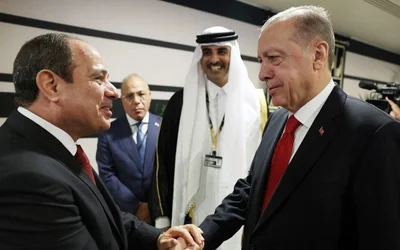
Trump apparently began pushing the move in earnest after meeting Egyptian President Abdel Fattah el-Sisi at the White House in the spring of 2019, according to a New York Times report.
At the time, Trump’s national security advisor, John Bolton, and Mike Pompeo, the former Secretary of State, supported the move, while US government lawyers, defence officials and career national security staff voiced objections, the paper reported.
Texas Governor Greg Abbott announced earlier this month that he was designating the Muslim Brotherhood as well as the Council on American Islamic Relations (Cair) - the largest civil liberties group for American Muslims - as both foreign terrorist organisations and transnational criminal organisations.
That decision has a local impact and stops both groups "from purchasing or acquiring land" in the state of Texas, Abbott said.
The proclamation also grants the state's attorney general leeway to sue the groups accordingly.
What is the Muslim Brotherhood?
The Muslim Brotherhood is most commonly known in the Arab world as a political party founded on Islamic principles and laws, whose support skyrocketed in the wake of the 2011 Arab protests aimed at overthrowing autocratic rulers.
It was established in the late 1920s in Egypt in opposition to British colonial rule.
Later, it was outlawed and attacked by nationalist Arab rulers like Egyptian President Gamal Abdel Nasser and Hafez al-Assad of Syria. However, the Muslim Brotherhood gained popularity in the 1970s and 1980s as secular, authoritarian governments pushed modernisation and western agendas.
In 2012, after the toppling of Hosni Mubarak, Egypt's ruler for three decades, an internationally monitored election in Egypt saw the victory of the country's first Muslim Brotherhood president, Mohamed Morsi.
Sisi was a former head of military intelligence and later minister of defence to Morsi. In 2013, Sisi spearheaded a coup that ousted Morsi from power and led a violent crackdown on members of the group.
Tensions over the group culminated in a rift between regional powers Turkey, Saudi Arabia, Qatar and the UAE. The UAE and Saudi Arabia led a blockade of Qatar and fought proxy wars with Turkey in countries like Libya.
More recently, the Gulf states have tried to patch up ties, but the Muslim Brotherhood remains a point of contention in the region. Many monarchies view the group as a threat to their dynastic rule.
In the region
The Muslim Brotherhood’s sway in the Middle East has ebbed since the toppling of Morsi, but the group still retains support in the region.
In Tunisia, the Ennahda party, which is affiliated with the Muslim Brotherhood, has been harassed and its leadership arrested. President Kais Said, who was democratically elected, has consolidated power in his hands, shuttered the parliament and purged the country of political opponents, secular and Islamist alike.
In other areas, however, the US’s allies have worked with governments supported by local parties seen as close to the Muslim Brotherhood.
For example, Yemen’s internationally recognised government, which is backed by Saudi Arabia, includes members of the Islah party, which has historically been close to the Muslim Brotherhood.
The US itself has shown no qualms about working with self-declared Islamist leaders, such as Syrian President Ahmed al-Sharaa, who served roughly five years in a US prison after travelling to Iraq to repel the 2003 US invasion of the country. Sharaa went on to found al-Nusra Front, al-Qaeda's Syrian branch. He was only officially removed from the US terror list in November, before his White House visit.
If Trump does move forward with the designation of the Muslim Brotherhood, the group could appeal it at the US Court of Appeals in Washington, DC.
One of the challenges in this case is that the Muslim Brotherhood lacks central leadership and is mainly composed of various parties and groups affiliated with it, often through loose ideological connections.
For example, Hamas is affiliated with the Muslim Brotherhood and was designated a terror organisation in 1987. The US also designated the secular Palestinian Liberation Organisation as a terror group.
The Muslim Brotherhood is now banned in Egypt, Saudi Arabia, Bahrain, and the United Arab Emirates, and most recently in Jordan.
Middle East Eye delivers independent and unrivalled coverage and analysis of the Middle East, North Africa and beyond. To learn more about republishing this content and the associated fees, please fill out this form. More about MEE can be found here.