Why did Trump meet members of an anti-Zionist Orthodox Jewish group?

US President Donald Trump on Thursday hosted Haredi Jewish leaders, some of whom are best known outside their communities for holding anti-Zionist positions, at the White House ahead of the Jewish new year, Rosh Hashanah.
Photographs later shared on social media by attendees and their allies showed something far beyond the usual religious holiday receptions held by most administrations.
The delegation of rabbis and other representatives, who had flown in from New York and New Jersey, enjoyed an intimate audience with the president, sitting directly across from him at the Resolute Desk, with Trump's Jewish son-in-law, Jared Kushner, in the room with them.
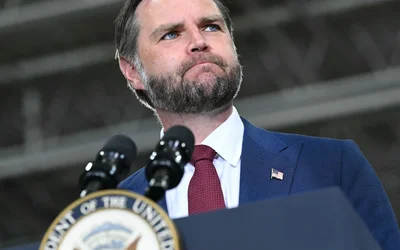
The group also met with Vice President JD Vance and New York Republican Congressman Mike Lawler, who is up for re-election in the state's largely liberal 17th district in November.
"I had the great honor and privilege to introduce 6 Leading Rabbis of the Hasidic Community in the US to @JDVance," Yossi Gestetner, a New York-based political activist and staunch pro-Israel voice who attended the meeting, wrote on X.
New MEE newsletter: Jerusalem Dispatch
Sign up to get the latest insights and analysis on Israel-Palestine, alongside Turkey Unpacked and other MEE newsletters
"I told the @VP that in this room there are the leaders of the most visibly Jewish people in the US, and despite the noise on social media and disagreements, he should know that his role is respected and appreciated by all those on the room."
Among those six rabbis was Satmar Rebbe Aaron Teitelbaum, a leading figure in Orthodox anti-Zionist circles. He leads the ultraconservative Satmar religious community in the Jewish village of Kiryas Joel, New York, and represents some 100,000 adherents.
Photographs show him sitting directly across from Trump, and reading from what is reportedly a letter he had prepared.
"The Satmar Rebbe was probably, I would say, the most important religious leader," in that meeting, Israel-American author and activist Miko Peled, who is familiar with the group, told Middle East Eye on Friday.
Rabbi Yisroel Dovid Weiss, who is frequently seen at New York protests against the actions of the Israeli government, described Satmar's approach to anti-Zionist politics as being "more nuanced, more careful" than his own group, Neturei Karta International.
"We know that officially it would be politically incorrect for them to meet with people who state unambiguously that [they] call for the entire dismantlement of the Zionist state of Israel," he told MEE.
Critics of Israel on social media lauded the meeting, highlighting the inroads to be made given many conservatives are now questioning the premise of the US-Israel relationship.
Elections ahead
The meeting takes place six weeks before the Israeli elections, and eight weeks before the US midterm elections.
Trump, by all accounts, can have a remarkable amount of sway on both.
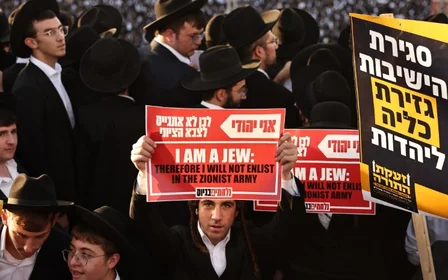
"My understanding is that [the delegation] wanted two things: One is to make clear their objection to Zionism, and that they are not Zionists," Peled said. "The second thing is their community is now under attack by the Israeli government, because ... they have close to 80,000 young men who are now considered draft dodgers."
Haredi Jews often protest against Israeli conscription and are met with police violence in Israel.
MEE has previously reported that Haredi exemption from enlisting in the Israeli military began as narrow, exceptional relief at the outset of statehood. It gradually ballooned into a mass phenomenon as tens of thousands became exempted, and public debate raged in the background.
Haredi Israelis have gone from constituting roughly 10 percent of the population in 2009 to around 14 percent today.
Some factions remain fiercely anti-Zionist, rejecting the legitimacy of the state, while others work with secular coalitions to defend their autonomy.
'A big deal'
A White House official told MEE that this was the "first gather of these rabbis at the White House since 1979".
Some Hasidic leaders had, in fact, met with former presidents George HW Bush and Bill Clinton on the premises, so it was unclear if this referred to leaders from specific sects.
"They thanked the President for all he had done in combatting anti-Semitism, advocating for school choice with the Middle-Class Tax Credit, and for fighting for peoples of faith," the official said via email.
"The White House Faith Office brings in Americans of faith to meet with the President on a regular basis. In the Jewish community, they have brought both the families of and former Hostages held in Gaza, survivors of the Holocaust, and rabbis from many branches of the faith."

Peled described the meeting as "a big deal" and "historic".
It was reportedly important enough to the president that he agreed to push the meeting time to accommodate the delays encountered by the private jets bringing the delegation to Washington.
And that may very well be because Lawler, a vocal Trump ally in a tight race, represents the very district that includes Kiryas Joel.
Halie Soifer, a former policy aide to President Barack Obama and Senator Kamala Harris who now leads the Jewish Democratic Council of America, described Thursday's White House meeting as serving "a narrow political goal" for Republicans.
The "selection of just a group of Hasidic men is on brand for Donald Trump", she told MEE.
"He brought in a very small non-representative sample of Jewish leaders to the White House, and was sure to include a vulnerable Republican incumbent who is likely to lose his seat in November."
Soifer alluded to Satmar as a fringe group, saying Jews are "not a monolith".
"In the Biden administration, the kind of pre-high holiday convenings held by the White House and with Jewish leaders always included some rabbis, including representatives of the Orthodox community," she recounted.
"But it has also included the wide range of denominations and representatives from across the spectrum of the Jewish community."
Middle East Eye delivers independent and unrivalled coverage and analysis of the Middle East, North Africa and beyond. To learn more about republishing this content and the associated fees, please fill out this form. More about MEE can be found here.