Turkey advances historic Hejaz railway project with Saudi Arabia deal

Turkey and Saudi Arabia on Tuesday signed two separate memorandums of understanding to expand cooperation on railways and connectivity between the two countries.
With the agreement, Riyadh has become the latest country to indirectly participate in the revival of the historic Hejaz railway, which would connect Turkey, Syria, Jordan, and Saudi Arabia.
Turkish Transportation Minister Abdulkadir Uraloglu travelled to Riyadh on Tuesday for talks with his Saudi counterparts.
“At this sensitive time our region is going through, the uninterrupted functioning of trade and the logistics chain has become more critical than ever. In this period, removing the obstacles facing the transportation sector is a strategic necessity,” Uraloglu said during the official signing ceremony.
He added that Ankara aims to activate transport routes through Syria, Jordan, and Iraq.
New MEE newsletter: Jerusalem Dispatch
Sign up to get the latest insights and analysis on Israel-Palestine, alongside Turkey Unpacked and other MEE newsletters
“Two trial runs starting in Turkey and extending to Saudi Arabia via Iraq have clearly demonstrated the feasibility of this route,” he said.
Since last year, Turkey has repeatedly said it wants to restore the historic Hejaz railway, which once stretched from Istanbul to the holy sites in Saudi Arabia.
Bypassing Strait of Hormuz
In the long term, the railway is envisioned to extend as far as Oman and the Indian Ocean. The aim is to establish an alternative trade corridor that bypasses the Strait of Hormuz.
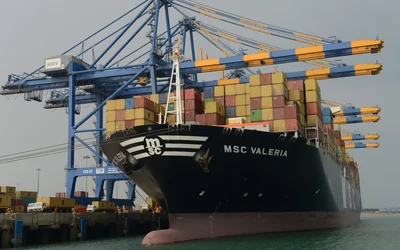
In such a scenario, Turkey could become a transit hub between the Gulf and Europe, a railway logistics base, and a key junction where energy and trade corridors converge.
In April, Turkey, Syria, and Jordan signed a similar trilateral agreement establishing a comprehensive framework to strengthen regional connectivity, integrate transportation systems, and facilitate cross-border transport.
The document envisions cooperation across all modes of transport, including road, rail, maritime, air, and multimodal transportation. It covers areas such as infrastructure development, harmonisation of technical standards, digitalisation, capacity building, private-sector participation, and coordination of transportation corridors.
The legendary Hejaz railway was the ambitious vision of Ottoman Sultan Abdulhamid II, who in 1900 sought to build a rail line connecting Istanbul, Turkey, to Mecca in Saudi Arabia.
Named after the Hejaz region in the western Arabian Peninsula, which is home to Islam’s two holiest cities, Mecca and Medina, the railway was constructed with remarkable speed and funded entirely by Muslim donations. Some contributions were voluntary; others were coerced.
The line, already linked to Istanbul, extended from Damascus to Medina, with a branch line reaching Haifa in Palestine.
Middle East Eye delivers independent and unrivalled coverage and analysis of the Middle East, North Africa and beyond. To learn more about republishing this content and the associated fees, please fill out this form. More about MEE can be found here.