UK train operator orders removal of Palestine badge after pro-Israel legal group pressure

A train company in the UK has told staff they cannot wear union-endorsed badges supporting Palestine while on duty following a complaint by a pro-Israel legal group.
Last month, UK Lawyers for Israel (UKLFI) sent a letter to London North Eastern Railway (LNER) after a passenger complained that a member of train staff serving food was wearing a badge which featured the logo of the Rail, Maritime and Transport Workers (RMT) union and the words "Palestine Solidarity".
According to UKLFI, the passenger, who is Jewish, said the display of the badge had made them feel "uncomfortable and unwelcome". It said the incident had occurred aboard a London to Edinburgh train on 14 June.
In its complaint, UKLFI argued that political symbols worn by customer-facing staff could create an "intimidating, hostile or offensive environment" for Jewish, Israeli and Zionist passengers.
It also cited the Equality Act 2010, arguing that service providers have an obligation not to subject customers to harassment based on protected characteristics.
New MEE newsletter: Jerusalem Dispatch
Sign up to get the latest insights and analysis on Israel-Palestine, alongside Turkey Unpacked and other MEE newsletters
A spokesperson for LNER told Middle East Eye that the train company has a "uniform policy that its onboard colleagues are required to adhere to".
"The uniform policy states that, when in uniform, colleagues are only allowed to wear a single pin badge on the lapel of their blazer/jacket," said the spokesperson.
"These pin badges must either be LNER issued, in support of a cause aligned to an LNER campaign when communicated, or the standard logo of a union a colleague is a member of."
In a further comment on Instagram following publication of this article, LNER said: "LNER has not banned specific badges. We have a uniform policy that has been in place for many years which outlines what onboard colleagues are permitted to wear."
In response to the UKLFI’s complaint, LNER managing director David Horne said the company had taken "appropriate steps" after receiving the complaint and reiterated that employees are not permitted to wear unauthorised badges while representing the company.
"LNER takes the concerns raised seriously," Horne wrote to UKLFI, in comments published on UKLFI's website.
"Colleagues are required to comply with LNER's uniform standards while on duty and when representing the company. Those standards do not permit colleagues to wear unauthorised badges or other items as part of their uniform."
Horne told UKLFI the employee involved had been spoken to on 17 June and reminded of the company's uniform requirements. LNER had also issued a briefing to staff across the business reiterating that unauthorised badges and other items must not be worn while on duty, he wrote.
Horne added that the company had informed the chair of its On Train Company Council, an employee representative body, of the action taken and said the chair had indicated they were content with LNER's position.
UKLFI included Horne's statement in a post on its webpage titled "LNER orders removal of Palestine Solidarity Badge and Reinforces Staff Neutrality Rules".
Caroline Turner, director of UKLFI, welcomed the company's response, and said she was "pleased that LNER responded quickly and decisively".
"Public transport providers serve passengers from every community," Turner said in a statement.
"Jewish passengers should be able to travel without being confronted by political messaging from staff members whilst receiving services."
UKLFI did not respond to MEE's request for comment.
The RMT, which has been one of the main trade unions supporting protests against Israel’s actions in Gaza and affiliated to the Palestine Solidarity Campaign, declined to comment.
The trade union, however, has issued statements condemning Israel's actions in Gaza, actively called for its members to campaign for Palestine in the workplace and called its members to join the national marches for Palestine.
Expressions of solidarity
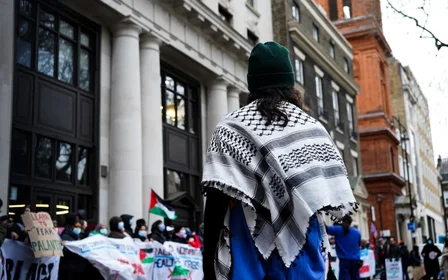
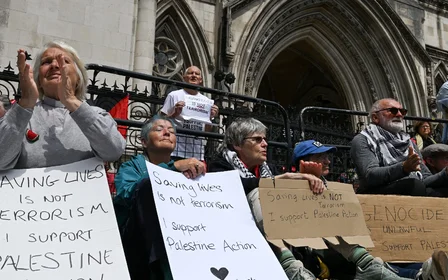
The issue of expressions of solidarity with Palestinians has become a point of debate in many British workplaces since the start of Israel's war on Gaza in 2023.
Campaigners have raised concerns about employers restricting displays of support for Palestine, while some organisations have argued that political messaging should not be displayed by employees in customer-facing roles.
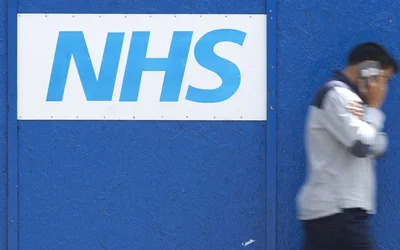
Earlier this year, the Department of Health and Social Care (DHSC) endorsed a review into anti-Jewish hate and other forms of racism in the NHS by the UK government’s adviser on antisemitism, Lord John Mann.
The review recommended mandatory antisemitism training for 1.5 million NHS staff members, as well as banning them from displaying political symbols, including wearing the Palestine badge, in the workplace and preventing them from attending protests in their uniforms.
Following the outbreak of Israel's genocidal war on Gaza, several cases have emerged of medical workers being reprimanded for showing their support for Palestine or using Palestine-related memorabilia in the workplace.
They include a British-Palestinian nurse who was ordered to remove a background on his video calls that showed a fruit bowl containing a watermelon because it could be perceived to be antisemitic.
Middle East Eye delivers independent and unrivalled coverage and analysis of the Middle East, North Africa and beyond. To learn more about republishing this content and the associated fees, please fill out this form. More about MEE can be found here.