Exclusive: UK won't comment on prosecutor's claim Britain threatened to defund ICC

The UK Foreign Office has refused to comment on the British chief prosecutor of the International Criminal Court's accusation that a senior UK government official threatened to withdraw the country's funding and support for the court if he pursued arrest warrants against Israeli leaders.
The allegation is contained in a statement submitted by Karim Khan to the court on Wednesday, which described details of an alleged campaign of threats faced by the prosecutor in the lead-up to his office requesting warrants against Israeli Prime Minister Benjamin Netanyahu and the former defence minister, Yoav Gallant, in May 2024 over alleged war crimes in Gaza.
As it has previously reported, Middle East Eye understands the British official referred to in Khan's submission to be the then-foreign secretary and former prime minister, David Cameron, who phoned Khan on 23 April 2024.
MEE asked the British Foreign Office for comment on Khan's accusation.
MEE further asked whether the Foreign Office would investigate what occurred during the phone call between Cameron and Khan on 23 April last year, when the previous Conservative government was in power.
New MEE newsletter: Jerusalem Dispatch
Sign up to get the latest insights and analysis on Israel-Palestine, alongside Turkey Unpacked and other MEE newsletters
But the Foreign Office declined to comment, having previously declined to comment in June when MEE first reported on the phone call.
'Like dropping a hydrogen bomb'
The prosecutor's statement, submitted to the ICC's appeal chamber in response to an Israeli request for Khan to be removed from the investigation and for the warrants to be dropped, appears to corroborate MEE's previous reporting, which uncovered many details of efforts to undermine Khan, including Cameron's explosive phone call to the prosecutor.
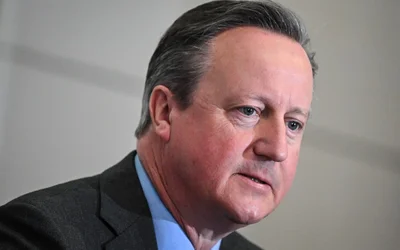
In his statement, Khan describes receiving a phone call from “a senior UK government official” who warned that arrest warrants against Israeli leaders would be disproportionate and could lead to the UK withdrawing funding from the court.
MEE has previously reported, based on information from a number of sources – including former staff in Khan’s office familiar with the conversation and who have seen the minutes of the meeting – that the phone call Khan referenced was with Cameron.
During the call, sources told MEE, Cameron told Khan that applying for warrants for Netanyahu and Gallant would be “like dropping a hydrogen bomb”.
Cameron said it was one thing to investigate and prosecute Russia for a “war of aggression” on Ukraine, but quite another to prosecute Israel when it was “defending itself from the attacks of 7 October”.
Cameron did not respond to MEE's requests for comment.
'We have a right to know'
French newspaper Le Monde reported in August that during the call, Cameron threatened that the UK would "withdraw from the ICC's founding treaty if Karim Khan followed through with his intentions".
In October, the New Yorker reported that Khan told UN investigators Cameron had said “such a move [seeking arrest warrants for Israeli officials] would be a 'hydrogen bomb'.”
In an account of the episode in MEE journalist Peter Oborne's book, Complicit: Britain’s Role in the Destruction of Gaza, a source close to Cameron said that the call with Khan did take place and was “robust”.

But the source said that rather than making a threat, Cameron pointed out that strong voices in the Conservative party would push for defunding of the ICC and withdrawing from the Rome Statute, the founding charter of the ICC.
In June, former Scottish first minister Humza Yousaf told MEE that the UK parliament’s foreign affairs committee should investigate what happened during the phone call.
Yusuf was the Scottish first minister while Cameron was the British foreign secretary.
He said: "Lord Cameron has to be held to account. We are talking about a matter of the utmost seriousness here. We need to know whether a serving British foreign secretary at the time threatened to defund the International Criminal Court."
In August, the independent MP Jeremy Corbyn, a former Labour leader, also called for the British government to investigate what occurred in the phone call between Cameron and Khan.
"I think we need to know, and we have a right to know as well," Corbyn told MEE.
Middle East Eye delivers independent and unrivalled coverage and analysis of the Middle East, North Africa and beyond. To learn more about republishing this content and the associated fees, please fill out this form. More about MEE can be found here.