UN General Assembly 2026: Arab and Muslim leaders denounce militarism engulfing region

Arab and Muslim leaders once again focused heavily on the US-Israel war on Iran and the genocide in Gaza on the second day of the United Nations General Assembly.
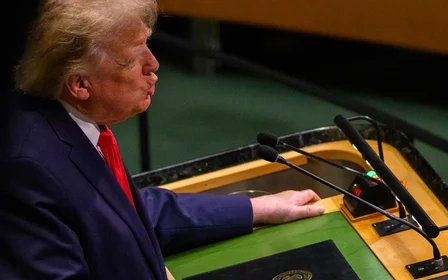
On Wednesday, it was Iran's turn to respond to US President Donald Trump's Tuesday speech, in which he set the tone by threatening to "annihilate Iran" while, in the same breath, mentioning that he would like to make a deal to end the war. Iranian President Masoud Pezeshkian implied that he had changed the contents of his speech after hearing the address, which referred to Iranians as "terrorists".
“Those who are terrorists, and train and protect terrorists, describe us as such. We have only defended ourselves. We are not terrorists,” Pezeshkian said. “America and Israel attacked us.”
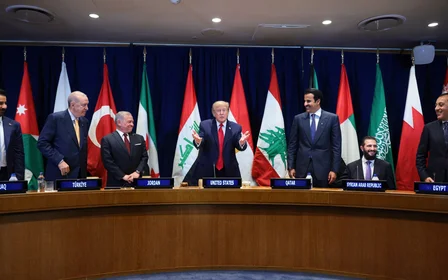
Later on Tuesday, Trump held a meeting with several Arab and Muslim leaders where he heaped praise on the officials, but it ended with a lack of agreements or announcements regarding the turmoil in the Middle East.
New MEE newsletter: Jerusalem Dispatch
Sign up to get the latest insights and analysis on Israel-Palestine, alongside Turkey Unpacked and other MEE newsletters
Also on Tuesday, envoys from the US met with Iranian officials for three hours to discuss a potential deal to end the war in Iran. Iran repeated its preconditions for any deal, starting with reopening the Strait of Hormuz, hardening its stance on access to the crucial waterway.
Syria's President Ahmad al-Sharaa also featured on the second day, focusing heavily on his country's southern neighbour, Israel, labelling it as diplomatically isolated and aggressive.
Syria: Israel 'at odds'
Syrian President Ahmad al-Sharaa used his speech at the United Nations General Assembly to declare his country’s return to the international community and slam Israel's attacks as "at odds" with the international consensus on Damascus.
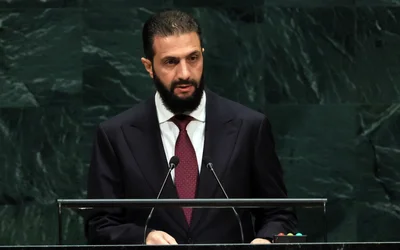
“The world is joyed by our return but Israel is launching attacks against Syria,” he said, saying Israel had launched 500 air strikes, conducted more than 1,200 incursions and 300 detentions in the country.
“This is at odds with the orientation we are seeing at a global level,” he said. “We reject their [Israeli] aggressions”.
In a blistering UN speech on Tuesday, Jordan's King Abdullah II also said that Israel's attacks on Syria prove it has territorial ambitions that extend beyond the occupied Palestinian territories.
“Any attempts that violate our sovereignty, that violate international law, will be stopped. Golan will remain Syrian territories,” Sharaa said, condemning Israel’s illegal occupation of the territory and calling for a return to the 1974 agreement that created a UN buffer zone between the two states.
In 1967, Israel seized the Golan Heights from Syria and illegally annexed the territory in 1981. Under the rule of Hafez al-Assad, the two countries signed a disengagement agreement that established a security framework and UN buffer zone on their border.
US President Donald Trump - who has made no secret of admiring Sharaa - decided during his first term in office in 2019 to unilaterally recognise the Israeli-occupied Golan Heights as part of Israel. The move had long been on Israeli Prime Minister Benjamin Netanyahu's wishlist.
Sharaa addressed the UN General Assembly for the first time last year after leading a militant group that ousted former Syrian President Bashar al-Assad from power in late 2024.
Israel invaded southern Syria and occupied the buffer zone after Sharaa came to power.
The US has been brokering talks between Syria and Israel. Sharaa told an audience at a think-tank event on Tuesday that he could not entertain the notion of diplomatic relations while Israel carries out air strikes on his country and occupies his birthplace in the Golan Heights.
Last month, Israel bombed an air base in northern Syria where it claimed Turkey intended to deploy troops. Syria is a close ally of Turkey and has emerged as a new arena of competition between Turkey and Israel.
Sharaa highlighted his government’s efforts to bring Syria back into the international fold.
“Security and stability has been established. We are no longer isolated,” Sharaa said, adding that Syria has cracked down on transnational crime and the trade of captagon, which flourished under the Assad government. He also said Syria is cooperating to destroy chemical weapons of the Assad era.
Although sanctions have been lifted on Syria, Sharaa’s government faces a number of challenges, including a weak economy and sluggish reconstruction.
“Syria is rising,” Sharaa said on Wednesday. “We proved to the world that the security of the r egion has to start in Damascus.”
Iran: 'America and Israel attacked us'
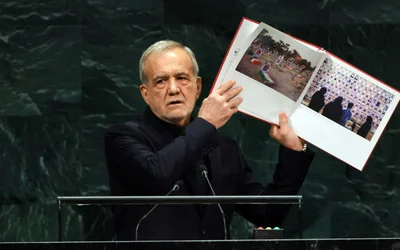
Pezeshkian began his speech holding a photo of Iran’s 86-year-old Supreme Leader Ayatollah Ali Khamenei, who was assassinated on 28 February in the opening salvo of the US-Israeli attack.
He also shared photographs of Iranian children killed by US air strikes and their graves. US strikes on the Minab elementary school killed at least 150 people, including approximately 120 children.
A US strike that discharged thousands of tungsten pellets also targeted a sports complex in the southern Iranian city of Lamerd. A UN fact-finding mission said earlier this month that there were “reasonable grounds” to believe the strikes amounted to war crimes.
Pezeshkian reaffirmed Iran’s denial of long-standing US claims that Tehran sponsors terrorism.
“Those who are terrorists, and train and protect terrorists, describe us as such. We have only defended ourselves. We are not terrorists,” he said. “America and Israel attacked us.”
“For the past two centuries, Iran has not attacked any territory or any country,” he said. “Now, we are labelled terrorists”.
The US has cited several justifications for its war on Iran. The Trump administration has claimed that Tehran was close to developing a nuclear weapon, despite boasting that it had destroyed Iran’s nuclear programme in June 2025 strikes.
Pezeshkian reaffirmed Tehran’s claim that it is not seeking a nuclear weapon but will not give up a civilian nuclear programme.
“Iran does not accept for nuclear technology to be at the exclusive disposal of some,” he said. “We will not bow our head and give up the right that is inherently ours. We say it clearly: no nuclear weapons and no limitations to peaceful nuclear technology.”
Pezeshkian accused the US and Israel of hypocrisy for trying to constrain Iran’s nuclear programme while allowing Israel to maintain a nuclear arsenal. Israel does not admit to having nuclear weapons, but is widely understood to.
The Trump administration also justified its attacks claiming that Iran’s ballistic missile programme is a threat to the US. Pezeshkian said Iran would maintain a “powerful” military to deter threats.
“Iran must be powerful, so as to avoid being threatened,” he said. “We do not wish to use our power for hegemony.”
“Our defensive systems have been built so that no one can think that the bombing of Iranian cities can go unanswered,” he said.
Pezeshkian also said that the Islamic Republic has the overwhelming support of its population, saying the US and Israel were behind protests that engulfed the country at the start of the year, which the Trump administration also used to justify its attack.
“The people of Iran have been in the street demonstrating in support of their homeland,” he said, adding that pro-government demonstrators were on guard for those “equipped, armed and trained by America and Israel to cause insecurity in our country”.
Libya
Mohamed al-Menfi, head of the Tripoli-based Libyan Presidential Council, called for the “right of the Palestinian people to their state” in his address to the UN General Assembly and expressed steadfast support for Saudi Arabia in the face of Houthi attacks.
He said the failure to achieve a Palestinian state “drives the region to a widening cycle of conflict [and] the spread of extremism”.
Menfi echoed the warnings of other Arab leaders, including Syrian President Ahmed al-Sharaa and Jordan’s King Abdullah II, over Israel’s “expansionist projects” in Lebanon and Syria.
“Neither the Islamic and Christian holy sites, nor civilians and civilian infrastructure have been spared the ravages of this conflict,” he said.
Menfi drew a direct connection to the undermining of a Palestinian state and conflict in the Arabian Gulf, where countries have faced attacks from Iran and its allies in response to the US-Israeli war on the Islamic Republic.
“We affirm our full solidarity with the kingdom of Saudi Arabia in safeguarding its security, its territorial integrity, its citizens, and its holy sites,” he said. “We reject any targeting that threatens it or endangers Islamic holy sites,” he said.
“The security of the kingdom and the Gulf, given their Arab and Islamic weight, is not a national matter, but a pillar in the security and stability of our region,” he said.
He also said the Sudanese people had “paid a heavy price” for the civil war raging in the African state and funded by outside powers. Menfi also warned over instability in the Sahel region of Africa.
Middle East Eye delivers independent and unrivalled coverage and analysis of the Middle East, North Africa and beyond. To learn more about republishing this content and the associated fees, please fill out this form. More about MEE can be found here.