
UN: RSF used rape and sexual slavery as weapons of war in Sudan since 2023

The Rapid Support Forces (RSF) paramilitary group is responsible for the majority of sexual crimes committed by warring parties in Sudan over the past three years, the United Nations human rights office said on Tuesday.
In a new trend analysis report on conflict-related sexual violence in Sudan since the outbreak of war between the RSF and the Sudanese Armed Forces (SAF) in April 2023, the UN found that rape, gang rape and sexual slavery have been used systematically as weapons of war, and warned that impunity risks entrenching cycles of violence for years to come.
Around 87 percent of verified incidents were attributed to men in RSF uniforms, its affiliates and allied Arab militias. Incidents were also attributed to the SAF, affiliated security actors, the Joint Forces and other armed movements.
The report by the Office of the High Commissioner for Human Rights (OHCHR), which covers the period from 15 April 2023 to 15 April 2026, documented 546 verified incidents affecting at least 838 victims, including 539 women, 284 girls, eight men and seven boys, across 16 of Sudan's 18 states.
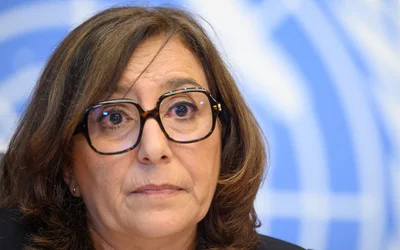
"Sexual violence is being used as a weapon of war. This is a war crime and, if committed as part of a widespread or systematic attack, a crime against humanity," said UN High Commissioner for Human Rights Volker Turk.
New MEE newsletter: Jerusalem Dispatch
Sign up to get the latest insights and analysis on Israel-Palestine, alongside Turkey Unpacked and other MEE newsletters
The OHCHR concluded it has reasonable grounds to believe that the RSF and allied Arab militias committed war crimes in Darfur, including rape, sexual slavery, cruel treatment, torture, and outrages upon personal dignity.
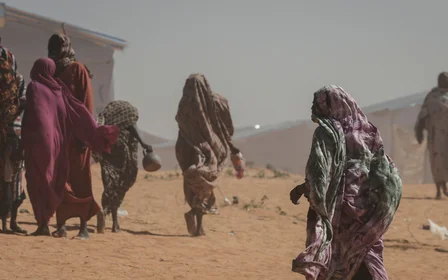
The scale, repetition, geographic spread and coordinated nature of violations in El Geneina and Ardamata in West Darfur, and at Zamzam camp for the internally displaced and el-Fasher in North Darfur, lead the office to conclude those acts were committed as part of a widespread and systematic attack against a civilian population.
The OHCHR said it thus has "reasonable grounds to believe" they may also amount to crimes against humanity, including rape, sexual slavery, torture and other inhumane acts.
Sexual slavery
The report lays out consistent patterns across three years. Sexual violence was carried out through planned, coordinated operations where perpetrators arrived in groups with weapons and vehicles, with roles divided, some securing buildings while others committed assault.
More than a quarter of incidents involved gang rape, in at least one case by 10 or more perpetrators against a single victim.
At least 85 women and girls were held in sexual slavery, compelled to perform domestic labour for fighters and, in some cases, to generate income for them too, the report said.
OHCHR also documented cases in which victims were chained, blindfolded or confined, subjected to repeated rape, and held hundreds of kilometres from where they were abducted. At least 59 women and girls became pregnant as a result of rape, the report found.
The report states that ethnicity often played a role in the targeting of victims.
In West Darfur, Masalit women were asked to identify their tribe before being assaulted. One was told: "If you are Masalit, we will slaughter you today." Others were told that "this year, all of you Masalit girls will deliver our children".
During the RSF offensive on the Zamzam camp for internally displaced persons in April 2025, victims were asked "Is your father SAF?" or "Where are your men?", with assault used as both punishment and intimidation.
Zaghawa women and girls were among those particularly targeted around el-Fasher during the final RSF offensive in October 2025.
In one documented case, a woman saw her mother shot dead after she begged a perpetrator not to rape her daughter; the daughter was subsequently gang raped. Another girl witnessed her younger sister gang raped and found dead from her injuries.
Sexual violence in detention was also documented across seven states, with male victims comprising a notably higher proportion of those cases, around 20 per cent.
A man from the Masalit community detained by the RSF in el-Geneina in October 2023 and subjected to sexual torture while in custody died in April 2025 from untreated injuries and compounded psychological harm, the UN report said.
'Persistent impunity is clearly deepening harms and reinforcing cycles of violations and abuses'
- Volker Turk, UN rights chief
Of 546 verified incidents, just 48 were reported to police or prosecution offices. At least two proceeded to investigation.
In areas under RSF control, no functioning formal justice system exists. The report warns that the SAF commander-in-chief's reiteration in October 2024 of an amnesty for RSF defectors - without explicit exclusions for sexual violence - risks shielding perpetrators from prosecution.
In one documented case, a woman who had been held under RSF coercion and subjected to sexual violence was subsequently charged by SAF-aligned security forces with collaboration with the RSF. At least one woman was sentenced to death on such charges, the report found.
"Persistent impunity is clearly deepening harms and reinforcing cycles of violations and abuses," Turk said. "All perpetrators, including those exercising command responsibility, must be held fully accountable, and victims must be guaranteed access to effective remedy, including reparation."
The UN fact-finding mission in Sudan has repeatedly found that RSF actions may amount to war crimes and crimes against humanity, including rape, sexual slavery, and persecution on ethnic and gender grounds.
Its latest investigation concluded in February this year that the RSF's deadly capture of el-Fasher bore the hallmarks of genocide, with sexual violence forming a central part of the assault. Women and girls aged between seven and 70, including pregnant women, were targeted, with survivors reporting being raped in front of relatives and children.
El-Obeid on 'precipice of an atrocity'
The publication of the latest OHCHR report coincides with mounting international alarm over el-Obeid, the capital of North Kordofan state, where the RSF has been carrying out sustained drone strikes on civilian infrastructure.
Drone attacks in recent days have struck key supply routes across North Kordofan and White Nile states, as well as fuel stations and electricity lines, cutting off access to basic services for more than 500,000 people, including 200,000 internally displaced persons.
Meanwhile, France, Germany, Ireland, Italy, the Netherlands, Norway and the UK issued a joint statement on Tuesday expressing deep concern over the continued assault on el-Obeid and warning that the atrocities seen in el-Fasher must not be repeated.
"Last year, the world witnessed with horror the atrocities in El Fasher - crimes that are assessed to bear the 'hallmarks of genocide'. We must not allow such failures to be repeated," they said. UK Foreign Secretary Yvette Cooper said el-Obeid was "on the precipice of an atrocity".
The six European countries have called out external actors fuelling the conflict, but they have yet to name the United Arab Emirates for its widely documented backing for the RSF.
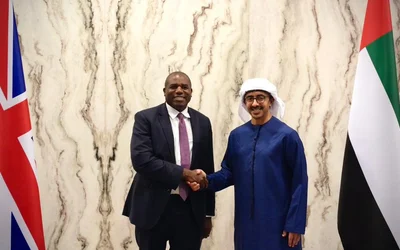
The UAE has repeatedly denied supplying the RSF with weapons or other support. However, since mid-2023, several investigations have concluded that weapons and material reached the RSF via an airbridge through Amdjarass in Chad, with the UAE repeatedly named as a suspected supplier.
Most recently, Middle East Eye revealed in April that the RSF were being covertly supported from an Ethiopian army base at Asosa, in the Benishangul-Gumuz region, with similar vehicles documented at the port of Berbera in Somaliland, where the UAE maintains a military presence.
On Tuesday, a human rights investigator told the UK parliament that the British government has failed to act to prevent atrocities in Sudan's el-Fasher due to "political capture" by the UAE and a desire to maintain good relations with Abu Dhabi.
Speaking before parliament's International Development Committee, Nathaniel Raymond said the UK, as penholder for the Sudan issue at the UN, was the "best hope" for stopping "what we believed would become one of the single largest mass casualty events of the 21st century".
However, Raymond said that his repeated warnings and recommendations delivered across two dozen private briefings were ignored, questioned or dismissed by London.
Raymond told MPs he believed the British government prioritises "economic, security, and diplomatic relationships with the UAE above preventing the intentional starvation, forced displacement, and the genocidal slaughter of tens of thousands of civilians living in el-Fasher and its surrounding communities".
The UN Security Council has sanctioned four RSF commanders over atrocities in Darfur, while the US has formally accused the RSF of genocide and sanctioned its leader, Mohamed Hamdan Dagalo, known as Hemedti, since January 2025.
The International Criminal Court in The Hague is investigating RSF and SAF commanders over their individual criminal responsibility for alleged war crimes and crimes against humanity committed during the latest conflict.
The war has killed thousands over the past three years, displaced over 13 million, and driven more than 19.5 million people to the brink of famine, prompting what the UN and EU describe as the world's largest humanitarian and displacement crisis.
Middle East Eye delivers independent and unrivalled coverage and analysis of the Middle East, North Africa and beyond. To learn more about republishing this content and the associated fees, please fill out this form. More about MEE can be found here.