As UN summit kicks off, protestors say justice will not come from gathering

As United Nations members claim to have made historic progress in the path to Palestine statehood, protestors outside say that UN actions are mostly symbolic, and demand for more to be done in advocating for Palestine.
In a conference co-sponsored by France and Saudi Arabia, more than 30 UN member states advocated for a two-state solution and the establishment of a Palestinian state.
Momentum for a Palestinian state has ramped up recently with the United Kingdom, Canada, Portugal, Malta, Monaco, and Luxembourg officially recognising it as a state as of late Sunday. Three more European countries, Belgium, Denmark and the Netherlands pledged to recognise a Palestinian state once certain criteria had been met.
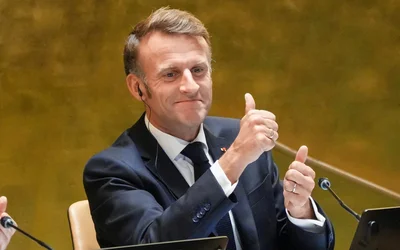
French President Emmanuel Macron officially announced France’s recognition of Palestine during the conference’s opening speech, prompting the General Assembly hall to rise in a standing ovation.
Even before he spoke, leaders from across the globe crowded around to greet him, offering effusive congratulations for what many in the hall declared a historic day.
But opinions on Palestinian statehood vary depending on who you speak to.
New MEE newsletter: Jerusalem Dispatch
Sign up to get the latest insights and analysis on Israel-Palestine, alongside Turkey Unpacked and other MEE newsletters
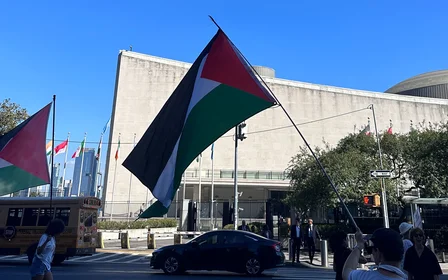
As world leaders gathered at the UN headquarters in Midtown Manhattan for a summit on Palestinian statehood, outside, pro-Palestine protestors say that while recognition is nice to officially have, it makes no difference. To them, Palestine has always been a state.
“To me, Palestine was already a state,” Quinten, a protestor from the Netherlands said. “I see it as a symbolic action, which is of no use. I want them to back up their words by protecting the Palestinian state and actually acting in its interest – like sending armed troops, or to just stop sending weapons."
Another protestor of Sudanese descent, Mazen, said that for him, the United Nations has never been the place to go to seek justice.
“The UN has ignored African issues for decades; it has never been for the African people,” Mazen said. “In fact, the Security Council right now does not have any African representation in a permanent seat."
'Not a political favour'
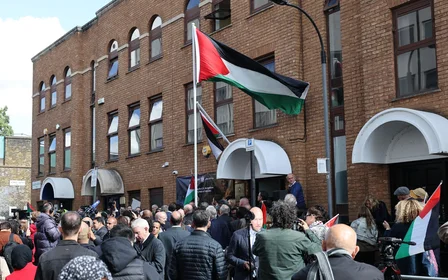
Following the UK’s announcement on Sunday, Palestinian ambassador to the UK, Husam Zomlot, said the UK's recognition was about "righting historic wrongs".
"In the same capital of the Balfour Declaration, after more than a century of ongoing denial, dispossession and erasure, the UK government has finally taken the long overdue step of recognising the state of Palestine," Zomlot said.
Others have been open to the recognition, but have pointed out that it is too little too late.
During a panel on Israel’s occupation of Palestine last week, Oxfam policy lead Bushra Khalidi said that recognition “cannot be a substitute for accountability".
In her opinion, if recognition of Palestine does not come with concrete actions to “halt settlement expansion, to stop arms transfers and to dismantle occupation,” then recognition will not have the impact it intends to have.
“It means your left hand gives bandages, while your right hand provides the weapons and the funding that cause the wounds,” Khalidi said.
“Recognition is not a political favour to be handed out when convenient. Recognition is about affirming a people's inalienable right to self-determination. It is a right. It is a right owed to Palestinians, not a gift to be dangled as leverage."
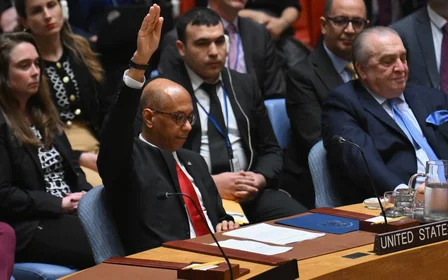
Back outside the UN headquarters today, Quinten said that as long as the United States had vetoing power, there is "no hope" in the UN.
"When the veto is revoked from the US, I might be able to have some hope, but otherwise, I think it will keep on voting for its interests, and that's clearly against the Palestinian interests."
Another protestor, Ridhima Hegde, acknowledged that this moment is a testament to western countries being pressured by their citizens in supporting Palestine, but that it’s mainly to appease, and not advocate, for Palestinian self-determination and statehood.
“Because of the pressure by the people, they are being forced to be pushed to do the right thing and intervene in Gaza immediately," Hegde said. “So it's up to the people to know how these organisations work in order to pressure them to follow their own rules."
New Yorker Jaime Torres argues that what many view as a recent decline in the UN’s legitimacy in fact stretches back much further.
"I don't think it's happened in the last few years. I think it's lost it quite some time ago," he said. "It was born out of a time when there was a more dimensionless kind of experience in the world, and there was more desire to have a unified front to problems," Torres told MEE.
In contrast, UN military medical adviser Dr Egon Ritter argues that the problem does not stem from the institution itself, but from the member states that comprise it.
"The UN is only as strong as the countries supporting the UN," he said.
"Here we have a forum for all the nations to exchange their opinions, to bring in their pros and contrasts, and to see in the future where we're coming to. 'What is the alternative to the United Nations?' is my question to the critics."
Middle East Eye delivers independent and unrivalled coverage and analysis of the Middle East, North Africa and beyond. To learn more about republishing this content and the associated fees, please fill out this form. More about MEE can be found here.