US acknowledges munition 'shortfalls' due to war on Iran

The US is facing ammunition “shortfalls” as a result of the war on Iran, the US Department of War’s inspector general said in a report on Monday.
"The munitions expenditure on OEF has resulted in strategic inventory shortfalls and revealed industrial base bottlenecks for munitions resupply," the report, which was submitted to Congress by the inspector general, said.
To deal with shortfalls and delays, the Pentagon is "working to streamline procurement processes and production lead times, and to stockpile critical materials, components, and selected munitions," the report added,
Though it noted that expanding production capacities requires "significant lead time”.
The Department of War report contradicts US President Donald Trump and Secretary of War Pete Hegseth’s claims that the war has caused no munitions shortfalls.
New MEE newsletter: Jerusalem Dispatch
Sign up to get the latest insights and analysis on Israel-Palestine, alongside Turkey Unpacked and other MEE newsletters
Middle East Eye reported in the early days of the conflict that the US faced a shortage of missile interceptors and that Gulf states were put on waitlists.
'Hundreds of facilities destroyed'
The Associated Press reported in August that the Iran war has impacted the US’s ability to defend Ukraine, with a ”beyond critical" shortage of advanced missile interceptors, especially Patriots, used to shoot down Russian ballistic missiles.
Reuters also reported that the US has exhausted its stockpile of sophisticated long-range missiles used in stand-off strikes.
The US drained its supply of surface-to-surface weapons, including ATACMS and Precision Strike Missiles, Reuters said, citing two sources who said the US had used "virtually all" of these munitions.
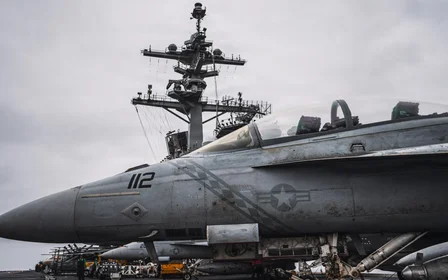
The inspector general's report also identified losses to the American fleet, including four F-15 fighters destroyed, one F-35 fighter damaged, seven KC-135 tanker aircraft damaged, and up to 30 MQ-9 Reaper drones destroyed.
It also confirmed that the US Navy's main logistics hub in the region, located in Bahrain, had been targeted by Iran with drone and ballistic missile strikes.

The report said “hundreds of buildings and structures” at US bases in Kuwait, Bahrain, Qatar, the UAE, Saudi Arabia, Iraq, Oman, and Jordan have been damaged or destroyed by Iranian strikes.
The report says it is not yet clear if all the bases will be rebuilt, or who will foot the bill. It does, however, say the estimated cost of the war is around $33.4bn, but that does not include infrastructure repair costs.
Out of that $33.4bn, $3.7bn is equipment loss and $22.3bn is expended munitions.
MEE has reported that current and former US officials say rebuilding bases in the Middle East is not a viable solution, with Iran showing how vulnerable they are to missiles and drones.
More than 50,000 personnel were deployed throughout the US Central Command area to support the war, with over 1,500 air missions conducted.
As of 30 June, seven US service members had been killed in action and seven in “non-hostile events”, the report said. An additional 417 service members were wounded in action, it added.
Middle East Eye delivers independent and unrivalled coverage and analysis of the Middle East, North Africa and beyond. To learn more about republishing this content and the associated fees, please fill out this form. More about MEE can be found here.