
US completes eighth night of strikes as Iran retaliates across Gulf

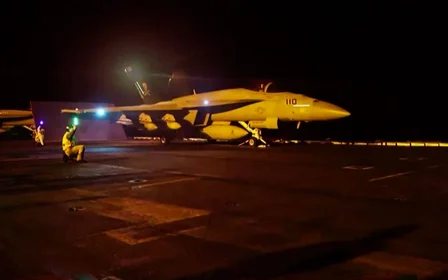
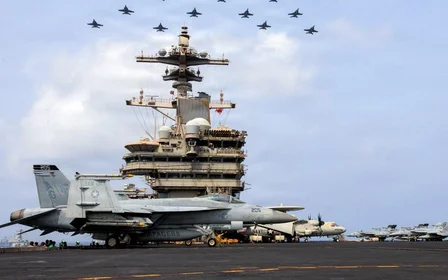
The United States completed an eighth consecutive night of attacks against Iran on Sunday, targeting military buildings and civilian infrastructure across the country's south.
The latest round appeared "less intense" than those carried out over the previous three nights, according to reporting by Al Jazeera.
US Central Command (Centcom) said US forces "successfully hit Iranian military coastal surveillance and air defence facilities, maritime capabilities, and missile and drone storage sites".
It added that its forces also targeted Islamic Revolutionary Guard Corps (IRGC) units that it said were responsible for attacks that killed two American service members in Jordan on 17 July.
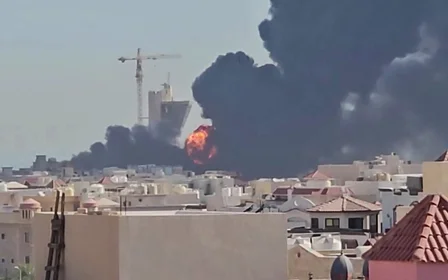
Iranian media reported explosions on Qeshm Island, Bandar Abbas, Hajiabad, Sirik and Shadegan in Hormozgan and Khuzestan provinces.
New MEE newsletter: Jerusalem Dispatch
Sign up to get the latest insights and analysis on Israel-Palestine, alongside Turkey Unpacked and other MEE newsletters
Tasnim News Agency said at least six explosions were heard on Qeshm Island before emergency civil defence teams were deployed to assess the damage.
Major-General Ali Abdullahi, commander of Iran's Khatam al-Anbiya Central Headquarters, warned that "any aggression or barbarism will be met with a decisive and devastating response".
Abdullahi said Washington was trying to create division inside Iran and pledged to "impose heavier costs" on the US than in previous rounds of fighting.
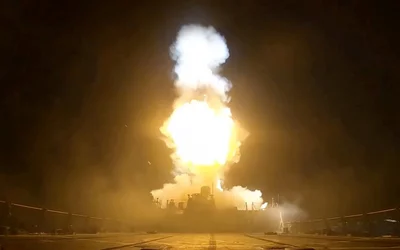
Meanwhile, Iran launched retaliatory attacks against Gulf states hosting US forces.
Iran said it carried out a large-scale drone attack against "two US military facilities" in Kuwait, targeting an ammunition depot at Camp Al Adiri and air defence systems at Ali Al Salem Air Base.
Kuwait's military said its air defences were intercepting "hostile missile and drone attacks".
Meanwhile, Bahrain sounded air raid sirens for the sixth time in several hours and urged residents to seek shelter.
IRGC also said it intercepted and destroyed a US MQ-9 drone over Ahvaz, while Iraqi Kurdish leaders condemned Iranian missile strikes in the Kurdistan region as a violation of sovereignty.
Infrastructure under pressure
Iranian officials said the latest strikes continued to damage civilian infrastructure across the country's south.
Bridges, roads, railways, tunnels and airports have been hit, limiting the movement of civilians, goods and humanitarian supplies, local media reported.
Several hospitals have also been evacuated and school examinations postponed.
Officials said the US was attempting to isolate the country's southern provinces and weaken the IRGC's control over the Strait of Hormuz, while insisting the force would not relinquish the strategic waterway.
The conflict has also heightened concerns over water security across the Gulf.
Kuwait accused Iran for the second time on Saturday of attacking a power generation and desalination plant. Residents told AFP they had begun stockpiling bottled water and canned food amid fears that supply chains could be disrupted.
The Gulf Cooperation Council accounts for about 60 percent of the world’s desalination capacity, making such facilities critical to drinking water supplies in one of the world’s most water-scarce regions.
Iranian officials also said earlier US strikes had destroyed a desalination facility in Hormozgan province, cutting off drinking water supplies to about 10,000 people across 20 villages.
The US Department of State has urged Americans worldwide to exercise increased caution because of escalating tensions in the Middle East.
Middle East Eye delivers independent and unrivalled coverage and analysis of the Middle East, North Africa and beyond. To learn more about republishing this content and the associated fees, please fill out this form. More about MEE can be found here.