US elections: Races to watch in the 2026 midterms

The US midterm elections, particularly the first ones in a new president's term, are always seen as a referendum on the White House's conduct.
This year is no exception, and for both Arab and Muslim Americans in particular, the stakes are high as the administration cracks down on refugees and immigrants, punishes criticism of Israel and pro-Palestine sentiment, and employs open, anti-Muslim verbiage - all moves that have dominated national headlines and radically reshaped how many minority communities go about their daily lives.
US President Donald Trump has also launched a war on Iran, alongside Israel, that has upended the entire region and skyrocketed fuel prices for Americans.
Only three in 10 Americans now approve of Trump's conduct during his first two years, Pew Research revealed last week.
Every two years, all 435 seats in the House of Representatives and about a third of the 100-seat Senate are contested. Representatives serve two-year terms, while Senators, who have a more senior role and are generally more prominent faces, serve six-year terms.
New MEE newsletter: Jerusalem Dispatch
Sign up to get the latest insights and analysis on Israel-Palestine, alongside Turkey Unpacked and other MEE newsletters
Each state has two senators, regardless of size or population. House seats, however, are based on population distribution.
There are no term limits.
Abdul el-Sayed - first Muslim to serve in Senate?
On 3 November, there are at least five Senate races to keep an eye on, as the Democrats seek to flip their fortunes. They are currently outnumbered 47-53 in the upper chamber, and any tie-breakers are decided by the vice president, who is currently a Republican.
Key among them is the Michigan race between Democrat Abdul el-Sayed and Republican Mike Rogers, given Michigan is an unpredictable swing state in US election cycles.
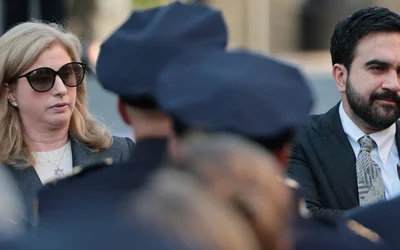
Sayed, who has never held elected office, has become a formidable force in the media, even leading presenters on the staunchly conservative Fox News to praise his style and skill.
Rogers, a former congressman and FBI agent, has Trump's endorsement, as well as the backing of pro-Israeli lobbying groups, from which he has received nearly $6m so far, according to the Aipac Tracker website.
At a campaign rally in Tennessee on Saturday, Trump said he would be referring to Sayed as "Mohammed" because he is a "radical jihadist".
If Sayed wins his race, he would become the first-ever Muslim to serve in the Senate. And unlike the groundbreaking win of New York City's first Muslim mayor, Zohran Mamdani, Sayed was born in the US, making him eligible for a presidential run someday.
The race currently leans in Sayed's favour.
The Senate
In deep Republican-red Texas, the Trump-backed and scandal-plagued Ken Paxton is facing stiff competition from Democrat James Talarico. That race is now also a potential big win for Democrats.
Paxton was previously indicted for fraud and also impeached for corruption while in the state legislature, but never convicted. As Texas attorney general, he has been at the forefront of efforts to criminalise the country's largest Muslim civil rights organisation.
The much younger Talarico has endeared himself to Texans by highlighting his strong attachment to his Christian faith and also his support for Israel, while at the same time saying there should be conditions on the weapons the US sends there.
In Maine, three-decade Senate veteran Susan Collins, a Republican, may very well be unseated by Democrat Troy Jackson, whose relatively new campaign has made it clear he believes Israel is committing a genocide in Gaza, and that the US should not be providing it with military aid.
Iowa's Senate race, which leans Republican but could be a toss-up, will see state legislator and wheelchair basketball player and Democratic candidate Josh Turek up against Republican Congresswoman and former broadcast journalist Ashley Hinson.
Hinson posits herself as a moderate Republican but famously did not support a congressional vote to compel Trump to seek authorisation for the war on Iran. She has also expressed her full support for Israel.
Turek has said that no taxpayer dollars should go to any country accused of violating international law.
And in Ohio, where a special election is taking place to complete the final two years of Vice President JD Vance's former Senate term, Democrat Sherrod Brown is in the lead over Republican incumbent Jon Husted, but the race could still go either way.
Brown was previously a three-term senator and has not changed his position on wholly backing Israel, despite his own party's voters now holding an unfavourable view of the country. His top known organisational donor is J Street, a group that describes itself as "pro-Israel, pro-peace, pro-democracy".
The House of Representatives
In the lower chamber, Republicans have a 218-214 majority. Democrats need to flip at least three to five seats to have measurable impact in the next congressional term. There is also one independent member and two vacancies.
Of the three Republicans in districts that Democratic presidential contender Kamala Harris won in 2024, New York 17th District Congressman Mike Lawler is most at risk.
So much so that Trump appeared to have summoned some anti-Zionist Jewish leaders from that district to the White House in a bid to rally support for him, given their outsized influence.

Nearly three dozen House seats across the country are considered toss-ups this year based on polling and voter sentiment, and a third are in America's heavily red South, defended by Republican incumbents. They range from parts of Virginia through North Carolina and Florida, west to Texas, and then Arizona.
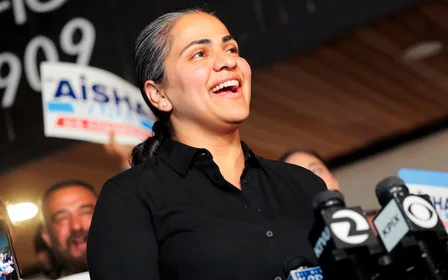
There are currently five Muslim House representatives, all of whom are Democrats: Andre Carson of Indiana, elected in 2008; Rashida Tlaib of Michigan and Ilhan Omar of Minnesota, elected in 2018; Lateefah Simon of California, elected in 2024; and Aisha Wahab also of California, elected in August to fill a vacant seat that she must now run for again in the general election.
But this year, all eyes are on an incoming wave of progressives from deep-blue districts who are all but guaranteed their seats in the US Congress after winning their state primaries.
They are largely political novices who carried the winning messages of the Mamdani campaign: a focus on affordability for working people and support for Palestinian rights.
They have also refused to accept corporate money to fund their campaigns - a relatively risky move in a country where elections can be wholly decided on how much money a candidate has raised.
Adam Hamawy, an Egyptian-American surgeon who gained national attention for his harrowing 2024 medical mission to Gaza, handily won the Democratic primary in New Jersey’s 12th district in June. He is expected to have an easy win next month.
Next door in New York, three progressives and vocal critics of Israel are expected to enjoy similar victories: Darializa Avila Chevalier, a Democratic socialist who mounted a stunning upset when she defeated an incumbent in the state's 13th District earlier this year; state legislator Claire Valdez, also a Democratic socialist who won the primary for the 7th District; and Brad Lander, a prominent Mamdani ally and former comptroller for New York City who won the primary for the 10th District.
The Democratic Socialists of America is not a political party, but it endorses candidates in elections based on its membership and an assessment of the candidate's platform.
In Pennsylvania's 3rd District, progressive Democrat and state legislator Chris Rabb is expected to coast to his congressional seat, as is the winner of the Democratic primary for Colorado's 1st District, 29-year-old Ethiopian immigrant Melat Kiros. She unseated a member of Congress in her primary who had held that job since before she was born.
Middle East Eye delivers independent and unrivalled coverage and analysis of the Middle East, North Africa and beyond. To learn more about republishing this content and the associated fees, please fill out this form. More about MEE can be found here.