
US envoy accuses Druze sheikh of using its backing to persecute other members of the community

US envoy Tom Barrack has criticised a prominent Druze leader in southern Syria, accusing him of exploiting the perception of Israeli backing and US support to persecute other members of the community.
Barrack, the US ambassador to Turkey and special envoy for Syria, made the remarks in an interview with the commentator Mario Nawfal published on X on Friday.
Barrack said his concern was not Israel but “a particular Druze sheikh”, whom he accused of using perceived Israeli backing and an apparent alignment with Washington to persecute other Druze.
“But let me tell you what, it’s not Israel that worries me. It’s a particular Druze sheikh who utilises the perception of Israeli backing and some alignment with America to persecute other Druze”.
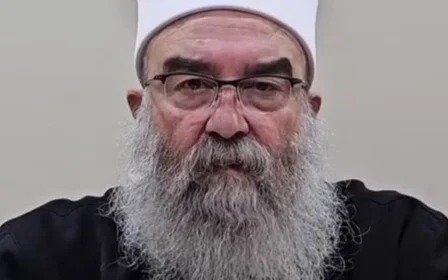
Barrack did not name the sheikh in the remarks. However, his comments come amid tensions surrounding Hikmat al-Hijri, a prominent Druze spiritual leader in Sweida who opposes Damascus's authority, called for Israeli support and advocated for independence from Syria.
New MEE newsletter: Jerusalem Dispatch
Sign up to get the latest insights and analysis on Israel-Palestine, alongside Turkey Unpacked and other MEE newsletters
Barrack further rejected the claims suggesting the sheikh had Washington's support, saying “it's absolutely wrong".
Earlier this month, Hijri's supporters raised Israeli flags at a rally in Sweida marking the anniversary of the 7 October 2023 attack.
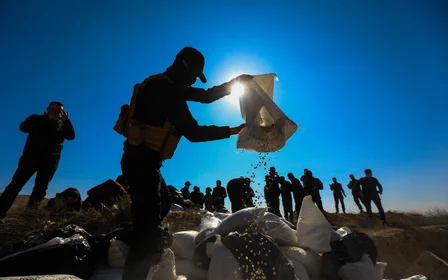
Barrack also indicated that the armed Druze factions in the province are funding their weapons through the captagon trade.
"Sweida to Daraa is the captagon manufacturing operation of the world. That's what it does. It lives off of the manufacturing and selling of illicit drugs," he said.
"The Druze can arm themselves with the money that they're making from the captagon trade. This captagon is something, and it's like manufacturing meth," he added.
However, the "Bashan administration", affiliated with al-Hijri, rejected Barrack's statements and denied that Jabal Bashan is a centre for captagon production in a Facebook post.
“The Bashan administration expresses its profound anger and unequivocal condemnation of the misleading falsehoods and baseless accusations made by US Presidential Special Envoy Tom Barrack in his recent remarks.
"We categorically reject Barrack's reckless attempt to portray Jabal Bashan as a centre for captagon production. It is a matter of public record that our community stood on the front lines against smuggling networks, confronting them at great personal cost and sacrificing some of its finest young men in the struggle to eradicate this scourge," the statement read.
In May 2026, al-Hijri declared that the move toward self-determination cannot be reversed, emphasising the goal of creating a fully independent administration for Jabal Bashan, entirely distinct from Damascus's government.
Regarding Israel's relationship with the Druze, Barrack said the relationship was beyond political interference, pointing to Druze communities in the Golan Heights and along the border.
“Israel’s alignment with the Druze is not just for political interference. The Druze, the Golan Heights Druze and the Druze right on the border have paid the price of being an ally along with the IDF soldiers forever.”
Israel has repeatedly presented its military intervention in southern Syria as an effort to protect the Druze, and in July 2025 it struck Syrian government forces during the fighting in Sweida.
Barrack said Syria had exercised restraint in response to Israeli incursions, warning that retaliation could trigger a wider conflict.
"Syria has been very cautious. It knows that if it bites on one of these incursions, the fire is going to explode."
"So it's been very patient in allowing Israel to protect its 'buffer zone' by coming across and having the Druze conduct themselves inappropriately," he added.
Syria and Israel expected to reach understanding
On relations between Damascus and Tel Aviv, Barrack said he believed the two countries would eventually reach an understanding, despite continuing mistrust and tensions along their shared border.
“I think Israel and Syria will come to terms,” he said, arguing that Syrian President Ahmed al-Sharaa had made clear he did not want a confrontation with Israel.
He said Israel remained wary of Syria's new leadership because of Sharaa's past as a fighter with al-Nusra Front and the presence of foreign fighters in Syrian army divisions deployed near the Israeli border.
Barrack said Israel was seeking greater security along its border following the Hamas-led attacks of 7 October 2023, adding that Israeli officials remained unconvinced that Syria's assurances were sufficient.
Barrack described the negotiations between Syria and Israel as an ongoing trust-building process, saying the two sides have held five rounds of border and boundary talks, beginning in Paris in May 2024.
“We almost got there. I think we'll get there again,” he said.
Middle East Eye delivers independent and unrivalled coverage and analysis of the Middle East, North Africa and beyond. To learn more about republishing this content and the associated fees, please fill out this form. More about MEE can be found here.