US freedom ranking drops to 'obstructed' for 2025

The repression of Palestine solidarity activism, violent Immigration and Customs Enforcement (ICE) raids on immigrant communities, and censorship of the press in the US mean the country's civic freedom ranking has been downgraded to "obstructed" status, the Johannesburg-based Civicus Monitor said on Tuesday.
Its annual People Power Under Attack report assesses and rates the state of civic space conditions based on data collected throughout the year from country-focused civil society organisations, as well as human rights groups.
The US's ranking for 2025 puts it in the same category as Gabon, Mauritania, and Senegal, though the three African nations have demonstrated an upward trajectory this year, unlike the US, the report found.
President Donald Trump's return to office has brought "unprecedented executive orders designed to unravel democratic institutions, global cooperation, and international justice", the report said.
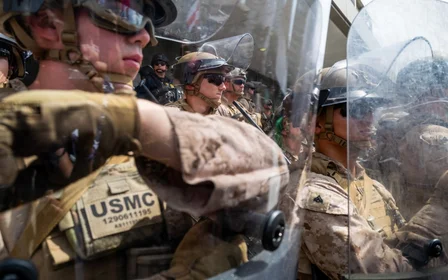
"Authorities have adopted a militarised response to large-scale protests triggered by aggressive and racist federal operations targeting migrant communities," it added.
New MEE newsletter: Jerusalem Dispatch
Sign up to get the latest insights and analysis on Israel-Palestine, alongside Turkey Unpacked and other MEE newsletters
The US also saw new waves of "censorship, judicial harassment and political interference manifesting in the cancellation or suspension of major talk shows, funding cuts affecting independent media and tighter restrictions on White House press access".
The five Civicus categories from top to bottom are "open", "narrowed", "obstructed", "repressed", and "closed".
Alongside the US, 14 other countries have been downgraded this year, mostly to either "obstructed" or "repressed" status.
They include Argentina; France; Germany; Italy; Liberia; El Salvador; Georgia; Israel; Madagascar; and Serbia.
Switzerland was downgraded from "open" to "narrowed".
Burundi, Oman, and Sudan were all downgraded to being "closed" societies.
Palestine activism
As with last year's report, the crackdown on Palestine solidarity was a key factor in the global rankings, and certainly in the US.
"With authorities cracking down on dissent across university campuses, including criminalisation of foreign-born students, disproportionate disciplinary measures against students and faculty, funding freezes and tax pressure on institutions and suspension of student groups, echoing a similar pattern of reprisals in 2024 during the Joe Biden administration," the Trump administration has only intensified its "repression", the report said.
Civicus also cites the US sanctions on the International Criminal Court (ICC) prosecutor and judges, as well as Palestinian human rights organisations and Francesca Albanese, the United Nations special rapporteur on the situation of human rights in the Palestinian territories.
Among its overall recommendations for 198 governments around the world, the report urged an "enabling environment" for civil society activists, recognition for the "distinct needs" of minority groups and people with disabilities, and investigations into law enforcement agencies that use excessive force.
They were mostly broad concepts that could apply to a vast set of circumstances.
Palestine activism, however, was the only specifically named issue.
Civicus urged governments to "respect protest rights in solidarity with [the] Occupied Palestinian Territories and stop repression and vilification".
To the UN and other international bodies, the report called for the strengthening of existing mechanisms and the implementation of new ones to address "reprisals" among "those mobilising solidarity with Palestinians".
Middle East Eye delivers independent and unrivalled coverage and analysis of the Middle East, North Africa and beyond. To learn more about republishing this content and the associated fees, please fill out this form. More about MEE can be found here.