
Israeli raids stoke renewed takeover fears at West Bank's Joseph’s Tomb

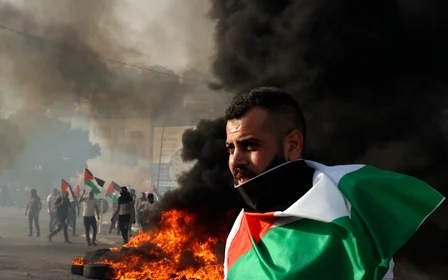
Like many areas across the occupied West Bank, Joseph’s Tomb has seen a spike in assaults by Israeli forces and settlers under the cover of the war on Gaza.
The site - located near Nablus, which is nominally under Palestinian Authority administrative control - has long been a target of Israeli raids that frequently result in killing of Palestinians.
Since October 2023, the site has been subjected to larger and more frequent settler-led incursions, with groups entering the area alongside Israeli forces under a religious pretext.
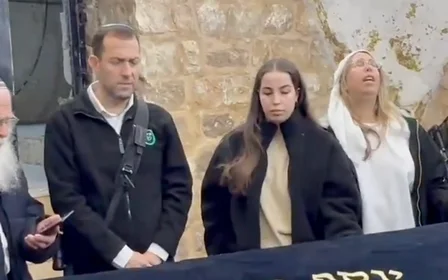
The most recent incident occurred last week, when settlers were joined by 20 US lawmakers from the National Association of Christian Lawmakers (NACL) who praised the Israeli army and reaffirmed their support for Israeli sovereignty over the West Bank.
“Israel and the Jewish people are the rightful heirs and sovereigns of all these areas,” said Arkansas Senator Jason Rapert, founder of NACL, during the army-escorted visit.
New MEE newsletter: Jerusalem Dispatch
Sign up to get the latest insights and analysis on Israel-Palestine, alongside Turkey Unpacked and other MEE newsletters
“We appreciate the IDF for their escort and protection as we visited Joseph’s Tomb,” he added.
The visit was far from an innocent political gesture, according to Palestinians.
Veteran Palestinian journalist and commentator Nawaf al-Amer described it as part of a growing trend since October 2023 indicating an Israeli push for reasserting control.
“Since 7 October, the situation has completely shifted,” al-Amer told Middle East Eye.
“Israel has been carrying out large, scheduled incursions involving significant numbers of settlers, religious figures, political leaders and influential parliamentarians,” he explained.
This, along with reports in Israeli media, shows a clear plan to “restore full Israeli control” over the area and re-establish the site as a religious school, he added.
'Fabricated historical narrative'
Since 1967, control over Joseph’s Tomb has been a focus of Israeli ambitions, consistently met with fierce Palestinian resistance.
The tomb holds symbolic and religious significance for both Palestinians and Jews, each presenting counter-narratives about the site's history and meaning.
'The occupation has attempted to construct a fabricated historical narrative to claim ancient roots in the land'
- Nawaf al-Amer, Palestinian commentator
Palestinians believe it is the burial place of Sheikh Youssef Dweikat, a local cleric who lived in nearby Balata in the early 1900s.
Israelis, meanwhile, maintain that the shrine contains the tomb of the Prophet Joseph, a figure revered in both Islamic and Jewish traditions.
In the 1980s, an Israeli yeshiva was established at the site and heavily guarded by Israeli forces.
Settlers regularly organised visits under military protection, often passing through densely populated Palestinian areas.
Palestinians, accusing settlers of fabricating religious pretexts to extend Israeli control over the city, frequently confronted these incursions.
Israeli forces routinely opened fire at unarmed Palestinians during such protests, killing many over the years.
By 2000, the Israeli army abandoned its permanent post at the tomb. However, it continued organising monthly settler visits from across the West Bank.
Al-Amer, who has extensively covered events at Joseph’s Tomb, said the religious narrative surrounding the site has been constructed to justify a broader process of Judaisation across the West Bank, which in turn is used to legitimise the occupation.
“The occupation has attempted to construct a fabricated historical narrative to claim ancient roots in the land, using religious symbolism to serve political aims. Joseph’s Tomb is one example,” he explained.
He added that rituals performed by settlers at the site often involve dancing, singing and chants.
“The religious claim of prayer is viewed as a cover for political, settlement and Judaisation objectives, similar to hundreds of other locations,” he said.
He noted there is now an attempt to reintroduce the yeshiva, given the expansion of settler activity across the West Bank since October 2023.
Over the past two years, settler violence and access restrictions have surged across the West Bank, leading to the forced displacement of 2,200 Palestinians from their homes, according to the UN.
This comes in addition to more than 6,000 people displaced due to home demolitions, and a further 40,000 displaced from northern West Bank refugee camps during Israeli military assaults.
Settlers have also killed 21 Palestinians during the same period, out of more than 1,000 people killed by Israeli forces in the West Bank.
Middle East Eye delivers independent and unrivalled coverage and analysis of the Middle East, North Africa and beyond. To learn more about republishing this content and the associated fees, please fill out this form. More about MEE can be found here.