US promises 'asphyxiation' of Islamic Republic as it imposes new sanctions

The US has promised the "asphyxiation" of the Islamic Republic as it imposed harsh new sanctions on Iran and threatened those who traded with it.
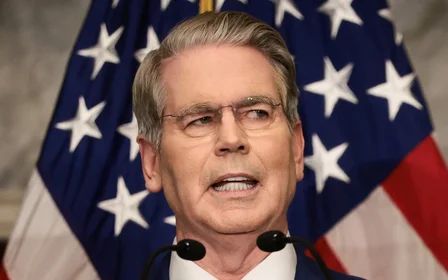
US Treasury Secretary Scott Bessent on Monday said they were working towards the "asphyxiation of this regime" amid the standoff in the Strait of Hormuz.
"Iran now faces a very clear choice, with only two paths before them: complete global isolation and a subsistence economy, or a path back to normalcy with an opportunity to rejoin the global economy," Bessent told reporters in Washington.
Bessant said that "Operation Economic Outcast" would "foreclose" every other option available to Iran, having earlier described the sanctions as an "economic D-Day".
"America is no longer managing the Iranian threat. We are ending it."
New MEE newsletter: Jerusalem Dispatch
Sign up to get the latest insights and analysis on Israel-Palestine, alongside Turkey Unpacked and other MEE newsletters
Using a "zero leakage approach", he said the Treasury had "mapped every node, every facilitator, and every network that Iran has used to smuggle oil and evade sanctions", and that President Donald Trump had already made phone calls to counterparts around the world "with specific requests to cease their interactions with the regime".
The threat to target those trading with Iran has already provoked a backlash, with China on Tuesday warning it would "firmly defend" its interests.
China is a crucial strategic and economic partner for Iran, with more than 80 percent of Iranian oil exports destined for the country prior to the war, according to the analytics firm Kpler.
Chinese foreign ministry spokesperson Lin Jian denounced the use of "economic warfare" saying it would do nothing to solve the problems in the region.
"It only stokes tensions and conflicts, triggers spillover effects, destabilises the global economic and financial order, and harms the legitimate rights and interests of other countries," he said.
Economic downturn
The Iran war, which has been ongoing in fits and starts since late February, has continued to take a toll on the global economy.
Only two commodity tankers passed through the Strait of Hormuz on Monday, the lowest daily number recorded since early May, according to shipping data.
Both vessels entered the Gulf from the Gulf of Oman, ship-tracking firm Kpler said. They included one very large gas carrier and one very large crude carrier.
Monday’s total fell sharply below the 10-day daily average of 14 vessels, Kpler data showed on Tuesday.
Preliminary figures from another ship-tracking firm, Vortexa, put Monday’s oil flows through the strategic waterway at five million barrels per day.
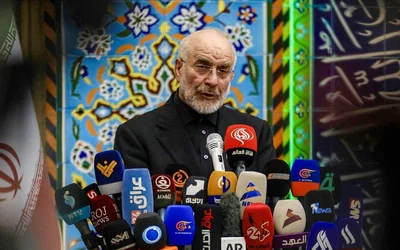
The seven-day moving average stood at between six million and seven million barrels per day as of 23 August.
Trump and the ruling Republican Party are expected to take a pummelling in midterm elections in November, in large part due to the war on Iran, which has hit Americans' pockets.
US Senator Chris Murphy, a Democrat, on Monday criticised the White House’s new sanctions on Iran, warning that American citizens were "paying a huge, huge cost" for the decision.
"'D-Day' is desperate window dressing. Iran is winning the war. Trump is losing. And Americans are paying a huge, huge cost," he said in a post on X.
In a series of posts, Murphy went on to list a number of reasons for Washington's setbacks in its war on Iran, including not achieving initial objectives, Tehran's control of the Strait of Hormuz and the depletion of army resources, including munitions.
"The bottom line: Trump lost the military campaign. And now he's desperate so in his humiliating defeat, he's selling this fake economic pressure to keep up the impression we are still fighting," Murphy added.
"But the war is basically over. Tragically, Iran won. This is all window dressing."
Middle East Eye delivers independent and unrivalled coverage and analysis of the Middle East, North Africa and beyond. To learn more about republishing this content and the associated fees, please fill out this form. More about MEE can be found here.