US sanctions International Criminal Court president, trial lawyer in bid to dismantle body

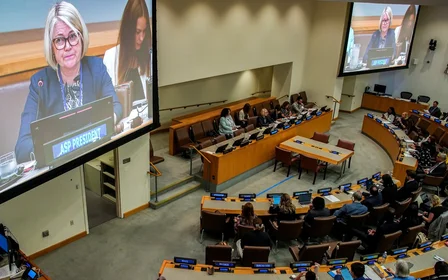
The US announced on Tuesday that it is sanctioning the Japanese president of the International Criminal Court (ICC), Tomoko Akane, as well as the body's Senegalese senior trial lawyer, Abdoulaye Seye.
The move is just the latest step in implementing US President Donald Trump's stated mission of dismantling the ICC for investigating Israeli and, potentially, US officials for war crimes.
Neither country is a signatory to the Rome Statute, which established the court in 2002.
There are, however, 125 countries that are ICC member states, several of which have been roiled by extrajudicial US and Israeli military action.
"The Trump Administration has been clear: the ICC is a corrupt and fatally politicized supranational court that has maliciously abused its authority and exceeded its mandate. We will not tolerate its assault on state sovereignty," Secretary of State Marco Rubio said in a statement.
New MEE newsletter: Jerusalem Dispatch
Sign up to get the latest insights and analysis on Israel-Palestine, alongside Turkey Unpacked and other MEE newsletters
Akane and Seye, he added, "have directly engaged in efforts by the ICC to investigate, arrest, detain, or prosecute officials whose government has not consented to ICC jurisdiction... This sets a dangerous precedent for all nations".
Just days after he assumed power in late January 2025, Trump signed an executive order to sanction the ICC over its investigations into top Israeli officials.
British barrister Karim Khan, who was the ICC's chief prosecutor, was the top sanctioned individual at the time.
He has since been removed through a vote by member states, albeit due to sexual misconduct allegations. Khan has denied them.
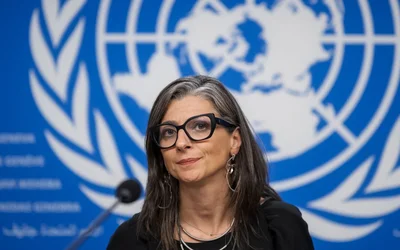
Three out of eight ICC judges were also sanctioned, alongside two of Khan's deputies, the United Nations special rapporteur for the occupied Palestinian territories, and three Palestinian human rights organisations.
The judges have since sued the Trump administration.
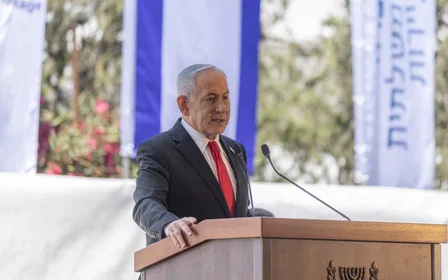
The Trump executive order followed a White House visit by Israeli Prime Minister Benjamin Netanyahu, who is wanted by the ICC over alleged war crimes and crimes against humanity committed in Gaza since October 2023.
Netanyahu and his then defence minister, Yoav Gallant, were issued arrest warrants in November 2024, alongside three Hamas leaders, who have since been killed by Israel.
All non-US individuals and their family members who assist in ICC investigations into US citizens or allies fall under the sanctions order. Their assets are frozen, they cannot use the international banking system, and they cannot enter the US.
"The Trump Administration stands ready to take additional measures, if necessary, to systematically dismantle the ICC until it is incapable of threatening American sovereignty," Rubio said.
'Brick by brick'
Last week, four US-based rights groups sued the Trump administration for its sanctions on the ICC.
In a statement, the American Friends Service Committee, the Center for Constitutional Rights, Human Rights Watch, and the Open Society Institute called the sanctions "blatantly illegal".
They said they are being forced "to curtail a wide range of human rights and legal work in violation of... First and Fifth Amendment rights under the US Constitution and under the Religious Freedom Restoration Act", given that anyone who appears to associate with ICC cases or officials could now face legal repercussions.
And in July, advocates for Palestinian rights in the US also filed a lawsuit in a New York City federal court, seeking an injunction to stop the Trump administration's enforcement of sanctions against groups or individuals liaising with the ICC.
Democracy for the Arab World Now, founded by the late Middle East Eye columnist Jamal Khashoggi, as well as the Taxpayer Alliance Against Genocide, said they felt compelled to immediately go to court after Rubio wrote in an opinion piece that the US was willing to dismantle the ICC "brick by brick".
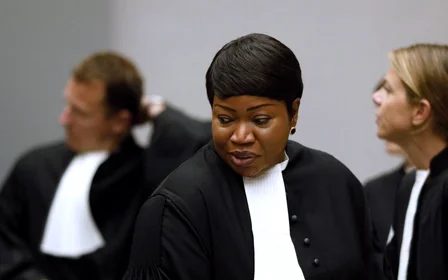
Earlier this year, former ICC chief prosecutor Fatou Bensouda said the previous head of Israel's Mossad intelligence agency pressured her in a series of meetings to drop her investigation into alleged war crimes in occupied Palestine.
Bensouda, who served in her role from 2012 to 2021, said unidentified men came to her home in The Hague after she opened a preliminary examination into the situation in Palestine in 2015.
"They came directly to my house," Bensouda told Al Jazeera in an interview published on Sunday. "I got the message that they’re sending."
She said the men handed her an envelope containing $500 and indicated it was from someone she had helped. Bensouda said she later concluded the gesture was intended to show that those behind it knew where she lived.
Middle East Eye delivers independent and unrivalled coverage and analysis of the Middle East, North Africa and beyond. To learn more about republishing this content and the associated fees, please fill out this form. More about MEE can be found here.