
War deadlock and international pressure: Why Netanyahu backs Trump’s Gaza plan

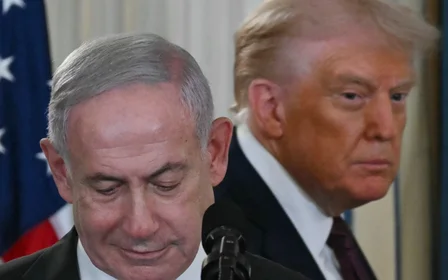
The announcement of the Israeli-backed US "peace plan" for Gaza on Monday is far from accidental.
It reflects a growing recognition by Prime Minister Benjamin Netanyahu that the war has reached a deadlock - both strategically and politically.
Israel’s latest ground offensive on Gaza City, aimed at driving out its Palestinian population and occupying the Strip, has already displaced the majority of the city’s one million residents to the south.
Yet, Netanyahu appears increasingly aware that military force alone cannot deliver the "total victory" he promised in 2023.
Even if the Israeli army succeeds in pushing all Palestinians from Gaza City to the southern part of the enclave, around two million Palestinians would remain in the Strip.
New MEE newsletter: Jerusalem Dispatch
Sign up to get the latest insights and analysis on Israel-Palestine, alongside Turkey Unpacked and other MEE newsletters
In this scenario, the Israeli government’s primary objective - complete control through forced displacement - would remain unfulfilled.
Netanyahu and his far-right government have openly advocated for the removal of Palestinians from Gaza - what is euphemistically referred to in Israeli discourse as “voluntary emigration”.
However, he is aware that forcibly expelling Palestinians from Gaza is not a feasible solution.
No country has expressed willingness to accept large numbers of expelled Palestinians, and neighbouring Egypt has made clear its opposition to any mass displacement across its border.
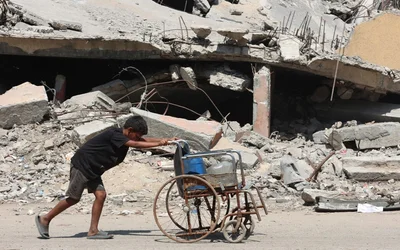
Netanyahu knows that occupying Gaza City and forcing out its population will not improve Israel’s strategic position.
On the contrary, it will likely lead to the city’s destruction and further isolate Israel on the international stage.
Furthermore, the scenes emerging from Gaza in recent weeks - since Israel launched its renewed offensive on Gaza City - have triggered an unprecedented decline in the country’s global standing.
There has been a wave of international condemnation and boycott threats.
From calls to expel Israel from the Eurovision song contest to potential suspension from Uefa, the backlash is intensifying.
The European Union is also reportedly considering suspending its trade agreement with Israel, which would represent a significant economic and diplomatic blow.
This mounting international pressure, along with recent moves by western nations, such as France, Britain and Australia, to recognise a Palestinian state during the UN conference in New York, has sent a clear message to the Israeli prime minister: now is the time to end the war in Gaza.
Failed Qatar attack
Internal pressure within Israel - not just mounting international criticism - also played a significant role in Netanyahu’s decision to accept the American plan.
Israel’s Chief of Staff Eyal Zamir warned that the occupation of Gaza City would neither end the war nor ensure the safety of the 20 Israeli captives still held by Hamas.
Recently, Hamas announced that it had lost contact with the operatives holding two of the captives, sparking deep concern among the captives’ families.
Netanyahu, known for closely monitoring public opinion, has also seen a decline in domestic support.
While there is no widespread opposition among the Israeli public to continued military operations in Gaza, recent polling suggests a shift in political sentiment.
A recent survey conducted by Channel 12 showed Netanyahu’s coalition dropping to 48 seats - a loss of around 20 compared to previous polls.
Internal pressure within Israel - not just mounting international criticism - also played a significant role in Netanyahu’s decision to accept the American plan
In addition to both international and internal pressure, another pivotal factor contributing to Netanyahu’s strategic impasse was the failed Israeli attack in Qatar earlier this month, in which Israeli forces attempted to assassinate senior Hamas leaders.
The botched attack sparked a rare show of unity among Arab and Muslim states, forming a broad coalition that included countries Israel had previously considered potential allies.
From Egypt to Qatar, and from the United Arab Emirates to Saudi Arabia, these governments have begun to speak of Israel as a destabilising force in the region.
Egyptian President Abdel Fattah el-Sisi expressed unusually strong condemnation during a conference in Doha, referring to Israel as “the Israeli enemy”, language not officially used by an Egyptian head of state since the 1979 peace treaty between the two countries.
Netanyahu understands that this emerging coalition could pose an economic threat through countries such as Qatar and Saudi Arabia, and a military threat through countries like Egypt, which is already reportedly mobilising troops in Sinai.
The failed Israeli attack in Doha also led to Qatari pressure on US President Trump to limit Israel's activity in the region.
Qatar's influence on Trump personally is great, with his family and his administration doing profitable business in the Gulf state.
Vague plan
Following the publication of the proposed plan, Netanyahu appeared content, even claiming that the agreement would lead to the isolation of Hamas, rather than of Israel.
Although the deal has yet to be formally signed, Netanyahu appears to hope that a symbolic Israeli endorsement - however non-committal - will be enough to reduce the intensity of international pressure.
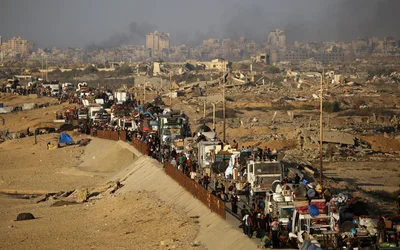
It is possible that his calculated show of support could indeed ease Israel’s growing diplomatic isolation.
However, it remains too early to judge, as much depends on the responses of both Hamas and the broader Arab coalition.
Yet, Netanyahu’s satisfaction with the plan is, in many ways, understandable.
The agreement is ambiguously worded and leaves considerable room for interpretation, with multiple loopholes and vague provisions regarding the future.
Crucially, it includes no firm Israeli commitment beyond a limited initial withdrawal following the release of captives by Hamas.
There is, in fact, no binding Israeli pledge to end the war altogether.
The details surrounding the proposed international force - how it will be formed, what mandate it will hold, and how it will operate - remain unclear and undefined.
Coalition trouble
Despite this, several elements of the agreement are likely to face strong opposition from key figures within Netanyahu’s governing coalition - particularly the far-right ministers Bezalel Smotrich and Itamar Ben Gvir.
Both have been among Netanyahu’s most vocal and influential partners in the genocide in Gaza, and they are unlikely to accept the agreement as it stands.
While Smotrich, finance minister, and Ben Gvir, national security minister, do not have the power to block the agreement within the government - as Netanyahu retains a governing majority - they could choose to resign in protest.
This could trigger early elections, well ahead of the scheduled date in November 2026.
For Ben Gvir and Smotrich, point 12 of the White House proposal, which states that “no one will be forced to leave Gaza” represents a complete betrayal of one of their central goals.
The forced expulsion of Palestinians from Gaza has become a core objective for the far right, one that Netanyahu and several other ministers have echoed as part of Israel’s broader war aims.

Smotrich and Ben Gvir view any compromise on this front as a missed, perhaps historic, opportunity to permanently alter the demographic and political landscape - to depopulate the Gaza Strip and, in their view, “resolve” the conflict with Palestinians on Israel’s terms.
Further provisions in the plan will be equally difficult for them to accept.
Netanyahu’s apology to Qatari Prime Minister Mohammed bin Abdulrahman bin Jassim Al Thani, the proposed release of hundreds of Palestinian prisoners - including scores serving life sentences - and the deployment of an international force into Gaza, all represent major concessions.
For years, Israel has staunchly opposed international military or political involvement in Gaza; reversing that stance will be seen by the far right as a capitulation.
Then there’s point 19 of the agreement - calling for “a credible pathway to Palestinian self-determination and statehood” contingent on Palestinian Authority reforms - along with clauses allowing humanitarian aid to be administered through UN agencies.
Those could further inflame tensions within the coalition. The far right will reject any language implying a future Palestinian state or legitimising UN involvement.
Nevertheless, Netanyahu appears to have sufficient support within his own Likud party to proceed with the agreement. He can also count on backing from the opposition, whose leaders have publicly endorsed the deal.
Still, Netanyahu may choose to call early elections once the agreement is signed.
By doing so, he could attempt to reframe the moment politically - presenting himself not as a prime minister under pressure, but as one who resisted both domestic and international demands while delivering a “historic” blow to Hamas.
Yet, regardless of how Netanyahu spins it, Israel’s core war aims remain far from realised.
The continued presence of Palestinians in Gaza, the potential deployment of international forces, and the possibility - however remote - of Palestinian statehood all represent significant setbacks for the Israeli government.
Above all, they underscore the political and strategic crisis Netanyahu now faces.
Middle East Eye delivers independent and unrivalled coverage and analysis of the Middle East, North Africa and beyond. To learn more about republishing this content and the associated fees, please fill out this form. More about MEE can be found here.