'We are crazy radicals': Israel's anti-war protesters struggle against ruling consensus

On Saturday night, as the war on Iran entered its third week, a small group of Israelis assembled in central Jerusalem.
“One, two, three four, we don’t want your fucking war,” chanted protesters, some dressed in orange jumpsuits and donning masks bearing the face of Israeli Prime Minister Benjamin Netanyahu.
Earlier that day, a protest with similar aims had been held in Tel Aviv. Neither demonstration gathered more than a hundred people.
One of the protesters was Noah, a 23-year-old Orthodox Jew who could only be identified by his first name. “My God does not want the state, that claims to be in his name, to be waging wars and consistently killing thousands of people,” he told Middle East Eye.
Despite a civilian death toll that continues to mount, both domestically and across the Middle East, Noah knows his opinion places him in the minority.
New MEE newsletter: Jerusalem Dispatch
Sign up to get the latest insights and analysis on Israel-Palestine, alongside Turkey Unpacked and other MEE newsletters
As it stands, 15 people have died in Israel, including nine on the second day after a direct strike on a building in Beit Shemesh, just west of Jerusalem. These figures pale in comparison to the carnage unleashed by Israel in both Iran and Lebanon, where thousands are dead and millions displaced.
Despite the rising casualties, calling for an end to the violence is a fringe position in Israel.
“We are viewed as crazy radicals,” says Mitan, a 46-year-old woman who attended the protest in Tel Aviv earlier that day, before making her way north to Jerusalem. “Trump and Bibi [Netanyahu] dragged us into another pointless war. They try to keep us quiet but we can't sit at home anymore.”
Israel’s anti-war coalition
While there is an elite consensus in Israeli society that this war will bring safety to the country, a few civil society voices have offered dissent.
As well as a handful of protests, 80 Jewish and Arab organisations recently signed an open letter to US President Donald Trump and Netanyahu. Put together by It’s Time, a coalition of peacebuilding groups, the letter calls to “stop the war with Iran - a war whose goals are unattainable and that lacks a clear exit strategy”.
For Mika Almog, creative director for It’s Time and granddaughter of former Israeli Prime Minister Shimon Peres, the war has caused Israeli society more harm than good. Schools are closed, the economy is hit and, she says, “our children are in constant danger of getting killed”.
'We are viewed as crazy radicals... Trump and Bibi dragged us into another pointless war'
- Mitan, Israeli anti-war protester
Almog says the current war did not begin in a vacuum. She traces regional instability back to the Israeli-Palestinian conflict, something Netanyahu has shown no willingness to solve through diplomatic means.
“There are seven million Palestinians who are living under occupation, who don’t have a future to look forward to,” Almog says. “This idea that you can keep them in this situation and it's not going to deteriorate is ludicrous.”
On top of pushing for diplomacy instead of never-ending military campaigns, Almog emphasises that one of the coalition's main objectives is to bring the idea of peace back into Israeli discourse.
She stresses that since the assassination of then-Israeli prime minister Yitzhak Rabin in 1995, “peace and negotiations have not been presented to the public as realistic options”.
Almog notes that when the public is offered a realistic option of peace, willingness grows significantly. “When the only thing we have is war, then people end up supporting war,” she says.
Political class lines up for war
While studies show that support for peace in Israeli society does increase when concrete diplomatic options are presented, voices presenting such an alternative are nowhere to be found in the current political establishment.
While Netanyahu declared a “historic victory” over Iran a mere eight months ago, the prime minister has made clear that this new war against Iran is once again essential, proclaiming that “we are in a fateful campaign for our very existence”.
For Haaretz columnist Gideon Levy, this war has been Netanyahu's “life project”. The veteran Israeli journalist, who also writes for Middle East Eye, says that even if fearmongering about Iran serves Netanyahu politically, “he really does believe that Iran is an existential danger”.
'There are seven million Palestinians who are living under occupation, who don’t have a future to look forward to'
- Mika Almog, It's Time coalition
Opposition parties have cemented this consensus. Rather than push for peaceful alternatives, many have outflanked Netanyahu, pushing even more hawkish, right-wing positions.
On the first day of the war, leading political rival Naftali Bennett backed the army and prime minister, writing on X that, “The entire nation of Israel stands behind you until the destruction of the Iranian threat.”
Opposition Leader Yair Lapid, who is often described as a centrist, has called on the army to “destroy all the oil fields and energy industry” on Kharg Island, Tehran’s main oil export hub.
But it's not only politicians who have rallied round the attacks on Iran. Israel’s media, much of which has portrayed the genocide in Gaza as an act of self-defence, has once again uncritically touted the views of the political establishment.
Levy notes that within the mainstream, “raising doubts about the war is not legitimate, you will not hear it or see it”.
One of the few Knesset members to speak out, Ofer Cassif of the communist-led Hadash-Ta'al coalition, has called the war “an imperialist aggression against the Iranian people”. But inside a united parliament, his calls for a diplomatic resolution are almost invisible.
Israeli public supports war on Iran
Given the rabid support from mainstream media and politicians, it’s not surprising that Israel’s public is heavily in favour of the war.
According to the latest polls from the Israel Democracy Institute, 92.5 percent of Israelis support Operation Roaring Lion, the codename for this war. The picture is different among Palestinian citizens of Israel, with 65 percent voicing opposition.
A large part of this support stems from the belief that Iran poses the single largest threat to Israel’s security.
Ofer Shelah, former Knesset member and researcher at the Institute for National Security Studies (INSS), explains that for over a decade, Israelis have come to see Iran as “the source of all evil”.
Shelah argues that this perceived danger legitimises each military campaign, even if the death toll domestically continues to rise. “It's a rationale for almost everything we do, because if we don't do it, we will be faced with more October 7ths.”
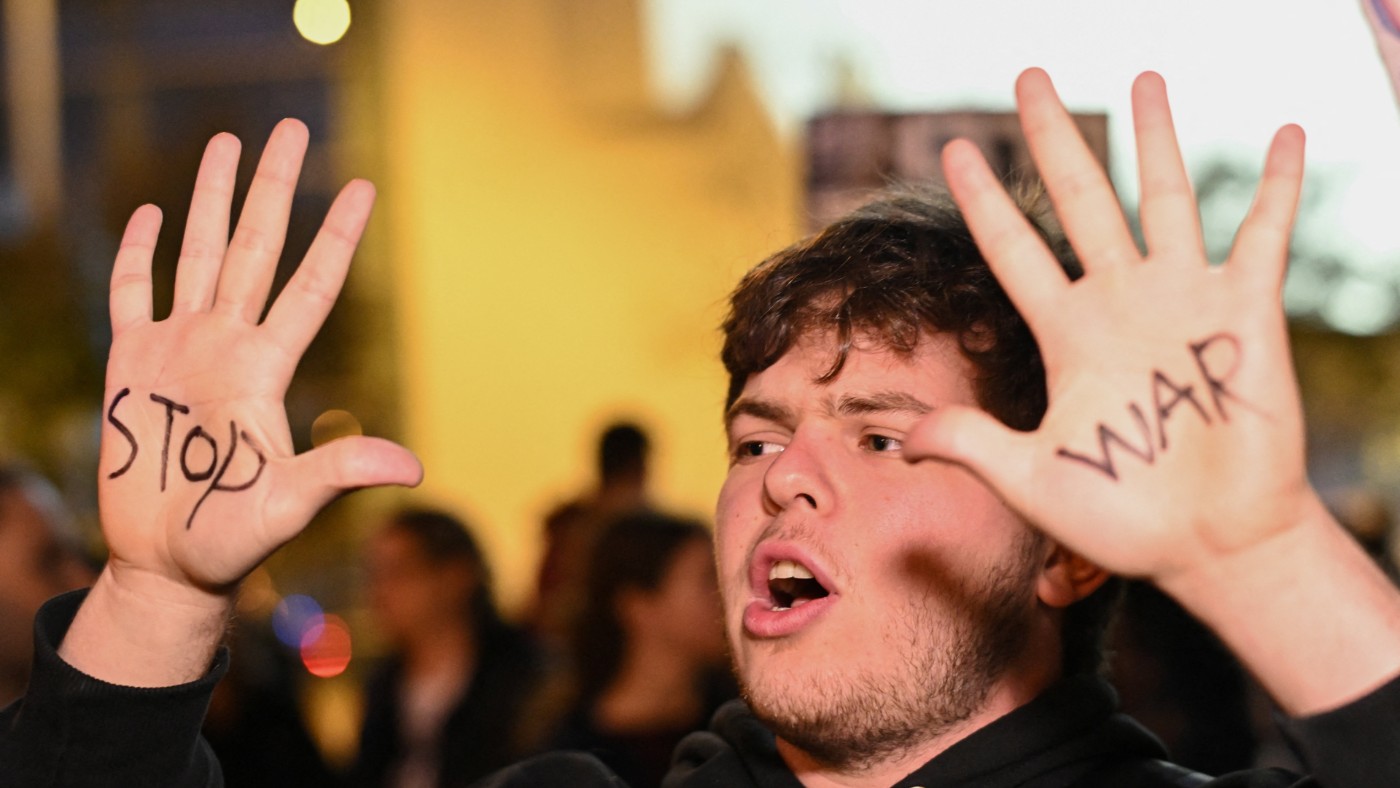

And yet, despite facing a prevailing consensus that a continued war is what’s right for the country, Israel’s pacifist movement perseveres.
For Noah, the small recent protests are an opportunity to call for a new government, one that can potentially effect change.
“I hope we see a government that includes Arab, moderate and left-wing voices, and that they're given some political power that we see put into action,” he says.
While some activists express optimism, the circumstances under which they are operating are undeniably difficult. Demonstrations are small, and while some passersby honk to show support, others roll down their windows to hurl insults at protesters.
They have also had to contend with an aggressive police force. A recent demonstration in Tel Aviv was broken up within 20 minutes, and activists in both Haifa and Tel Aviv have been arrested.
Levy points out that if the war continues to drag on, further resistance may begin to spring up. “Right now, the price is reasonable,” he says. “Let's wait, if it really becomes a war of months, criticism will get stronger.”
For now, the movement remains small, with a message that doesn’t resonate with the broader public. “War is a temporary measure with temporary solutions,” says Noah, “but another head will rear itself until we make peace.”
Middle East Eye delivers independent and unrivalled coverage and analysis of the Middle East, North Africa and beyond. To learn more about republishing this content and the associated fees, please fill out this form. More about MEE can be found here.