
Why are Kurdish groups in Iraq being attacked amid the US-Iran flare-up?

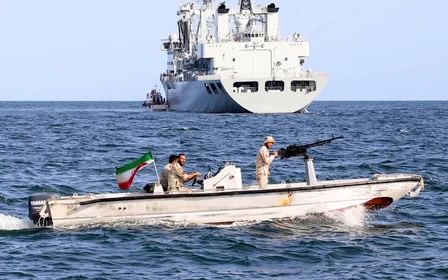
As the US has continued its war against Iran, the Islamic Republic has responded by launching retaliatory strikes across the Gulf, mainly targeting American assets.
At the same time, Iranian forces or those aligned with them are widely believed to have been carrying out attacks on Iranian Kurdish groups based in northern Iraq.
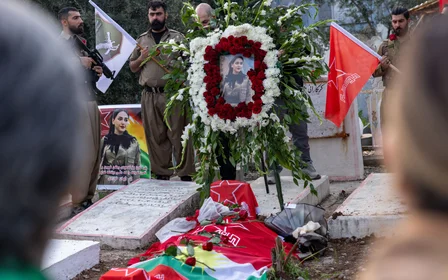
Keywan Faramarzi, international relations officer for the Komala party, told Middle East Eye that attacks in recent weeks on bases and "centres of activity" belonging to his party in Iraqi Kurdistan had killed 10 fighters.
Though no one has claimed responsibility for the strikes, Faramarzi blamed Iran.
"These attacks are part of the Islamic Republic's ongoing policy of targeting Iranian Kurdish opposition parties based outside Iran's borders," he said.
New MEE newsletter: Jerusalem Dispatch
Sign up to get the latest insights and analysis on Israel-Palestine, alongside Turkey Unpacked and other MEE newsletters
Other Iranian Kurdish groups have reported similar attacks in Iraq, as well as within Iran's borders.
The attacks raise questions about how great a threat the Iraq-based groups pose to the Islamic Republic.
Iran's strikes come in the wake of reports in Israeli media that Turkey had pressured the US into abandoning an operation to send Iranian Kurdish fighters across the border to try to overthrow the government.
Though the possibility of a Kurdish incursion had been mooted several times since the US-Israeli war on Iran began in February, this latest suggestion seems to have had higher ambitions and the Iranian government, at least, seems to have taken it seriously.
'We make use of every available method of resistance'
- Hana Yazdanpanah, PAK
In an interview released on 19 July, Iranian Foreign Minister Abbas Araghchi said Israel and the US had plotted to break up the country using the Kurdish groups.
"I said that if any threat comes our way from Iraqi Kurdistan, we will definitely respond," he said.
As with all previous claims, however, Kurdish groups in Iraq have denied any involvement in fighting in Iran, or that Trump had proposed any ground operation to them.
"We have no information about such a plan, and there is no credible evidence to confirm these claims," said Faramarzi. "Such reports appear to be media speculation and do not reflect the realities on the ground."
A representative of the Kurdistan Freedom Party (PAK) echoed the sentiment to Middle East Eye.
"We likewise have no such intention," said Hana Yazdanpanah.
She said that PAK had been involved in defending people in Iranian Kurdistan from the security services during the anti-government protests in January, but that any claims that they were involved in an operation to oust the government were nonsense.
"Neither the Kurdistan Region nor we as PAK - and I can say the same about the other Kurdish parties - have participated in any such operation, nor have we received any weapons or military equipment."
Despite this, the continuing attacks suggest Iran still views the groups as a threat.
MEE contacted the Iranian foreign ministry for comment, but did not receive a response by the time of publication.
'Neutrality'
According to research cited by Minority Rights Group International, Kurds make up around 10 percent of Iran's population, living mainly in the provinces of Kurdistan, Kermanshah, West Azerbaijan and Ilam.
Several Iranian Kurdish opposition movements, which Tehran generally considers to be terrorist groups, have operated for decades from bases in northern Iraq.
These include Komala, PAK, the Kurdistan Democratic Party-Iran (PKDI), Khabat, and the Kurdistan Free Life Party (PJAK) - an organisation linked to the Kurdistan Workers Party (PKK).
'The Islamic Republic is attempting to weaken this political and organisational capacity and simultaneously send a threatening message to all opposition forces'
- Keywan Faramarzi, Komala
The groups have a range of political ideologies, though most are united on the need for self-defence of Kurdish communities in Iran and the eventual liberation of Iranian Kurdistan.
On 22 February, these parties announced a new coalition with the stated aim of working together towards "the overthrow of the Islamic Republic of Iran".
In April, US President Donald Trump claimed that he had sent "a lot" of guns to anti-government protesters in Iran and that the Kurds "took" them, something they denied.
"We have established an alliance to strengthen and intensify the struggle in East Kurdistan and throughout Iran against the Islamic Republic," said Yazdanpanah. "In that struggle, we make use of every available method of resistance."
Nevertheless, she said the coalition had "declared and maintained its neutrality" in the US-Iran conflict.
Overthrowing the government?
PAK said in 2019 that it had around 1,000 members, while the PDKI, Komala and Khabat are believed to have similar numbers.
PJAK officials have boasted of as many as 3,000 active fighters - but even combined, the numbers pale in comparison to the hundreds of thousands of Islamic Revolutionary Guard Corps (IRGC) personnel and hundreds of thousands more in its Basij volunteer units.
It is generally accepted, therefore, that the Kurdish coalition does not have the power to overthrow Iran's government - and there has been deepening frustration among the Kurdish parties at the repeated reports of their military involvement in the ongoing conflict.
"The parties reacted to the war with great caution. We should take that seriously and indicative of their own thinking about their capabilities and the quality of the opportunity that the moment presented," said Winthrop Rodgers, an associate fellow at Chatham House.
"This probably disappointed the expectations of some foolhardy US and Israel planners, who did not seem to appreciate the dynamics on the ground."
And yet Iran has continued to attack Iranian Kurdish targets in northern Iraq - indicating that they still see them as a thorn in their side, if not an existential threat.
Faramarzi said Komala's main role was in "organising, supporting and strengthening civil and protest movements across Iran" and that was the government's concern.
"Through these attacks, the Islamic Republic is attempting to weaken this political and organisational capacity and simultaneously send a threatening message to all opposition forces," he said.
Middle East Eye delivers independent and unrivalled coverage and analysis of the Middle East, North Africa and beyond. To learn more about republishing this content and the associated fees, please fill out this form. More about MEE can be found here.