Why Israel's opposition no longer wants Palestinian parties in government

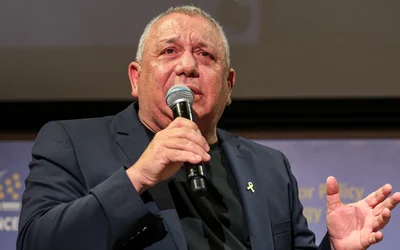
Gadi Eisenkot last week became the latest Israeli politician to pledge to form a "Zionist majority" government if he became Israel's next prime minister.
The phrase is widely understood as ruling out a coalition with Palestinian Arab parties to unseat Prime Minister Benjamin Netanyahu.
"I prefer to achieve a Zionist majority of 63-64 seats, and if that doesn't happen, to call on the ultra-Orthodox parties to understand the gravity of the moment," Eisenkot, a former general and leader of the Yashar party, said at a security conference organised by Yedioth Ahronoth and the Institute for National Security Studies.
"If they don't understand, then it's better to go to new elections," he added.
His remarks reflect a broader shift. From Naftali Bennett to Yair Lapid, leaders across the anti-Netanyahu camp have increasingly ruled out forming a government that relies on Palestinian Arab parties, including the United Arab List (Ra'am), whose leader, Mansour Abbas, has repeatedly said he is willing to negotiate with Jewish-majority parties.
New MEE newsletter: Jerusalem Dispatch
Sign up to get the latest insights and analysis on Israel-Palestine, alongside Turkey Unpacked and other MEE newsletters
The change is striking. Bennett and Lapid defended their partnership with Abbas in the 2021 coalition as a necessary political experiment that ended Netanyahu's 12-year hold on power.
Today, the post-7 October reality in Israel has made such cooperation politically costly.
"This is first and foremost the result of the shift in Israeli public opinion after 7 October," Ehab Jabareen, a Palestinian political analyst, told Middle East Eye.
"Any partnership with a Palestinian Arab party is now presented electorally as a concession on security and identity. Even parties in the political centre fear being portrayed as relying on those who reject the Jewish character of the state."
The election, scheduled for 27 October, is widely seen as pivotal for Israel's political future.
Polls show an Eisenkot-led bloc running neck and neck with Netanyahu's. Some surveys suggest Eisenkot could win enough seats to govern without Palestinian Arab parties, while others indicate that neither bloc is likely to secure a parliamentary majority without their backing.
Taboo returns
Palestinian parties represent Palestinian citizens of Israel, the descendants of Palestinians who remained in their homeland after Zionist militias displaced around 750,000 people in 1948 to create the state of Israel, an event Palestinians refer to as the Nakba.
Today, the community numbers about two million people, accounting for roughly a fifth of Israel's population.
After decades of discrimination, Palestinian citizens of Israel established political parties to advocate civil equality, an end to the occupation and recognition of Palestinian national rights.
For decades, however, those parties remained on the margins of Israeli politics. Cooperation with governing coalitions was widely viewed as politically toxic by much of the Jewish electorate and many Palestinian citizens alike.
That taboo was broken in 2021, when Ra'am became kingmaker, providing the four seats needed for Bennett and Lapid to assemble a razor-thin majority and end Netanyahu's rule after four inconclusive elections.
'Today, the political cost of being seen as close to Palestinian Arab parties has become very high'
– Ehab Jabareen, political analyst
Since the Hamas-led attacks of October 2023, however, the taboo has largely returned.
According to the Israel Democracy Institute's Democracy Index, published in December 2025, 71.5 percent of Jewish Israelis opposed including Arab parties in the next government.
A separate 2025 survey by the Institute for National Security Studies found that 57 percent of Israelis opposed the establishment of a Palestinian state under any circumstances, underscoring the hardening of public opinion.
"Netanyahu succeeded in turning relations with Palestinian Arab parties into an electoral weapon," Jabareen said, referring to years of campaigning that portrayed cooperation with Palestinian politicians as politically illegitimate.
"Today, the political cost of being seen as close to Palestinian Arab parties has become very high."
Jabareen believes some parties could still seek the support of Palestinian Arab parties after the election if the parliamentary arithmetic leaves them with no alternative. During the campaign, however, few are willing to signal that possibility.
"They keep the back door open, but the front door is locked."
Politics of the possible
The increasingly hostile political climate towards Palestinian citizens of Israel since October 2023 has also reshaped the strategy of Palestinian parties.
For years, Abbas has maintained that Ra'am is willing to negotiate with any coalition capable of replacing Netanyahu, despite repeated declarations from opposition leaders ruling out such cooperation.
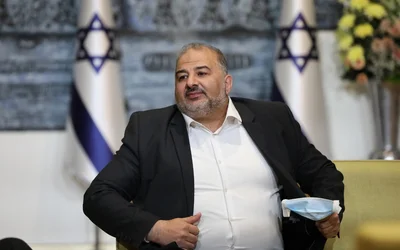
This election cycle, however, he has gone further. Israeli media have reported that Ra'am has reached an agreement in principle with Yoav Segalovich, a Jewish former Yesh Atid lawmaker, to include him on the party's electoral list.
A Channel 13 poll suggested Segalovich's inclusion could lift Ra'am's projected representation from five seats to an unprecedented seven.
Jabareen says Abbas is speaking to three audiences at once: Palestinian voters, the anti-Netanyahu camp and the Israeli establishment.
"He wants to tell Palestinian Arab voters that he is still the only one practising the politics of the possible," says Jabareen. "At the same time, he is leaving the anti-Netanyahu camp an exit if it eventually needs the support of non-Zionist parties, while signalling to the Israeli establishment that Ra'am remains a reliable institutional partner."
But the strategy also carries risks.
"He is signalling a willingness to negotiate with a side that publicly says it has no interest in negotiating with him," Jabareen said. "That creates an image of weakness because the balance of power is not in his favour."
Should Palestinians run for the Knesset?
For Aida Touma-Sliman, a Knesset member from Hadash, a Palestinian-led party, the refusal of Jewish parties to work with Palestinian parties reflects more than electoral strategy.
"The leaders of these parties know the Israeli public does not want any partnership with Palestinian Arab parties after years of incitement," she told MEE.
"They lack the courage to present a genuine alternative to the current government's policies. In reality, they also hold Zionist and discriminatory positions."
Touma-Sliman also rejects the idea that joining a governing coalition should be the primary objective of Palestinian parties.
"Our presence in the Knesset was never based solely on joining governments," she said.
"It is a space for political struggle where we represent our community, expose government policies and defend our people's rights."
While she acknowledges that parliament is no longer the only arena for political action, she argues that abandoning it would only weaken Palestinian citizens' influence at a time when, she says, "our political weight is needed to confront fascism, even if that only means preventing the formation of another far-right government".
For Jabareen, however, the challenge extends beyond coalition politics. He argues that Palestinian parties have spent too many election campaigns focused on which government they might help form, even as Israel's political landscape has fundamentally changed.
"The important question is no longer who will invite us into a coalition," he said. "The real question is how we rebuild Palestinian political power inside Israel over the next decade in a way that makes ignoring us politically costly."
Middle East Eye delivers independent and unrivalled coverage and analysis of the Middle East, North Africa and beyond. To learn more about republishing this content and the associated fees, please fill out this form. More about MEE can be found here.