Yemenis turn to 'Ruqyah' faith healers as medical healthcare remains in crisis

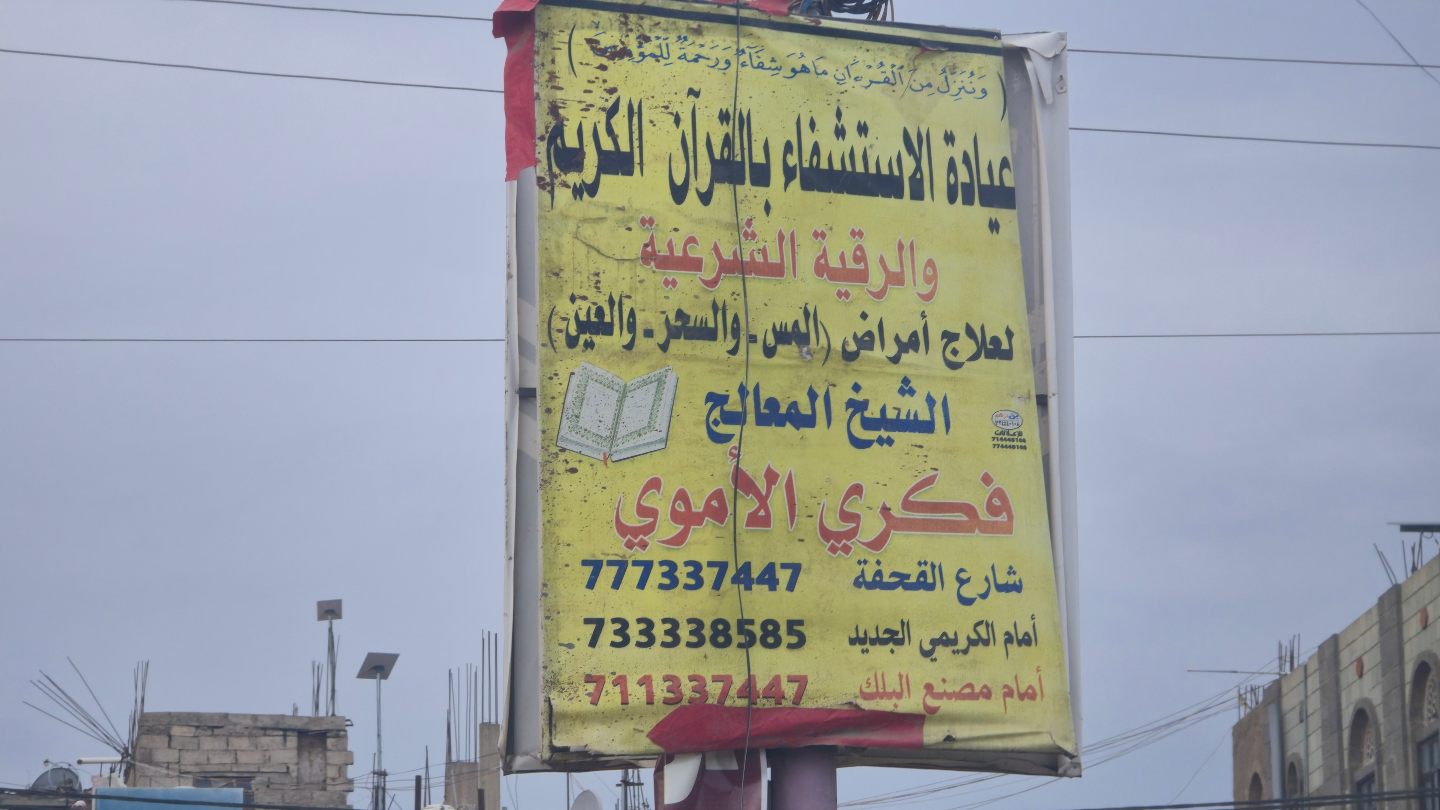
In the middle of Taiz city, Yemen, the entire four-story house reverberates with the Quraniq recitation coming from the old recorder on the second floor.
A common practice during funeral ceremonies in Yemen, the recitation this time is for a different reason.
The place is filled with people who have travelled from across Yemen, waiting for hours for a chance to meet the sheikh for Ruqyah Shari’ah (divine healing recitation).
The sheikhs here recite the Quran and occasionally perform cupping therapy (Hijama) on visitors suffering from simple headaches to life-threatening diseases like cancer.
Many have come in the belief that his recitations will spiritually cure their illnesses.
New MEE newsletter: Jerusalem Dispatch
Sign up to get the latest insights and analysis on Israel-Palestine, alongside Turkey Unpacked and other MEE newsletters
Others seek treatment here because they do not have access to qualified medical healthcare in hospitals.
In her 60s, Fatima, who is battling stomach cancer, says that after she felt unwell, she tried seeking medical treatment at various hospitals across the Taiz governorate, and even travelled to Aden, but to no avail.
“My sister advised me to visit a sheikh of Ruqyah Shari’ah because she had suffered from similar symptoms and felt better. I went because I simply didn’t have an alternative,” Fatima says.
'I realised the sheikh couldn't actually do anything; he was just trying to make money by reciting the Quran over patients'
- Fatima, Ruqyah patient
She continued visiting the sheikh for six months, as he kept reciting the Quran over her. Though the pain would occasionally subside before returning, she says she did not get better.
“He kept telling me that I had been struck by the evil eye and that recovery takes time,” she recalls.
However, after six months, Fatima could no longer eat as her condition worsened and the pain became unbearable.
When she went back, she says the sheikh realised how dire her situation had become.
“He told me my situation was very dangerous and that I needed to see a tumour specialist," she says, adding, “It was then that I realised the sheikh couldn't actually do anything; he was just trying to make money by reciting the Quran over patients.”
Fatima says he had been paying the sheikh 12,000 Yemeni riyals (approximately $7) per week, an amount that is much less compared to what she now needs to pay to treat her cancer.

“Cancer treatment in Yemen is incredibly difficult because there are no precise diagnostic devices or advanced treatment methods. Those who cannot afford to travel abroad for treatment simply die at home,” Fatima says, as the details about her illness remain unclear.
She has not yet been scanned to see if other parts of her body are affected.
Many cancer patients in Yemen, those who can afford international travel, leave to find better care.
However, as the domestic healthcare system lies in collapse, most patients struggle to access qualified medical treatment at home.
Challenges to accessing healthcare
With limited access to education, women who travel from rural areas vastly outnumber men who rely on spiritual healing as a replacement for clinical medicine, as the Ruqyah Shari’ah centres have spread across Yemen.
Khadijah al-Ghaili, who is in her 50s, suffers from shortness of breath. She travelled from a village 80 kilometres away to visit a famous sheikh of Ruqyah who also treats patients using cupping therapy.
Al-Ghaili acknowledges that proper healthcare is available in private hospitals, but because the costs are very high, she preferred to try Ruqyah.
“Private hospitals require a lot of money that I simply cannot afford, so I chose to come to this sheikh as an alternative,” al-Ghaili says.
“This is a good alternative because it was recommended by our Prophet, and our grandparents used it back when there were no hospitals.”
Unable to afford medical healthcare, Khadijah places deep faith in the effectiveness of Ruqyah and cupping.
So far, the sheikh has performed cupping on six different areas of her body over three separate sessions.
“The shortness of breath is still there, but there is no pain after the cupping. I believe I will get better once I finish my sessions with the sheikh,” she stressed.
Years of conflict and severe funding shortages have led to the collapse of Yemen’s healthcare system, leaving over 20 million Yemenis, nearly half the population, without access to basic medical care.
'It is the needy who fall victim to both the collapse of the healthcare system and the deception of these religious traders'
- Dr Adel, tumour specialist
According to the World Health Organisation (WHO), Yemen suffers from a severe shortage of skilled health workers, with 18 percent of districts across the country completely lacking doctors.
Over 50 percent of health facilities are entirely non-functional.
Many of the nation's most qualified health professionals have left in search of better opportunities abroad. The impact on healthcare has been profound.
Today, Yemen’s physician ratio stands at a mere 0.1 doctors per 1,000 people, far below the regional average of 1.1, according to the World Bank.
By comparison, the global average is 1.9, the Arab world sits at 1.2, and other fragile, conflict-affected regions average 0.5 doctors for every thousand people.
Prophetic medicine
The popularity of Ruqyah sheikhs is growing not only in Taiz but across various governorates. Because Ruqyah is a recognised practice in Islam, the issue lies not with the practice itself, but with how differently it is understood from one person to another.
A Ruqyah practitioner for more than 20 years, the faith healer who uses the pseudonym Abu Ahmed is in his 60s. He believes that while Ruqyah is important for many patients, it does not replace clinical medicine in hospitals.
“We help patients recover who suffer from the evil eye, envy, magic, and jinn possession. We determine whether a patient is suffering from one of these afflictions during our recitation sessions,” Abu Ahmed says.
“Physical diseases, such as the spread of toxins in the body or tumours, can sometimes be the result of the evil eye, envy, or magic.”
He says that everything he does is rooted in the Quran and the teachings of the Prophet, completely free of charlatanism, emphasising that his work does not conflict with medical healthcare.
“If I see that a patient is not suffering from the evil eye, envy, magic, or jinn possession, I advise them to visit a hospital to seek medical healthcare, as we cannot help every case,” Abu Ahmed says.
Because there appear to be no licensing requirements or restrictions for opening Ruqyah centres, Abu Ahmed noted that some individuals claim to be sheikhs solely to exploit patients for financial gain.
“This work should, first and foremost, be a voluntary act for the sake of Allah. Those who can afford to pay should only pay a small amount, and it should be entirely free for those who cannot,” he added.
'Traders of religion'
Dr Adel, a tumour specialist who preferred to use a pseudonym to avoid confrontation with those he calls “traders of religion”, told MEE that he has received several patients who only came to him after spending months visiting Ruqyah sheikhs.
During that time, he said, their health significantly deteriorated.
“I am not speaking about all Ruqyah sheikhs, as Ruqyah is part of Islam. I am talking about the fraudsters who claim they can treat physical diseases like tumours, deceiving patients for months until their conditions become critical,” he says
Just this month, he says, a female patient with a facial tumour approached him for treatment after failing to find relief through Ruqyah sheikhs.
However, it was too late, and Dr Adel could no longer help her.
“All of the patients who come to me after spending months with Ruqyah sheikhs are poor, and they only went there because they cannot afford the high cost of medical healthcare,” he confirmed.
“Rich tumour patients come to me first and then travel abroad. It is the needy who fall victim to both the collapse of the healthcare system and the deception of these religious traders.”
Mohammed Abdulkhaleq, the director of health awareness and media at the Taiz health office, said that the dire economic situation of many patients and the high cost of medical care are the primary reasons driving people to Ruqyah sheikhs.
“Ruqyah is a religious practice and is absolutely not a replacement for medical healthcare. However, there are several factors, including the two I mentioned, that prevent people from seeking hospital care,” he told MEE.
“The major problem is that those who visit Ruqyah sheikhs seek medical care too late, when their conditions have become untreatable. We urge anyone who is sick to go to whatever hospital they can afford.”
As she battles her cancer, Fatima says that she would advise all sick Yemenis to avoid falling into the trap she fell into.
Those who need medical help should avoid Ruqyah sheikhs, she says, and head straight to hospitals to seek medical treatment from the early stages of their illness.
“Ruqyah is for spiritual healing,” she said. “It is not for someone who has tumours in their body.”
Middle East Eye delivers independent and unrivalled coverage and analysis of the Middle East, North Africa and beyond. To learn more about republishing this content and the associated fees, please fill out this form. More about MEE can be found here.