Voting extended by a day after unexpected low turnout in Egypt

Egypt’s electoral commission confirmed on Tuesday that it is extending the presidential election for another day, after a disappointing turnout at the polls.
"The decision was taken to allow the largest number of voters, including those living outside their home provinces, to cast ballots," commission secretary-general Abdel-Aziz Salman told Turkish news agency Anadolu.
The two-day election was originally scheduled to end on Tuesday at 10pm local time (8pm GMT), but will now be extended to Wednesday at 9pm.
The announcement has been greeted with anger from the camp of candidate Hamdeen Sabahi, whose campaign's legal advisor has reportedly filed a legal complaint with the Presidential Electoral Commission.
Reports have been circulating all day that election turnout would be even lower than feared, with the interim authorities trying various tactics to encourage voters to get out to the polls.
New MEE newsletter: Jerusalem Dispatch
Sign up to get the latest insights and analysis on Israel-Palestine, alongside Turkey Unpacked and other MEE newsletters
Tuesday was declared a national holiday, voting hours have been extended while the prime minister, Ibrahim Mahlab, said he would be revive an old law which allows authorities to fine
Numerous TV personalities have also appealed to the Egyptian public to turnout to vote while the Ministry of Tourism has promised to pay the travel expenses of all citizens, returning to their home provinces to vote.
Despite the measures, turnout seems to have remained extremely low, with different figures being cited by different sources.
Abdel-Aziz Salman said "the percentage of voters was about 37 percent," according to the MENA news agency, but he added that the number was not an official tally, and it has been greeted with scepticism on social media.
Earlier in the day a local election committee head told the state news agency MENA that the voter turnout in Alexandria, a city of more than 4 million people, was only 20 percent.
Turnout on Monday is believed to have been somewhat better although it was still well below the 52 percent seen at the last elections in 2012. Unlike then, when the Muslim Brotherhood candidate, Mohamed Morsi won with almost 52 percent of the vote in a hotly contested election against Ahmed Shafik, the last prime minister to serve under Hosni Mubarak.
“There was a high turnout [Monday], in the morning,” international monitoring group Global Network for Rights and Development said in a statement.
We saw "about 12 percent by midday, but it decreased in the afternoon. [On Tuesday] there's very few people voting. The turnout is very low.”
Various news sources, including al-Ahram and al-Jazeera have also said their reporters observed a low turnout, while social media reports have said that Sabahi's campaign told al-Jazeera Egypt on Tuesday evening that turnout was extremely low, calling it “shameful”.
Translation: An official from the legal team for Sabahi’s campaign says that the turnout did not exceed 12 percent
A previous poll by the public opinion research organisation Baseera, which is regarded as one of the most reliable polling sources on Egypt, had suggested that 87 percent of people intended to vote in the presidential elections, despite several opposition groups calling for a boycott of the vote.
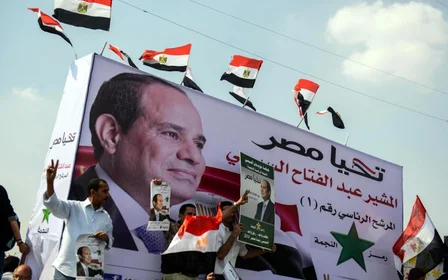
Leading candidate Sisi had previously called for an "unprecedented" turnout in the elections.
Social media has been buzzing:
Translation: "The faces from the Mubarak era that have been dominating the political scene since 30 June were an important reason behind Egyptians’ aversion to the ballot boxes."
Middle East Eye delivers independent and unrivalled coverage and analysis of the Middle East, North Africa and beyond. To learn more about republishing this content and the associated fees, please fill out this form. More about MEE can be found here.