Five Turkish lawmakers hurt as violence breaks out over security bill

Political tensions spilled over into violence in the Turkish Parliament on Wednesday, as scuffles broke out over a controversial security bill. Five lawmakers were injured, including two that had to be hospitalised.
The bill, also referred to as the protest bill, aims to give police more power to deal with demonstrators and has sent tempers flying, with the debate late on Tuesday descending into scenes resembling a brawl.
In images captured and later shared on social media, parliamentarians could be seen brandishing ceremonial gavels, exchanging punches and throwing chairs. One deputy was even dumped in a flowerbed, while two were hit over the head with the speaker’s gavel, the Dogan news agency said.
The scenes were some of the worst seen in years.
Turkish opposition parties have long slammed the bill and accuse President Recep Tayyip Erdogan of trying to turn Turkey into a police state.
New MEE newsletter: Jerusalem Dispatch
Sign up to get the latest insights and analysis on Israel-Palestine, alongside Turkey Unpacked and other MEE newsletters
Previous attempts to introduce a reading of the bill had to be postponed, with the ruling Justice and Development Party (AKP) still not being able to begin a formal debate on the legislation. The bill is now expected to be debated on Thursday.
Deputies from the opposition Republican People's Party (CHP) and the Peoples' Democratic Party (HDP) held separate press conferences but both condemned the violence saying that the AKP was “drawing the first blood even before the legislation of the security bill”.
Musa Cam, from the CHP, was seriously wounded in the fight and said that he sustained a cracked rib in the fighting. He told daily Hurriyet that he was attacked by 20 AKP lawmakers.
“Oktay Saral and his friends were like bodyguards,” Cam said, while adding that he would be filing criminal proceedings against his attackers.
Levent Gok, another CHP deputy, likewise accused the AKP of imposing fascism in parliament, and vowed to fight the bill with all possible means. “We, as the CHP, are ready to pay whatever the cost is,” he said.
The Nationalist Movement Party (MHP) chairman Devlet Bahceli dubbed the bill “make-up for unlawfulness and a legal cover for the secret agendas of the government”.
“How is giving [powers] that belong to judges and prosecutors to governors, sub-governors and police associated with security?” Bahceli added.
The HDP’s deputy parliamentary group leader, Pervin Buldan, also vowed to stay firm and said that he felt the bill would be used to suppress opposition.
“The AKP group’s lynch attempt against our group is an indication of the derailment of the government. The AKP is like a like truck with failed brakes,” she said. “We will not permit the legislation of this bill.”
However, AKP lawmaker Mustafa Elitas has accused Buldan and Sebahat Tuncel, a female HDP deputy, of harassing him and heckling him when he took to the floor to discuss the bill in the late-night session.
"They tried to drive me away from the rostrum," he said, accusing the two of merely pretending to be hurt.
"The two women lawmakers battered themselves. They played their role very well."
“Unfortunately these three parties have formed an extraordinary coalition against us to stop this bill,” Elitas added.
The AKP insists that the measures are necessary for national security and has vowed to push through the bill, despite the fierce opposition.
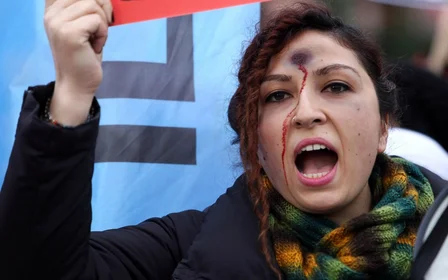
The issue of police brutality has become a hot topic since 2013 when large-scale youth protests that became known as Gezi Park protests broke out, but were eventually suppressed by police that used tear gas and water cannons to clear the peaceful encampment, similar to the Occupy Movement that sprung up in Europe and America in 2011.
Eleven protesters were killed, 8,000 injured and more than 3,000 arrested in the ensuing crackdown that came to be criticised by EU parliaments and human rights groups.
The families of two teenagers killed in the clashes - Berkin Elvan and Ali Ismail Korkmaz – have now become a key part of the anti-security bill camp.
Elvan, 15, died in March 2014 after spending 269 days in a coma following a head trauma caused by a teargas canister. Korkmaz, 19, also spent 38 days in a coma after receiving a beating by two plainclothes policemen during the Gezi protests. Korkmaz died in June 2013. Two policemen were sentenced to 10 years in prison for his killing last year.
Addressing the families, CHP leader Kılıcdaroglu said shortly before the parliamentary session on the bill:
“All democratic, patriotic and decent citizens of this country, not just CHP members, are there for you. Since 2007, 183 persons have lost their lives due to police bullets. Why would 183 of our children lose their lives? The police are there to assure a person’s life, not to kill a man.”
Middle East Eye delivers independent and unrivalled coverage and analysis of the Middle East, North Africa and beyond. To learn more about republishing this content and the associated fees, please fill out this form. More about MEE can be found here.