Senior partners at BCG 'step down over Gaza humanitarian controversy'

Two senior partners at the Boston Consultancy Group (BCG) have resigned following the controversy over their involvement in the US-based aid project in Gaza.
Last week, the Financial Times reported that BCG staff had modelled costs to "relocate" Palestinians from Gaza and entered into a multimillion-dollar contract to help launch the US and Israeli-backed Gaza Humanitarian Foundation (GHF).
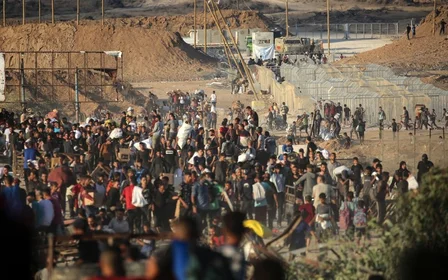
The GHF has been beset by controversy since it emerged publicly in May, with the UN and aid organisations warning that its plans to take over aid distribution in Gaza failed to meet humanitarian principles and would encourage the forced displacement of Palestinians.
Gaza health authorities also reported that more than 700 Palestinians seeking aid have been killed since GHF's aid distribution centres were launched.
According to the Wall Street Journal, BCG's involvement with the project has outraged long-term clients, while employees and BCG alumni have criticised the collaboration.
New MEE newsletter: Jerusalem Dispatch
Sign up to get the latest insights and analysis on Israel-Palestine, alongside Turkey Unpacked and other MEE newsletters
In light of the scandal, BCG’s chief risk officer, Adam Farber, and the head of its social-impact practice, Rich Hutchinson, are reportedly resigning from their roles, but will remain as senior partners.
The WSJ cited insiders as saying both were aware of early phases of the work but not all of the details.
It added that in June, partners Matt Schlueter and Ryan Ordway - who BCG suggested "essentially went rogue" in the months following the beginning of the project - were sacked.
“In late 2024, a BCG partner misrepresented pro bono work," the firm told the WSJ on Thursday.
"Months later, he began a paid phase of work without authorisation, and in parallel, he and another partner undertook off-the-books modelling on Gaza reconstruction scenarios, directly against BCG instructions.”
The BCG added that it had immediately stopped the work with GHF once it became aware of it and that it wasn’t being paid for any of it.
“An independent investigation confirmed this was the result of individual misconduct coupled with failures in oversight and judgment - we’ve taken swift action to ensure this does not happen again," they said.
It was reported that BCG - which counts Israeli Prime Minister Benjamin Netanyahu amongst its alumni - became involved with GHF when the US security contractor Orbis engaged the firm to help with a feasibility study for a new aid operation.
BCG was reportedly chosen because of its relationship with Phil Reilly, an ex-CIA officer who works at Orbis and, as Middle East Eye first reported, was a senior advisor for BCG for eight years until just six months ago when he started Safe Reach Solutions, a for-profit security and logistics company guarding GHF's aid hubs in Gaza.
The FT has also reported that staff members from the Tony Blair Institute (TBI) participated in a post-war Gaza project which included plans for a "Trump Riviera" and used financial models developed inside BCG.
The TBI has said that it neither endorsed nor authored slides referenced in the FT reporting, and that staff members involved in meeting groups were "essentially in listening mode".
Middle East Eye delivers independent and unrivalled coverage and analysis of the Middle East, North Africa and beyond. To learn more about republishing this content and the associated fees, please fill out this form. More about MEE can be found here.