
Islamic State may be responsible for atrocities against Druze, not Syrian forces, Barrack says

US envoy Tom Barrack suggested that Syrian government forces were not responsible for atrocities committed against Druze in southern Syria, and that the armed fighters who carried out the attacks may have been Islamic State militants disguised in government uniforms.
Barrack, who is President Donald Trump’s envoy to Syria as well as ambassador to Turkey, made the comments in an interview with Reuters in Beirut on Tuesday.
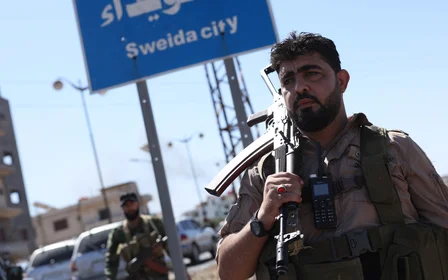
Syria’s southern province of Sweida was the site of sectarian violence between the majority Druze community and Sunni Bedouins.
Around 1,000 people were killed in the clashes in southern Syria, with reports of government-aligned forces carrying out scores of summary executions of Druze.
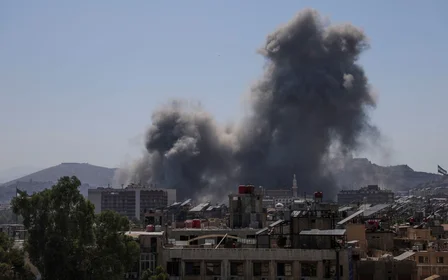
The conflict was internationalised after Israel intervened, bombing Syrian government forces. Israel cast the bombings as an effort to protect Druze. Israel is home to around 150,000 Druze.
New MEE newsletter: Jerusalem Dispatch
Sign up to get the latest insights and analysis on Israel-Palestine, alongside Turkey Unpacked and other MEE newsletters
Barrack also cast doubt on video footage that circulated widely on social media alleged to be of Syrian government forces committing atrocities, saying it could have been easily altered.
"The Syrian troops haven't gone into the city. These atrocities that are happening are not happening by the Syrian regime troops. They're not even in the city because they agreed with Israel that they would not go in," he told Reuters.
Israel’s intervention in the fighting "upset" the Trump administration and Saudi Arabia, as Middle East Eye was the first to report. On Monday, the White House said Trump was "caught off guard" by Israel’s bombing.
Barrack is spearheading the lifting of US sanctions on Syria. He has been a vocal supporter of efforts by Gulf states to invest in the war-torn country. He has generally walked a tightrope between concerns for minorities in Syria and calls for the central government in Damascus to assert its authority.
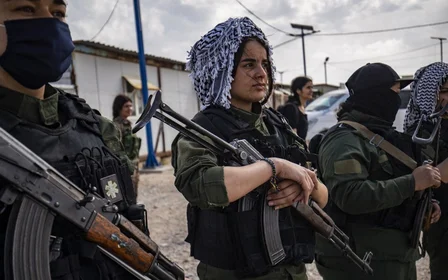
Barrack is trying to push the Kurdish-led Syrian Democratic Forces (SDF) to integrate into the Syrian army as the US looks to continue reducing its military presence in northeast Syria.
Barrack has been well received in Turkey. US support for the SDF has been a long-running sore point in the Nato allies ties.
Barrack's messaging on Sharaa
In a press conference in Beirut on Monday Barrack was asked about Israeli intervention, which he said “came at a very bad time” and created “another very confusing chapter” for Syria.
Current and former Arab, Israeli and US officials told MEE that Israel’s strikes and efforts to position itself as a defender of the Druze suggested it was bent on carving out a zone of influence in Syria that conflicts directly with the vision of a unitary post-war Syria put forward by Barrack.
Barrack has repeatedly stressed that the US was not dictating Syria’s form of government. He has cast his diplomacy as a test case for Trump’s pledge in May to stop western “nation builders” and “interventionists” from working in the Middle East and instead empower locals allies such as the Gulf states and Turkey.
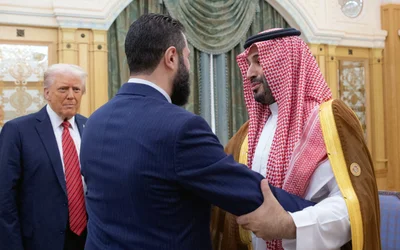
But Barrack said Syrian President Ahmed al-Sharaa should assess the fallout of the Sweida conflict, saying Sharaa should reflect: "I’m going to adapt quickly, because if I don't adapt quickly, I'm going to lose the energy of the universe that was behind me."
Barrack added that Sharaa’s “theme … isn't working so well”, and told Reuters he advised Sharaa to reduce the influence of Islamists in the military and cooperate on security with regional states.
Sharaa was the leader of Hay'at Tahrir al-Sham, a former US-designated terrorist organisation that toppled Bashar al-Assad last December. Before that he ran al-Qaeda's Syrian branch.
Syria has been seen bouts of sectarian violence since Sharaa came to power. In March, Syrian security forces killed hundreds of Alawites - the sect to which Assad belonged - along the Mediterranean coast.
In June, at least 25 people were killed in a bombing at Mar Elias Greek Orthodox Church. Sharaa was criticised for his handling of the fallout. He has promised to protect minorities.
Barrack said that Sharaa had to address those concerns. "If they end up with a federalist government, that's their determination. And the answer to the question is: everybody may now need to adapt."
Middle East Eye delivers independent and unrivalled coverage and analysis of the Middle East, North Africa and beyond. To learn more about republishing this content and the associated fees, please fill out this form. More about MEE can be found here.